Cookie settings
We use our own and third-party cookies in order to offer our services, display videos, obtain statistics and offer personalized advertising.
For more information, please read our cookies policy.
Cuenca is an original medieval town. Some historians think that the Concanos, a warlike nation, passed through this town, and that probably the Lobetanos were settled down in it. In the IX Century, there was a fortress known as Conca, built by Arabs, in its current location.
It was conquered in 1177 by Alfonso VIII, after nine months. Then, Cuenca was included into the Crown of Castile´ s territories, and it favoured to a fast increase of the population, becoming one of the main producers of Castile until the XVII Century, thanks to its agriculture and livestock.
The increase of the wool price drove Cuenca to a deep economical crisis. The decree promulgated by Carlos IV suppressed the handmade workshops in order to prevent they compete with the Spanish Royal Factory of Tapestries. It also suffered the fights among different groups of the nobility, especially between the López Vázquez de Acuña family and the Diego Hurtado de Mendoza family.
In the political field, Cuenca took part in the War of the Spanish Succession in favour of Felipe V and in other subsequent wars such as the Carlist wars or the Spanish War of Independence.
Address and telephone
Opening times
If you see any mistakes or want to add anything to this information, please contact us.
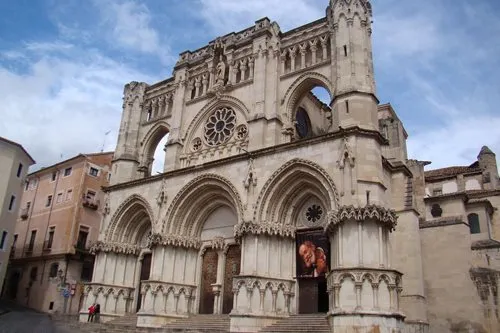
The Cathedral of Santa María la Mayor de Cuenca began construction during the reign of Alfonso VIII, specifically around the year 1196. Built on what was once an Arab mosque and due to the need for a temple in the city, this Gothic building was erected. Although construction was completed in 1257, various transformations were carried out in the following centuries.
Thus, in the 16th century the exterior was almost completely reformed. The architects Juan de Herrera, Andrés de Vandelvira, Juan Andrea Rodi and García de Alvarado worked on the cloister. Later, in the 18th century, the facades and towers were redesigned, acquiring a purely Baroque style.
At the beginning of the 20th century, the Cathedral faced a delicate situation, with structural problems and the Giraldo tower collapsed. It was then that the facade was reconstructed in a Neo-Gothic style. A series of stained glass windows that had disappeared or were damaged were also installed. Since that time, a significant number of restoration processes have taken place up to the present.

Book your hotel