Cookie settings
We use our own and third-party cookies in order to offer our services, display videos, obtain statistics and offer personalized advertising.
For more information, please read our cookies policy.
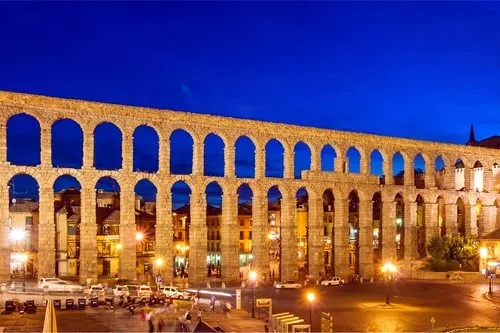
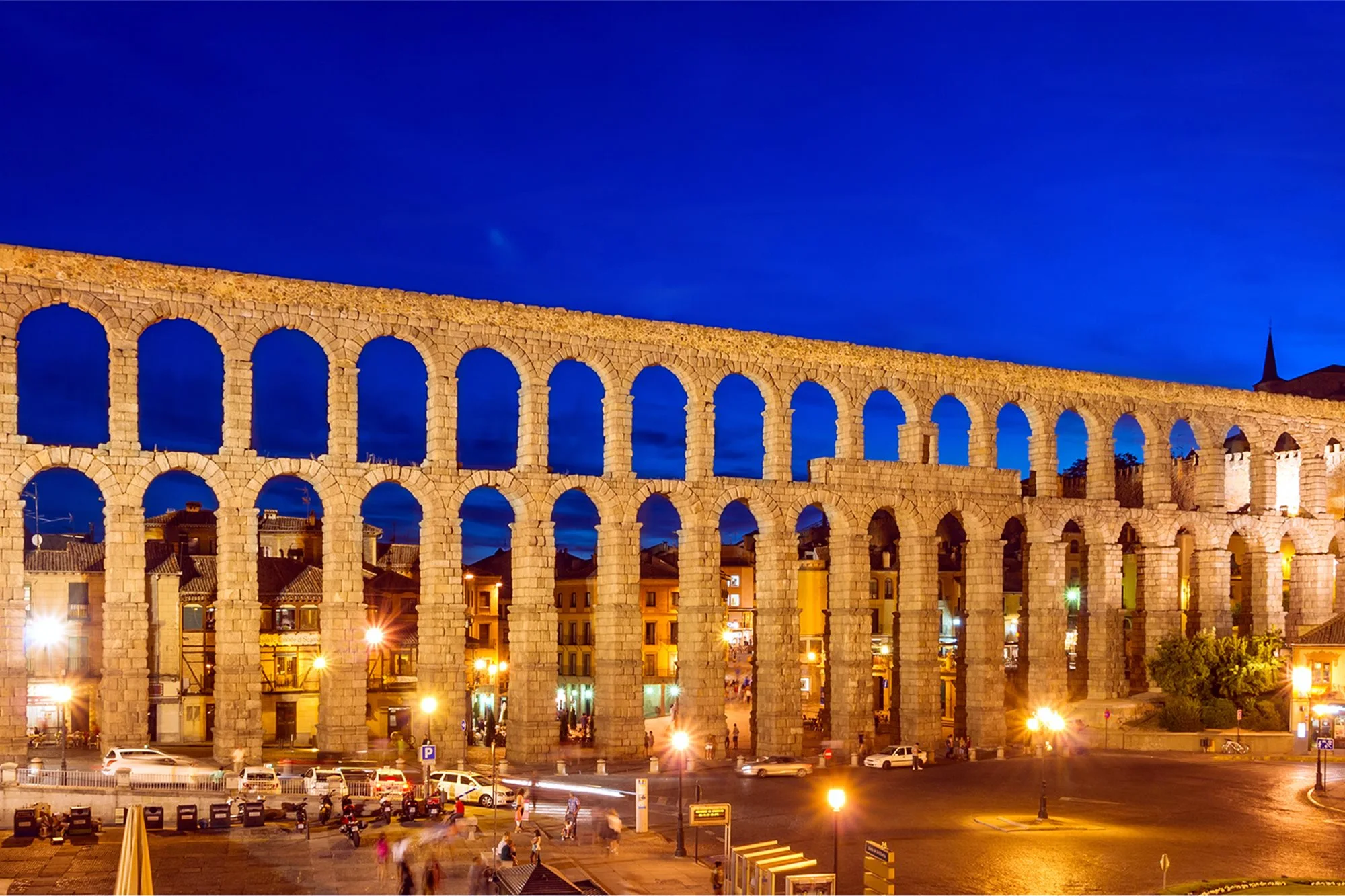
This Civil work was thought and built with the aim of supplying the town of Segovia with water from the River Acebeda, through a subterraneous system that starts to rise on the arches that form the monumental part, travelling a total of 18 km until arriving to the Alcázar. It is one of the consequences of the Roman presence in the Iberian Peninsula during six Centuries that caused the development of a wide program of public buildings.
20,400 stone blocks joined without using any type of mortar were used for its construction. The technique of construction used in this building consists of lifting huge pillars placing them gradually with a 22.40 by 3 meters section, joined half way up and with supporting arches in the upper section.
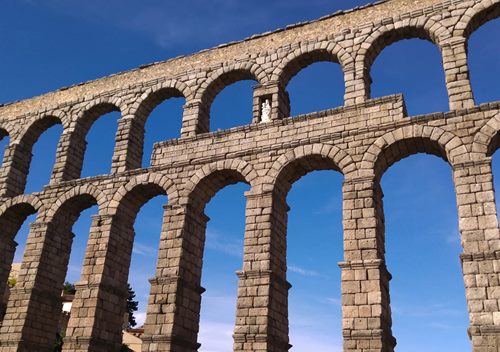
The most famous and monumental part of the aqueduct belongs to the transparent wall of successive arches that keep it raised. We can appreciate four bays in its structure. The first bay consists of six round arches and it is almost 2.40 meters high. The second bay consists of 25 arcades and the third one consists of 44 arcades that, as well as in the four bay, are superimposed in two floors, except for the two ends.
Over the three highest arches there was a bronze plaque with the date and the author of this monument. In the niches that the aqueduct has on each side, we can see the image of the Virgen de la Fuencisla, the patron Saint of the town, and of St Sebastian, from the XVI.
The author made an excellent use of technique, because of the balance of the piping rests on the whole complex.
A city as beautiful as Segovia deserves a first encounter with its history. Book this essential free tour and get a close look at the Roman aqueduct, its length, and its number of arches. Stroll through its narrow streets, admiring its traditional houses and landmarks such as the Segovia Cathedral.
All this and much more awaits you in the company of a knowledgeable guide. Plus, you'll receive the best recommendations on where to enjoy authentic Segovian suckling pig.

Address
Plaza del Azogüejo, s/n. 40001 SegoviaIf you see any mistakes or want to add anything to this information, please contact us.
A city as beautiful as Segovia deserves a first encounter with its history. Book this essential free tour and get a close look at the Roman aqueduct, its length, and its number of arches. Stroll through its narrow streets, admiring its traditional houses and landmarks such as the Segovia Cathedral.
All this and much more awaits you in the company of a knowledgeable guide. Plus, you'll receive the best recommendations on where to enjoy authentic Segovian suckling pig.