Cookie settings
We use our own and third-party cookies in order to offer our services, display videos, obtain statistics and offer personalized advertising.
For more information, please read our cookies policy.
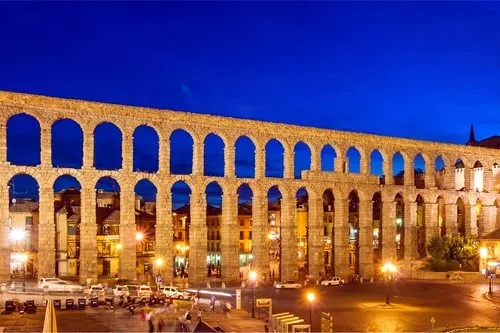
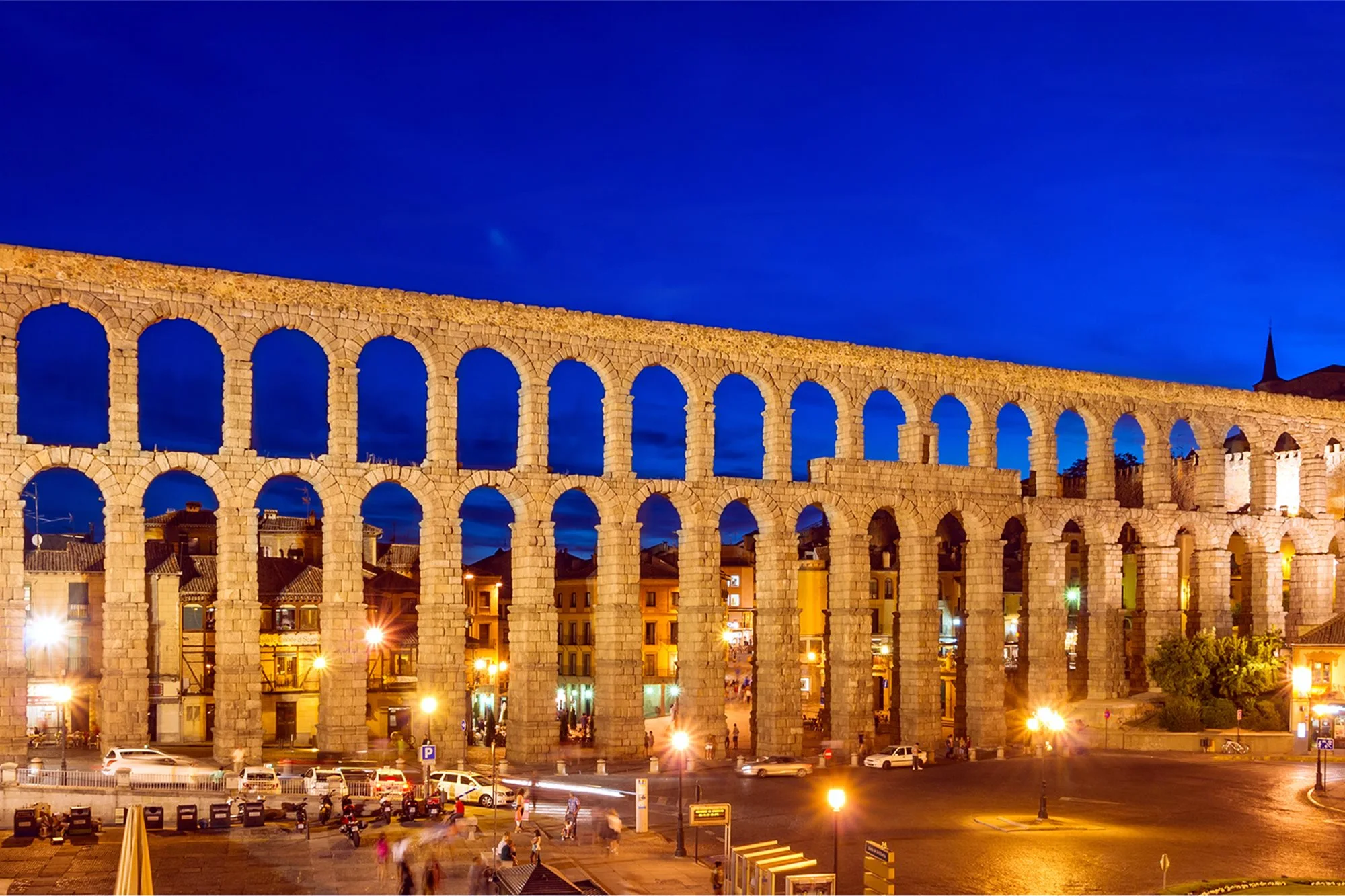
The aqueduct continues being an enigma for historians and archaeologists. No one knows anything about its history and none of Romans remains have been found in this place to give an idea of that historical time. It is a huge and very important building, however no one knows if there was important Roman population living here. It was probably built in order to supply a legion that would stay here waiting for orders to fight against the Vaccei.
Historians also disagree the date of its construction. Some of them state that it was built in times of Augusto, the first emperor of the Roman Empire from 27 B.C. to 14 A. C., and others say that it was in times of the emperor Claudio (41-54 A.C.) It has been working throughout the centuries and perhaps that is why it has arrived to our days in a perfect state.
Segovia was the Celtiberians´ place of resistance against the Romans. It was occupied by Romans and was devastated in 80 B.C. During the Arab rule, it became capital city and later, it became the King Alfonso X el Sabio´ s court. In this town, Doña Isabel la Católica was proclaimed queen in 1474 and Don Fernando el Católico swore to respect the privileges of Castile.
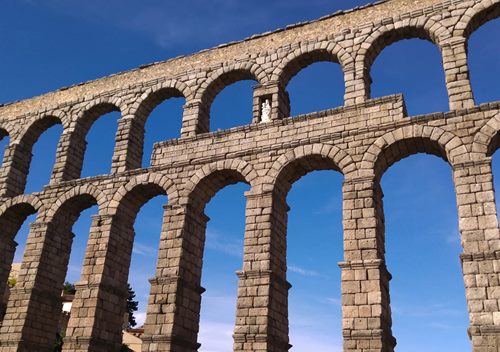
A city as beautiful as Segovia deserves a first encounter with its history. Book this essential free tour and get a close look at the Roman aqueduct, its length, and its number of arches. Stroll through its narrow streets, admiring its traditional houses and landmarks such as the Segovia Cathedral.
All this and much more awaits you in the company of a knowledgeable guide. Plus, you'll receive the best recommendations on where to enjoy authentic Segovian suckling pig.

Address
Plaza del Azogüejo, s/n. 40001 SegoviaIf you see any mistakes or want to add anything to this information, please contact us.
A city as beautiful as Segovia deserves a first encounter with its history. Book this essential free tour and get a close look at the Roman aqueduct, its length, and its number of arches. Stroll through its narrow streets, admiring its traditional houses and landmarks such as the Segovia Cathedral.
All this and much more awaits you in the company of a knowledgeable guide. Plus, you'll receive the best recommendations on where to enjoy authentic Segovian suckling pig.
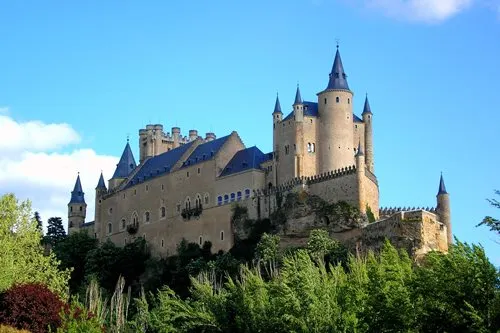
The Alcázar of Segovia was built in the junction of the rivers Eresma and Clamores. Many people believe that the fortification comes from the Roman times. The building is divided into two nucleuses. The first one consists of a Juan Herrera´ s courtyard with a pit, a lifting bridge, a Keep and two round turrets with spires. The second one is the interior one and it has a wonderful chapel and the Galley Room, the Pine- Cone Room and the Queen´ s Chamber.
Moreover, it has four floors with attics and large basements. We should highlight the Monarchs room that is decorated with coffered ceiling of hexagons and golden rhombuses and a peculiar freize with 52 coloured and sit images. In the Throne Room, there is a Mudejar dome and Gothic- Mudejar plasterworks. Its walls are covered with velvet and with different kings´ portraits. The Keep was built by Juan II during the transition from Romanesque to Gothic style. It is 80 meters high and is decorated with sgraffitos and twelve beautiful small towers. You access to it through a passage. We should highlight the Tower of Alfonso X el Sabio, from which the monarch studied the firmament, and the beautiful internal rooms that are decorated with Mudejar coffered ceilings and rich plasterworks.
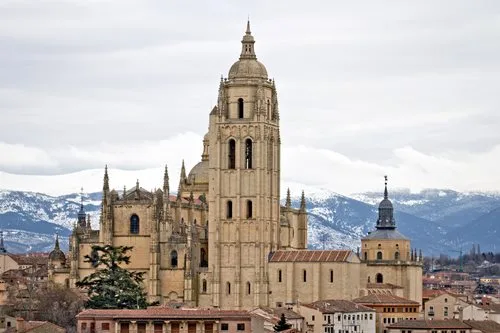
The marvellous cathedral is located in the higher point of the town, standing out as watchtower the tower of the temple. It was built after the fire of the former Romanesque cathedral that took place in 1520 during Carlos V´ s reign. It is 105 meters length by 50 meters wide and 33 meters height in the major nave. It is a three naves temple with three side chapels in the transept, semicircular presbytery and ambulatory.
It has three entrances: in its main facade is located the Puerta del Perdón (Door of Forgiveness), by Juan Guas; in the Southern façade the Puerta de San Geroteo (St Geronteo´ s door) and the Puerta de San Frutos (San Frutos´ door).
Inside, the major altarpiece is sculpted with marbles, jaspers and bronze, and it houses the Gothic image of Nuestra Señora de la Paz. There are 23 chapels with interesting works of art, the impressive major altar, and the exceptional organ, still used, among other elements. It also includes artistic and historic treasures distributed around the temple. In the Cathedral Museum we can find excellent works of art, such as silversmith´ s craft pieces, tapestry, documents, etc.