Cookie settings
We use our own and third-party cookies in order to offer our services, display videos, obtain statistics and offer personalized advertising.
For more information, please read our cookies policy.
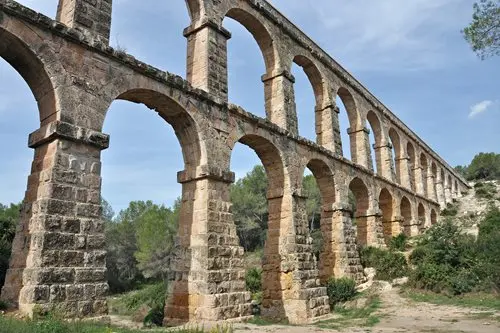
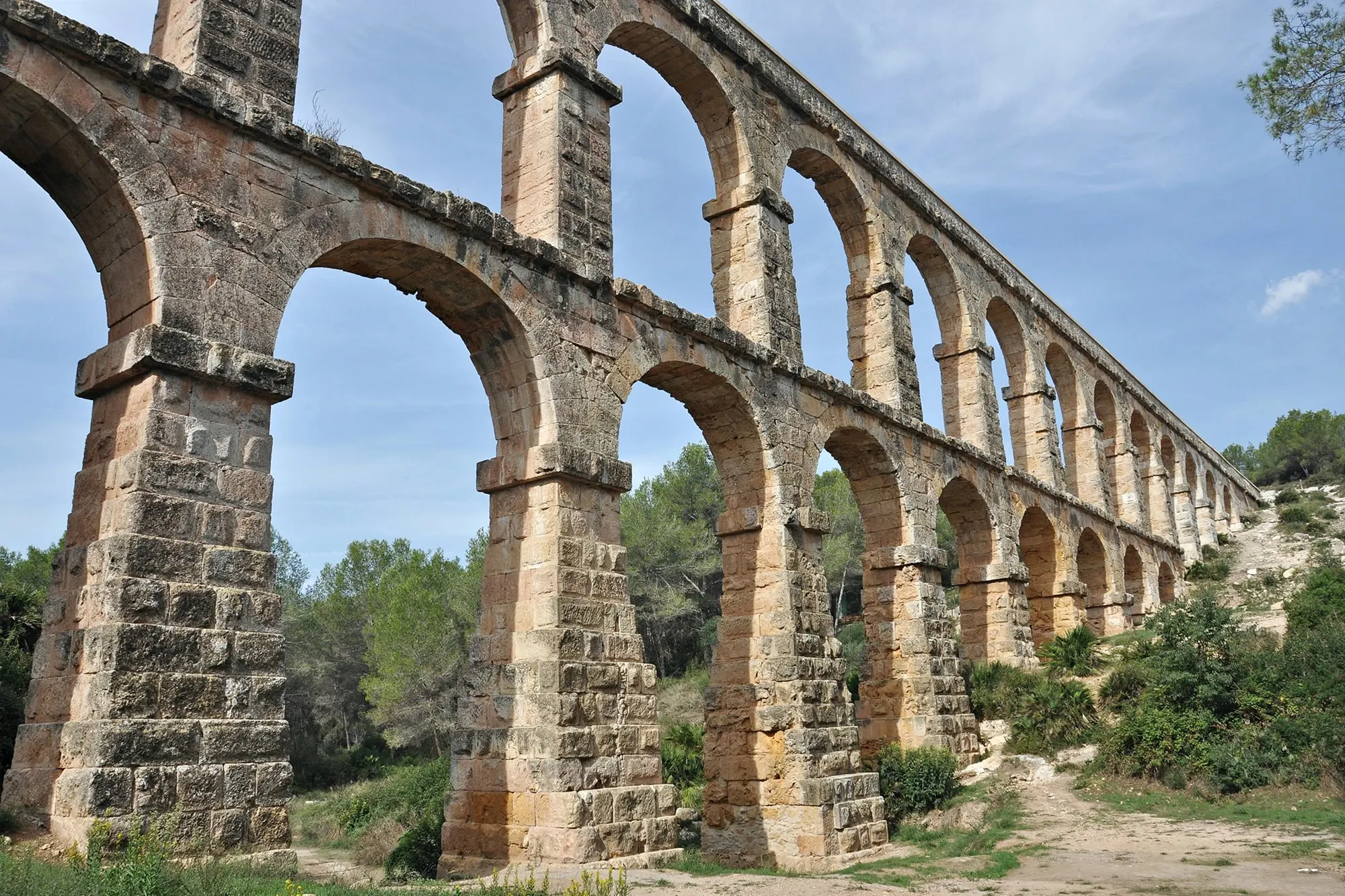
In the 1st century A.D., two long aqueducts were built to supply the city with water.
The first was fed by the Gaià river and was approximately 40 km long. The second was fed by the Francolí river and was some 15 km long. The most spectacular surviving stretch belongs to the second aqueduct and consist of a 217-metre segment that stands 26 metres tall at its highest point and bridges a ravine.
It was built from large ashlars stacked without mortar to form two tiers at arches. It is popularly known as the Pont del Diable (Devil’s Bridge) or the “Les Ferreres” Aqueduct.
Built: I. Century A.C.
Author: Anónimo
Style: Roman Classic
Category: Civil
Type: Aqueduct
Address
CN-240 de Valls a Lleida a 4 Km. de Tarragona 43006 TarragonaOpening times
Free Access
If you see any mistakes or want to add anything to this information, please contact us.
The Cathedral, perched on the highest point of the hill, is the city’s most emblematic building and home to Tarragona’s rihest Collection of mediaeval art.
Construction began on the structure in the mid-12th centiry, and it was consecrated in 1331 A.D., making it a fine example of the transitional architecture thath linke the Romanesque an Gothic periods.
The temple has a basilic floor plan with three naves and a stone transept. The 14th century main façade, with its enormous rose window, is of particular interest. On the mullion dividing the massive doors is a beautiful image of the Virgin with the Christ child, in which the prophets an apostles can be seen at the same height.
The bell tower has a Romanesque base, but the rest of the structure is done in the Gothic style. The top segment, which is octagonal in shape and studded with soaring windows, houses the cathedral’s fifteen bells, some of which date from the 14th century.
The high altar has magnificent frontal from the early 13th century, which depicts scenes from the life and martyrdom of St. Tecla, one of the city’s patrom saints. The reredos, which was begun in 1429 A.D. and is the work of the sculptor Pere Johan, is of particular interest.
Likewise, an arched stone hollow, known as an arcosolium, that stands open on the right wallof the presbitery holds the tom of the archbishop Joan of Aragon, son of King Jaume II. The sarcophagus evokes the figure of the buried man with great realism and detail.
The walls delimiting the choir stalls ate from the 14th century and are decorated with mural paintings, while the wooden pews date from the era of Archbishop Pere de Urrea (1445-1489).
Among the Gothic chapels, the one known as Capella dels Sastres, or the Chapel of the Tailors, which also dates back to the 14th century, is of especial interest and may well be the complex’s finest example of Gothic architecture thanks to its architectural and sculptural ornamentation.
Also of note is the baptistery chapel, formerly dediated to St. Ursula and the eleven thousand virgins and built under Archbishop Arnau Sescomes (1335-1346), with its star vault and intricate detail.
The three chapels located at the end of the suthern wing are the work of Canon Barceló and date back to the late 15th century. Also worth noting are the chapels of St. Michael and the Presentation in the right nave and those of the Cardona family in the left nave, all done in the Gothic Style.
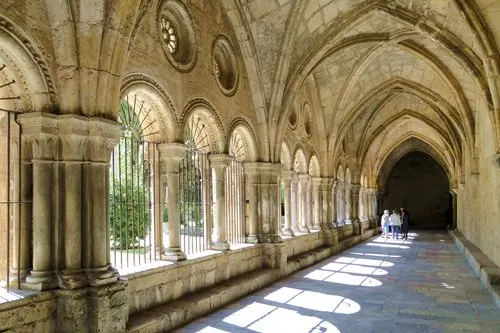
The cloister its rectangular in shape. The round arches, supported by double columns, are grouped in threes under pointed relieving arches.
The cloister’s sculpture work is one of the most pre-eminent examples of Romanesque art in Catalonia an dates back to the turn of the 13th century. The reliefs are concentrated in the capitals one ogees and are characterised by the great wealth of their iconographic repertoire, among which special attention should be alled to the famous “procession of rats”.
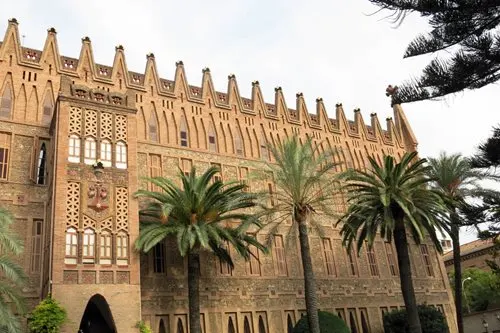
The façade of this building is very evidently eye-catching. The dimensions of the building underline its importance and the high regard that the Teresian nuns enjoyed in the city at the start of the century.
The reddish colour of the walls, achieved by applying adobe, and the inclusion of parabolic arches at the entrance evince an evidently Modernist language.
The building was planned by a notable disciple of Antoni Gaudí, Bernadí Martorell i Puig; various circumstances led to work being started in 1922 but not finished until 1949. In the vestibule of the monument ther ar some columns that have an obvious Gaudí connection, and further on is the convent’s chapel which was blessed in 1926. The convent is no longer inhabited and now functions as a school.
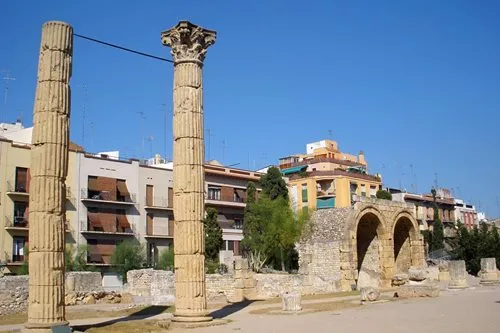
The forum was the hub of daily life. A vast square, it was rimmed by the most important buildings in the city: the curia, the basilia, temples and countles shops.
Unfortunately, much of Tarraco’s forum was destroyed as a result of urban expansion in the 19th century. Today only a portion of the basilica, a large building divided into three naves separated by columns, remains.
Another section of the ruins that has survived reveals the back of the capital city’s temple and several streets and homes.
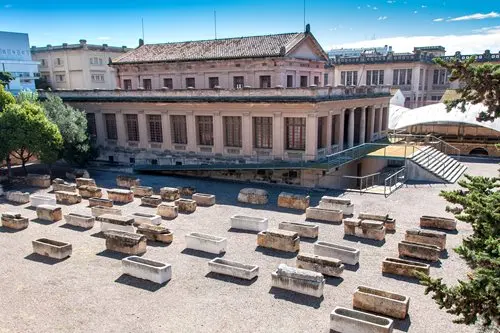
In the mid-3rd century A.D. a burial ground was started near one of the roads leading out of the city. The cementery grew considerably following the burial there of the remains of Saint Fructuosus. The early Christian community turned his tomb into a sanctuary and built two basilicas on the site at the turn of the 5th century, as well as several other buildings and graves (mausoleums, sarcophagi, mosaics an stone markets, etc.).
Today, visitors can tour a section of the paleochristian necropolis housing a museum with the burial sit’es main findings, as well as section of the complex uncovered during construction of a local shopping centre and now open to the pubic in the centre’s basement.