Cookie settings
We use our own and third-party cookies in order to offer our services, display videos, obtain statistics and offer personalized advertising.
For more information, please read our cookies policy.
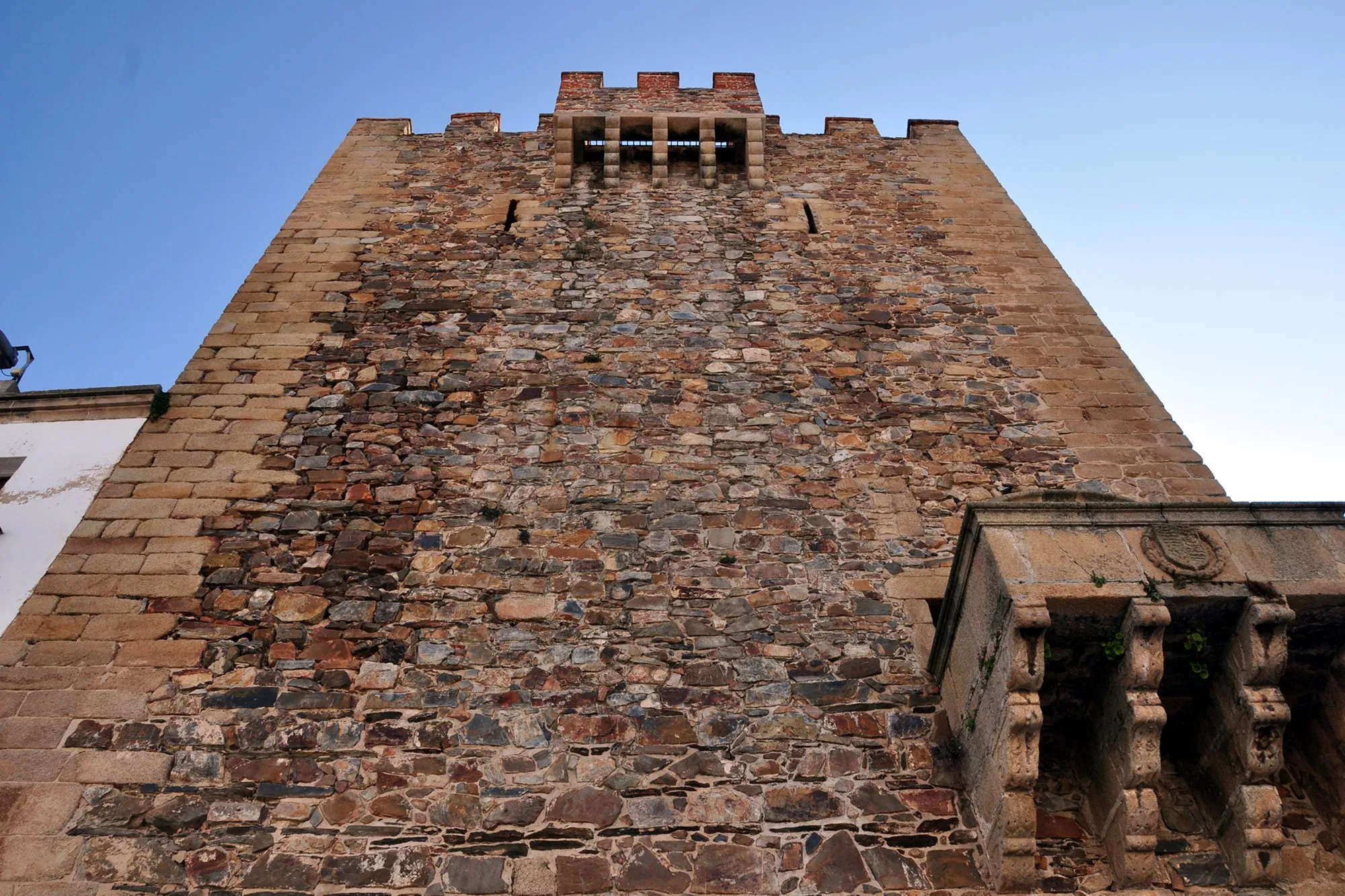
It is also known as Torre Nueva or Torre del Reloj (New Tower or Clock Tower) during the XVI and XVIII Century, and it was suitable for temporary orientation to those who lived in the public square and worked as merchants.
Originally Arab, it is from the same time of the Almohad wall. It has a square floor over Roman ashlars, with two side cantilevers and a frontal one in Renaissance style. It is crowned by merlons and is 10 meters length by 25 meters high. It has a small balcony that was added in the XVIII Century.
Its name belongs to the derivation of the name of the Caliph Abú-Ya’qub, whose troops conquered the town in 1173. According to the legend, 40 Christian Knights of the Orden de Caballería de Santiago (Order of Chivalry of Santiago) were cut the throat of by the Arab troops.
Built: XII Century
Author: Anónimo
Style: Almohad
Category: Civil
Type: Military Watchtower
Address and telephone
Opening times
Prices
Free entry
If you see any mistakes or want to add anything to this information, please contact us.
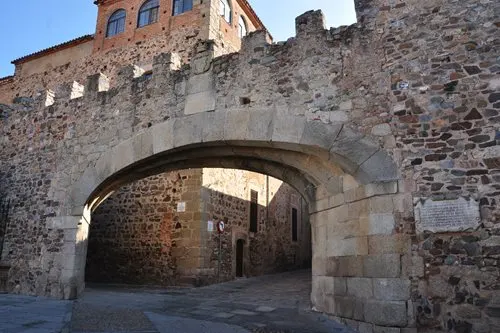
It was built in the XVIII Century on the ruins of a former construction from the XV Century. It is a segmental arch of great spaciousness and skewed, built with this form with the aim of making easier the way of the carriages to the Monumental Town (Ciudad Monumental).
It is one of the five gates of access to the town, together with the one of Mérida, La Fuente or Puerta del Concejo, the Puerta del Socorro and the Puerta del Postigo.
The 30 June of 1497, this gate had the honour of being crossed by the Queen Isabel la Católica and two years later by his husband the King Fernando V de Aragón.
In 1726, Churriguera modified it towards a Baroque style and enlarged it in order to make easier the way of the carriages.
Inside, and in a Baroque small temple, was located the image of the Virgen de la Estrella, the reason of its name. After crossing the arch, we can find the Calle de la Estrella that drives to the Plaza de Santa María. It joins the interior of the town with the Major Square.

In 1261, this Parish house was built and has been reformed and enlarged several times throughout centuries.
The main façade was built in 1587 in Renaissance style. We should highlight the door with a round arch, decorated with dressed ashlars and with forged iron bars on it.
Inside this group, we can find two medallions with themes related to the Conquest of America. Inside the building, there is a courtyard with portico decorated with several Episcopal coats of arms. In the upper part we can see the coat of arms of the bishop Galarza.
Another façade, the one located in the street of the Arco de la Estrella, presents the coat of arms of the bishop Don Alonso Enríquez de Mendoza. Since many years, the bishop lives here and he governs the diocese Coria-Cáceres from it. Here, we can also find the Diocesan archive. Felipe II stayed here.

This convent is part of San Francisco Javier Church.
Its main façade consists of an entablature above supported by columns with composed capitals, and finished off by a broken gable, with a balcony that is closed in its higher part, emphasizing the white marble coat of arms which belongs to Carlos III, with quarters of Castile and León. We can see obvious Churrigeresque influences.
Inside, its courtyard with a large cloister attracts our attention.
Nowadays, it is the head office of the Palacios de San Jorge (San Jorge Exhibition Hall) and the Regional Ministry for Culture and Heritage of the Regional Government of Extremadura.
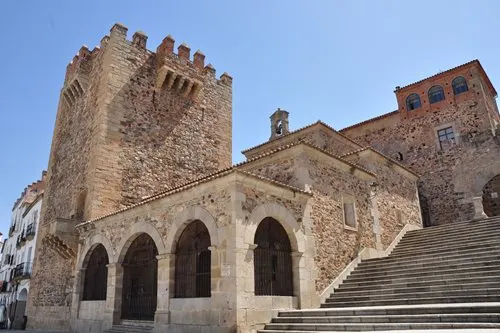
This hermitage was built in the XVI Century and rebuilt in Baroque style in the XVIII Century, on the ruins of the former Renaissance chapel of San Benito.
It is located next to the Bujaco Tower.
The main façade consists of three round arches over stone pillars. The grilles with the eagle with two heads of the Austria dynasty is a Juan de Acedo´ s work of art.
Inside, we can find, as well as a vault decorated with Mudejar paintings, a beautiful dome and a Baroque altarpiece with an image of the Virgen de la Paz, by the sculptor Pedro Correa.