Cookie settings
We use our own and third-party cookies in order to offer our services, display videos, obtain statistics and offer personalized advertising.
For more information, please read our cookies policy.
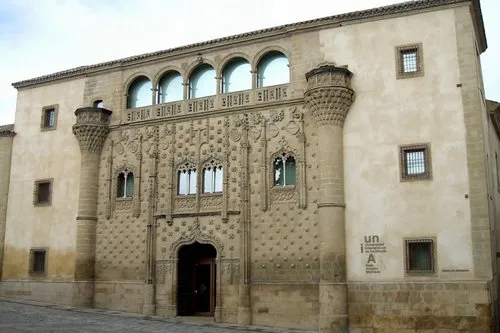
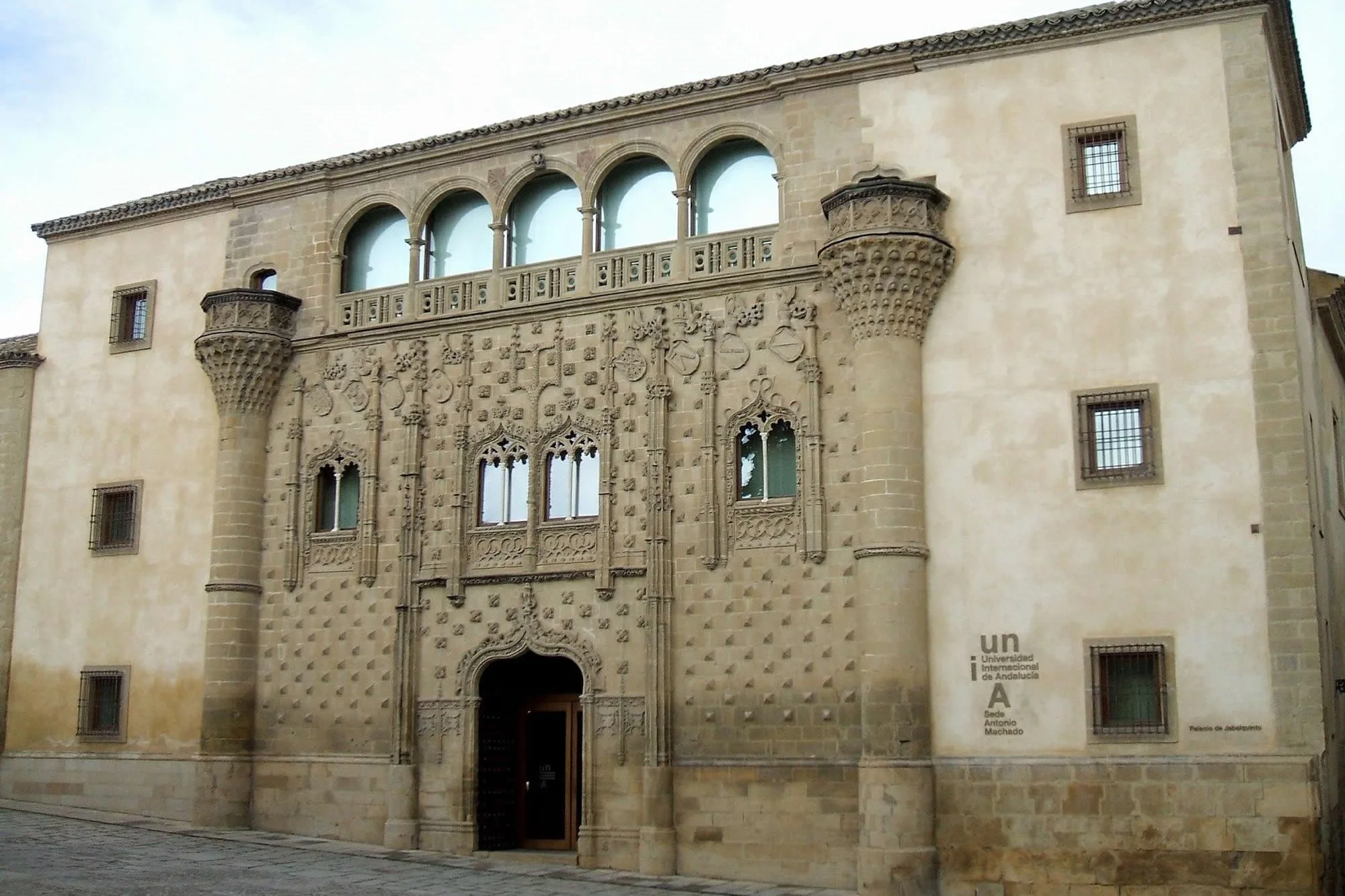
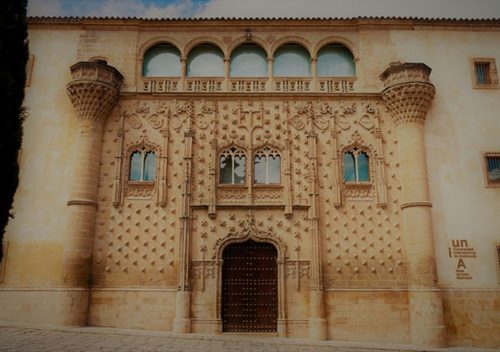
It is one of the jewels of the Spanish Renaissance Gothic style. It was ordered by the Señor de Jabalquino, Juan Alfonso de Benavides Manrique, the king Fernando el Católico´ s first cousin once removed. Its façade is in Flamboyant style with Mudejar influences. It is framed by two cylindrical buttresses with mocarabes crowned by eaves similar to the ones of the windows.
There is a Baroque staircase covered by a semi- spherical vault. The beautiful Renaissance courtyard, with Baroque elements, has a double arcade with marble columns and coats of arms.
The door to the courtyard forms an ogee arch with two trunks that are climbed up by fourteen small human figures. In the second body, there are four windows twin to the central ones, also between pinnacles and mullioned windows with thin columns. On top, eight coats of arms “a la valona” (inclined) with helmets, crests and lambrequines (a short of ornamental drapery for the top of a window or door or the edge of a shelf). There are decorative elements such as diamonds points, foliages, flowers, knots, pinnacles, heraldry and mocarabes.
It has become headquarters of the University of Antonio Machado.
Built: XV Century
Author: Juan Guas
Style: Baroque, Renaissance, Spanish Renaissance
Category: Civil
Type: Palace
Baeza is the city of which Antonio Machado wrote ‘Campo de Baeza, I'll dream of you when I don't see you’. With this guided tour you will understand why the illustrious poet expressed his longing for Baeza, a city declared a World Heritage Site together with Úbeda, thanks to its great monumental and historical heritage of its splendid Andalusian Renaissance.
Cobbled streets, a Cathedral of Romanesque origin and later transformed into Renaissance, palaces with beautiful ‘altarpiece-doors’ in honour of the nobles who lived there. It will seem as if you are walking through a Castilian city but in the middle of the olive groves of Jaén. You will also be able to taste the local olive grove's ‘green gold’. A perfect visit to get to know the culture and tradition of Baeza to the full.

Address and telephone
Opening times
From 10:00 a.m. to 2:00 p.m. and from 4:00 p.m. to 6:00 p.m.
If you see any mistakes or want to add anything to this information, please contact us.
Baeza is the city of which Antonio Machado wrote ‘Campo de Baeza, I'll dream of you when I don't see you’. With this guided tour you will understand why the illustrious poet expressed his longing for Baeza, a city declared a World Heritage Site together with Úbeda, thanks to its great monumental and historical heritage of its splendid Andalusian Renaissance.
Cobbled streets, a Cathedral of Romanesque origin and later transformed into Renaissance, palaces with beautiful ‘altarpiece-doors’ in honour of the nobles who lived there. It will seem as if you are walking through a Castilian city but in the middle of the olive groves of Jaén. You will also be able to taste the local olive grove's ‘green gold’. A perfect visit to get to know the culture and tradition of Baeza to the full.
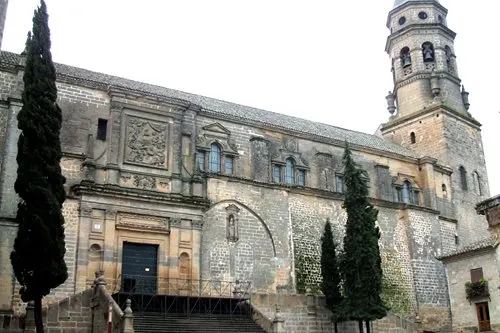
The Cathedral of the Nativity of Our Lady is a true symbol of the Historic Centre of Baeza and the oldest Catholic place of worship in Andalucía.
Its monumentality rises in the Plaza de Santa María, having been built on the site of the old Aljama mosque (main mosque). It has been declared a Site of Cultural Interest since its publication in the Gaceta de Madrid on June 4, 1931.
It was consecrated in 1147 for Christian worship by order of King Alfonso VII. It was then under the dedication of Saint Isidore. Already in 1227, it was definitively consecrated as the "Nativity of Our Lady". In that same year, it was designated as the seat of the Diocese of Jaén, until the transfer of said seat to the capital of Jaén in 1249.
The floor plan of this cathedral is basilical with three naves covered by barrel vaults.
Its oldest part is the lower body of the tower, which corresponds to the minaret of the previous mosque. This body is of a cubic and solid plan, framed by four shafts. Also preserved from that time are three blinded and hidden arches.
Both elements, the lower body of the tower and the blinded arches, belong to the 11th century. In the 13th century, gargoyles were added to the cornice.
It features three façades. The most notable is the north entrance that faces the Plaza de Santa María, consisting of two bodies with Corinthian pilasters. A beautiful relief of the Nativity of the Virgin crowns the door.
The west façade has a small Gothic-Mudéjar door, called the Moon door (13th century). The most remarkable feature of this entrance is its beautiful rose window, also in Gothic-Mudéjar style.
The south façade or Door of Forgiveness gives access to the Gothic cloister. This cloister stands out for its robust appearance, with its simple pointed arches flanked by prismatic buttresses.
In the 16th century, the cathedral was more extensively remodeled, following the designs of Andrés de Vandelvira, Francisco del Castillo, and Alonso de Barba among others.
The Renaissance construction is evident in its façade and the barrel vaults inside. The naves are divided by square pillars with attached Corinthian columns. The hallmark of Vandelvirian architecture is also observed in the Golden Chapel and Saint Joseph's Chapel.
The Golden Chapel was founded by Dean Pedro Muñoz and is covered by a dome-shaped vault and another barrel vault with coffers. Meanwhile, Saint Joseph's Chapel is decorated with religious sculptures and caryatids.
Its Cathedral Museum holds paintings and valuable religious objects, such as a collection of tunics or old costumes. It is located in the chapter house and the cloister.
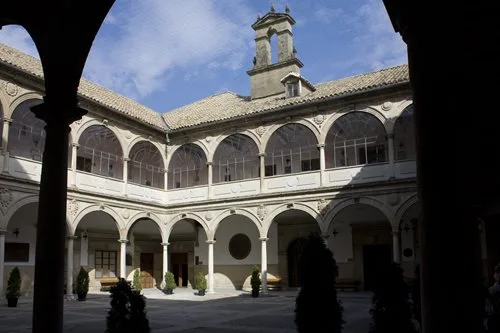
It is one of the four universities founded in the 16th century in Andalusia, alongside Granada, Seville, and Osuna, within the group of “minor universities.”
Initially, it was the College of First Letters under the advocacy of the Holy Trinity - represented in the medallion on the façade. It operated until it was abolished in 1824 by Royal Decree.
Later, it became a College of Humanities and a free Institute where Antonio Machado taught classes, and subsequently it was a Secondary Education Institute.
The building is a good example of Mannerism in Baeza, commissioned by the Administrator and Canon Don Pedro Fernández de Córdoba, where the Franciscan convent of San León once stood. It follows the architectural typology of Renaissance palaces, structured in two storeys around a large courtyard. The galleries of both storeys overlook the courtyard with beautiful semi-circular arches on Doric columns and with mirrors in their spandrels.
Among the various rooms surrounding the courtyard, the staircase and the square-plan auditorium stand out. The ceiling of the latter is wooden, crafted with beams, knuckles, and braces with a horizontal panel of hexagons and coffered ceilings.
The façade is made of ashlar stone, with a semi-circular arched doorway. The extrados of this arch is adorned with fluting and acanthus on the keystone. The doorway is framed with double pilasters, supporting an entablature interrupted in the centre by the medallion with the relief of the Holy Trinity. Above it, there is a rectangular window with a parapet and entablature resting on paired Ionic columns. The window is topped with a mixtilinear pediment, curved at the sides and straight at the vertex.
This façade is completed by four rectangular windows and mouldings on the first floor or body. On the second body, the windows are lintelled and with pediments. Some pediments are straight and others mixtilinear, alternately. These last ones harmonise with the upper body of the doorway. There is a third body, with four lintelled windows between fluted pilasters over corbels.
On the left side of the façade stands the chapel of San Juan Evangelista, finished at the beginning of the 17th century. It is a single-nave building with a barrel vault roof, while the chancel is covered with a dome on pendentives supported by four paired, fluted columns with a composite capital. On the Gospel side, there is a large niche closed with a sculpture inside it. At the foot lies the choir, situated over a lowered vault decorated with coffers and lunettes, and with four Doric columns on each side.
On the same plane as the south façade is a semi-circular arched door framed between Corinthian columns and with a grooved extrados. Above its entablature, there is a rectangular body, whose lower part features geometric decoration and in the upper part three circular windows that illuminate the high choir.
As for the west façade, it also has a semi-circular arched doorway, but its extrados is adorned with rhombuses, framed between Corinthian columns and with a pediment. The tower has a first body up to the roof in a square plan, while beyond this it is octagonal in plan.
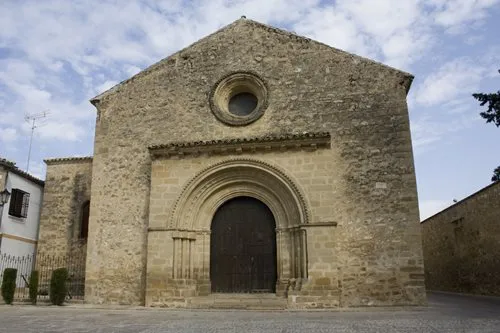
It is the only one remaining of the six parishes that were built after the conquest by Ferdinand III (Baeza capitulation, 1227).
It is in late Romanesque style, and is located opposite the Jabalquinto Palace and the Old University.
Most experts suggest that this church belonged to the Order of the Temple.
It was considered a parish until the 19th century. Initially, it housed the parish of the cathedral's sanctuary (which was relocated). Later, it served as an auxiliary chapel of the parish of El Salvador. It was assaulted at the start of the Spanish Civil War and restored in 1950, with the addition of the west doorway, which came from the ruins of the Romanesque church of San Juan Bautista.
Its floor plan comprises three naves separated by original cylindrical pillars, and with an apse at the chevet, preceded by a wide rectangular section, which opens onto two chapels.
Four pointed arches rest on its pillars. Its side walls are smooth, with only doorways, chapels, and the triumphal arch leading to the chancel - the area around the main altar - at the chevet.
The original roof covering the naves was Mudejar style, but was renovated in 1575 and later restored to its original appearance with a neutral wooden structure.
The chancel is covered with a quarter-barrel vault and the fore-chancel with a pointed barrel vault.
The right chapel opening onto the chancel is square-shaped, with a horseshoe arch entrance. The other chapel, the left one, is also square-shaped and opens with a pointed arch, covered with a simple Gothic ribbed vault. Both were added post-construction.
The walls and interior arches are covered with frescoes depicting Saint Sebastian and the Virgin nursing the Child, under a canopy on the intrados of the arch. Inside, it depicts Saint Catherine. All paintings are late Gothic and today preserve their colours quite faded. In worse condition are the pictorial themes in the central apse, dating from the 15th century.
Externally, the masonry wall with irregular ashlar work is visible. The South and West facades are notable. The former is original to the temple, while the latter comes from the Romanesque church of San Juan. These doorways are splayed, presenting three semicircular archivolts, resting on columns and decorated with chevron and vegetal motifs. The jambs contain three pairs of columns, from whose acanthus-leaf capitals the archivolts spring.
The doorway from the Parish of San Juan has slight variations. It presents a slight pointing at the start of the archivolts, and fantastic cardina decoration with dragons and other animals on the impost. Above it, a rose window is preserved whose decoration in its splaying is similar to that of the Baeza cathedral.
Following the restoration carried out in this church in 1990, a Visigothic horseshoe arch was found next to the epistle. This arch is formed by smooth voussoirs and an archivolt. There is a theory about this discovery that the Church of Santa Cruz was built on a Mozarabic Christian temple.