Cookie settings
We use our own and third-party cookies in order to offer our services, display videos, obtain statistics and offer personalized advertising.
For more information, please read our cookies policy.
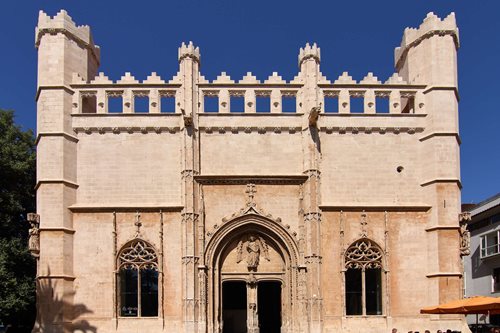
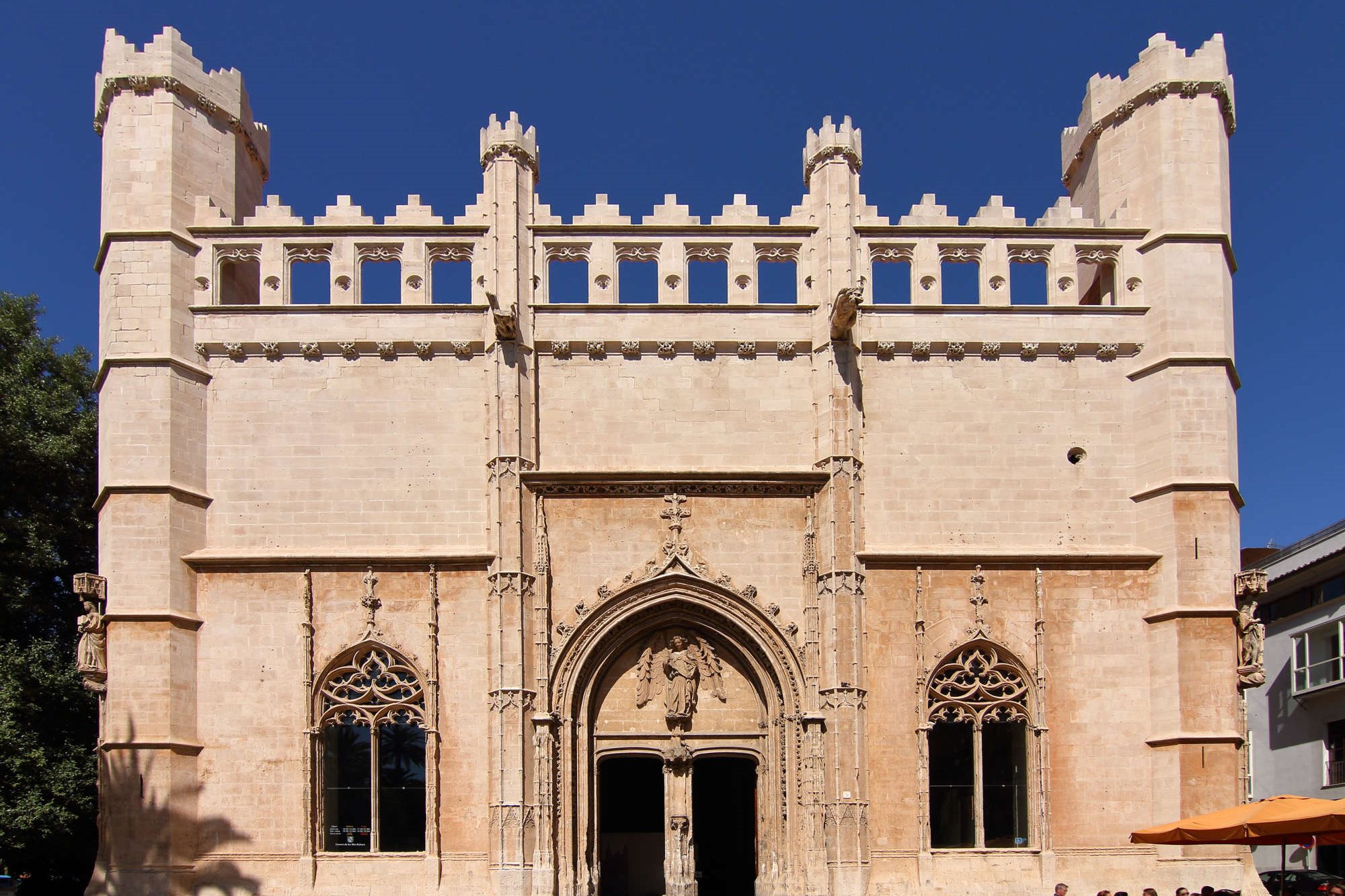
The important trading activity developped in the ports drove the king Jaime to hand over the lands in order to build this fish market, assigned as meeting point of merchants that did bussiness there.
It is a rectangular building covered by rib vaults leaned on helicoidal columns, that divide the space into six naves supported by simple fluted pillars, inside the grandness of only one room.
Four elegant large fortified towers decorate its corners and other ten small towers coincide with the inside columns. The upper part of the building has a gallery of ogee windows (an element that will be usually reproduced in some porchs of the Palma mansions). This gallery is finished off by a merlons cresting.
There are two facades: The one of the West, in whose tympanum there is a Virgin crowned by an angel; and the main one with the Angel, merchants´ Patron Saint. The drillings of its hollows have a beautiful structure as well as the motives of its freizes and cornices. On its lintels we can see sculptures of the four Evangelists.
Nowadays it is a building assigned as exhibitions room.
Built: XV Century (1426- 1448)
Author: Guillem Sagrera
Style: Gothic
Category: Civil
Type: Market
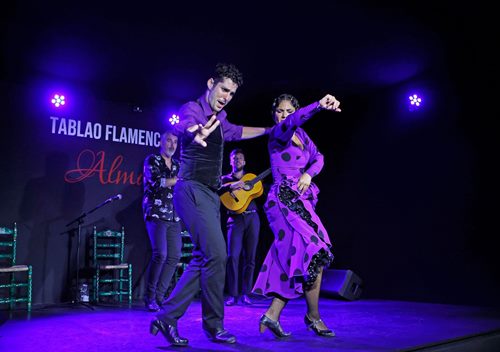
Experience an authentic flamenco show in the heart of Palma de Mallorca. Book your show at Tablao Flamenco Alma and fall in love with the magic and spirit of flamenco.
The exceptional artists performing on its stage come from various Spanish cities such as Barcelona, Madrid, Granada, and Seville.
Additionally, you can complement your evening with a delicious dinner featuring traditional Spanish cuisine.

Address
Plaza de la Llotja, 5, 07012 Palma (Balearic Islands)Opening times
If you see any mistakes or want to add anything to this information, please contact us.
Experience an authentic flamenco show in the heart of Palma de Mallorca. Book your show at Tablao Flamenco Alma and fall in love with the magic and spirit of flamenco.
The exceptional artists performing on its stage come from various Spanish cities such as Barcelona, Madrid, Granada, and Seville.
Additionally, you can complement your evening with a delicious dinner featuring traditional Spanish cuisine.
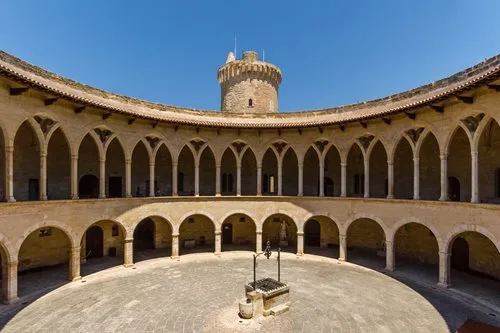
Bellver Castle is the only circular castle in Spain and the oldest of the few of its kind in Europe.
Bellver Castle is a Gothic fortification, located 3 kilometres from the centre of Palma de Mallorca, and 112.6 metres above sea level. Its name, Bellver, means "beautiful view" (from the Old Catalan bell veer), due to its location, surrounded by forest and with beautiful views of the city and the Serra de Tramuntana.
Construction began in 1300 by order of James II of Mallorca, taking 9 years to complete, with ornamentation added later. It was conceived as a royal residence, where James II, Sancho I, and James III resided. In the late 14th century, it was inhabited by John I of Aragon and Violante de Bar with their court for a period, while fleeing the plague in Barcelona.
The layout of this castle is circular and has two floors. Three semicircular towers are attached to the main part of the castle, while the keep, which is round and the most prominent, is separated from it by about 7 metres.
Its rooms are arranged around a large central circular courtyard. The gallery overlooking the courtyard has semicircular arches and is covered with a flat ceiling on the ground floor, whereas on the upper floor, it features pointed arches with a Gothic ribbed vault ceiling.
Since 1931, this building has housed the Palma History Museum and the Despuig Collection of Classic Sculpture. The Palma City Council also organises various cultural and leisure activities here.
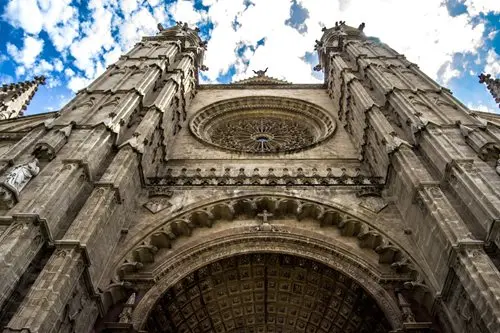
The Cathedral of Mallorca, better known as La Seu, was built in 1230, during Jaime I´ s reign. It was built on the site of the existing Arab mosque of Medina Mayurca.
It has a Basilical structure with three naves finished off with three stepped chapels of rectangular profile. The central nave is 44 meters high.
It has three huge doors, and the door of the Southern facade is the most relevant: the Portal del Mirador, which receives this name because it is located in the façade that is oriented to the sea. It is decorated with geometrical and vegetal motives, where we see one of the best examples of Gothic sculpture in Mallorca: Guillem Sagrera´ s angel with spread wings.
The Almoina is the usual door of entrance to the cathedral and it comes from 1498. We should highlight the spectacular rose window, which is 12.5 meters of diameter and is considered as the major circular oculus all over the world.
The Capilla de la Trinidad (Chapel of Trinity) was built as a mausoleum in 1329, and it is the burial place of the Kings of Mallorca, Jaime II and Jaime III.
The major chapels are in the side naves, such as the Capilla del Evangelio (Gospel Chapel) that contains sculptures and the Bishop Torrilla´ s sepulchre, and the Capilla de la Epístola (Chapel of the Epistle) that contains a Salvador Torres´ s painting.
The Royal Chapel is the oldest and better decorated part of the temple. It was redesigned by Gaudí at the beginning of the XX Century. This master is also the author of the singular iron forged canopy of the baldachin.
The sacristy conserves jewels of great artistic and historical value.
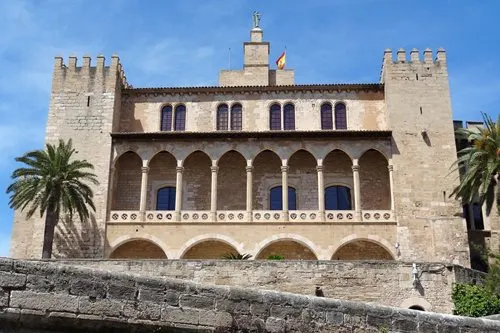
The impressive Royal Palace of La Almudaina, which stands next to the cathedral, was the seat of the kings of Mallorca after the Christian conquest in the 13th century. Today it is the summer residence of the Spanish royal family.
La Almudaina is the Royal Palace (also known as the Royal Alcázar) of Palma de Mallorca. It has been declared a Site of Cultural Interest since 3 June 1931. It was built on settlements dating back to Roman times and possibly corresponded to the seat of power.
During the Muslim era, it became an alcázar. With the Christian conquest in the 13th century, it became the seat of the kings of Mallorca. Its walls preserve the historical footprint of the islands since their megalithic origins.
Currently, it is one of the residences of the Spanish royal family, specifically during the summer months. It is managed by National Heritage and can be visited just like all the buildings of the Crown of Spain.
Book your hotel