Cookie settings
We use our own and third-party cookies in order to offer our services, display videos, obtain statistics and offer personalized advertising.
For more information, please read our cookies policy.
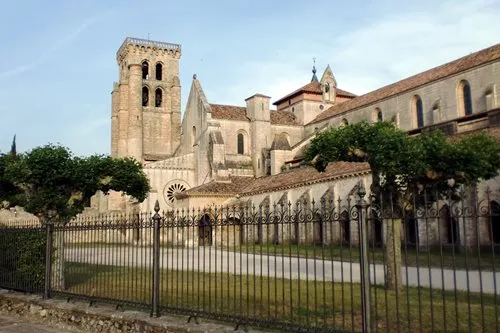
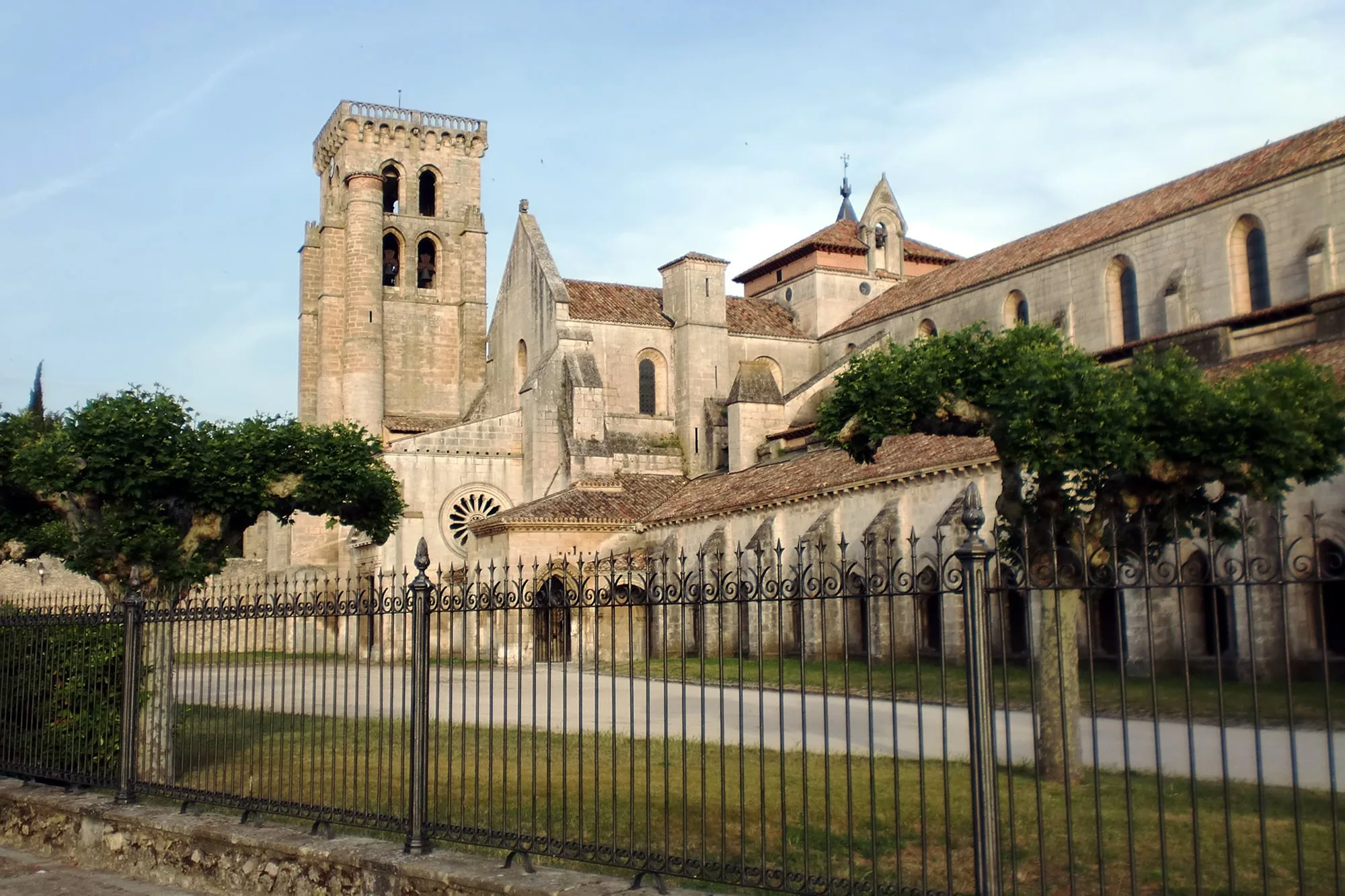
This monastery was built over the site of a leisure residence of the monarchs known as “Huelgas del Rey”. It was founded by Alfonso VIII, as a Kings´ Pantheon in 1887 and spiritual place of the High Society and Nobility Ladies. This group consists of a church, a monastery and a cloister for Cistercian nuns.
The church was built in 1219 in Gothic style. It has three naves, with a large presbytery with five apses and a transept. In the central one we can find the nuns´ choir next to the Kings´ Pantheon.
The major cloister is known as San Fernando. It was built during Fernando III el Santo´ s reign, the reason of its name. It should be highlight because of its pointed barrel vaults, maintaining in some of its bays fragments with fine Spanish- Muslim plaster motifs, such as set of bows and Arabic inscriptions.
From here, we can access to the Claustrillas or first monastic nucleus of the Community, in Romanesque style, and the Northern side of the cloister we can find the valuable Moorish chapel of the Assumption with horseshoe arches and Arab vegetal decoration.
The Chapter House has nine bays of transept over four pilasters, and here is exhibited the Flag of the Battle of the Navas de Tolosa.
Another important chapel is the chapel of Santiago, where the ritual of the Knights´ reception took place and where we can find the seated image of Santiago.
Finally the Museo de Ricas Telas, located in its former Cilla or pantry of the monastery, which have valuable samples of cloths as well as sacred object and ornaments.
Built: XII Century
Author: Anónimo
Style: Gothic, Mudéjar, Romanesque
Category: Religious
Type: Monastery
Address and telephone
Opening times
Prices
General admission: 8 €.
Free admission (unemployed people, people with disabilities, large family): €0.
If you see any mistakes or want to add anything to this information, please contact us.
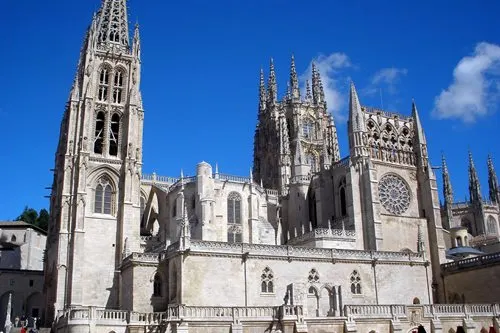
The Burgos Cathedral is one of the most beautiful and perhaps, one of the most representative cathedrals in the country. In a Gothic style, it was founded by the bishop Mauricio. Its majestic proportions and its exterior, as admirable as its interior, should be highlighted.
In the centre of the transept, we can find the Cid and his wife Mrs Jimena´ s sepulchre. We should not forget its splendid collection of works of art: altarpieces, paintings, choir´ s set of chair, sepulchres and sculptures.
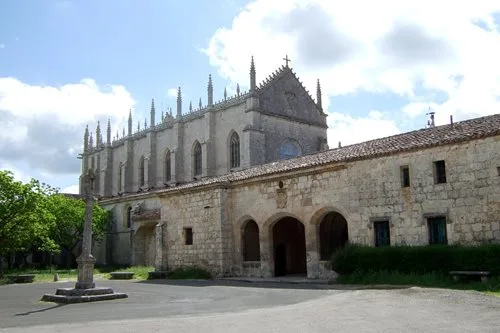
The Charterhouse of Miraflores is a Carthusian monastery of Isabeline style, founded by John II of Castile, and completed by his daughter, Queen Isabella in 1484. During the Middle Ages, it was the rest residence of King Henry III.
The church is a single nave structure with a polygonal apse and star-shaped vaults.
The cenotaph of King John II and his wife Isabella of Portugal stands out, with a star-shaped design, a work by Gil de Siloé.
There are several Late Gothic access doors. The most spectacular one connects the church's western atrium with the cloister. It is crafted in the Isabeline Gothic style. The Chapel of the Blessed Sacrament is prominent, as well as the main altarpiece also by Gil de Siloé, which boasts great ornamental richness.
It depicts the theme of the Pietà, where the figure of the crucified Christ is inscribed in a large circle (an allusion to the Eucharist) and at the foot of the cross, the vertical figures of the Virgin and St. John; and at the bottom, the Annunciation and the Nativity, with praying statues on the sides and the coats of arms of Kings John II of Castile and his wife Isabella of Portugal.
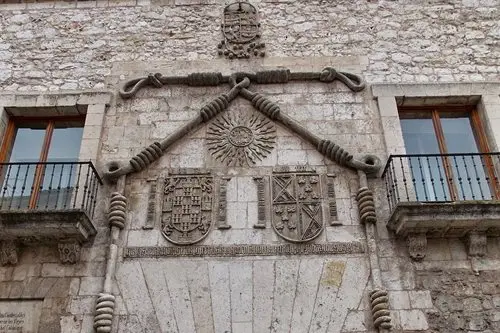
The Palace of the Constables of Castile, popularly known as Casa del Cordón, is a palace from the XV Century that was built in the old part of Burgos. Its founder was the Constable of Castille, don Pedro de Velasco. A strong mansion flanked by two towers crowned by a cresting.
Inside, we should highlight the courtyard with portico with two floors of galleries and a great Neogothic staircase, by the architect Vicente Lampérez. The courtyard is a result of the second phase of construction, which takes from 1484 to 1497, and inside its galleries we can find the interior rooms, following the model of Renaissance palace of that time.
It is known as Casa del Cordón because of the great Franciscan stone cord the surrounds its door, surrounding at the same time the royal arms and the Casa de Velasco, Mendoza y Figueroa´ s arms. Inside, the great Classic courtyard with a gallery of three floors attracts the attention.
Felipe el Hermoso died in this palace, the Catholic Kings met Christopher Colombus here when he went back from his second trip to America, and the Courts met in 1515.
Nowadays, it is the headquarters of the bank Caja de Burgos.
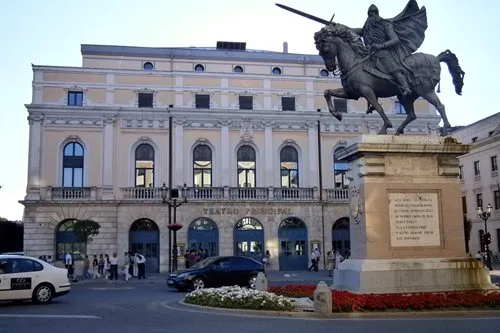
The theatre incorporates all the innovations known up to that point. The auditorium is horseshoe-shaped with four floors and five rows of boxes. The exterior is Italianate in the composition of the openings and the palace-like appearance.
Its aesthetic is in the academicist style of the reign of Isabella II, which is why it has been called “Elizabethan style”.
In 1886, the Polisón building was added, owned by the Recreation Hall Society.
Throughout the year, the theatre offers a varied programme of quality dance, theatre, and music; additionally, in the building, we find a library, an exhibition hall, and a conference room. It was renovated in 1997.

Book your hotel