Cookie settings
We use our own and third-party cookies in order to offer our services, display videos, obtain statistics and offer personalized advertising.
For more information, please read our cookies policy.
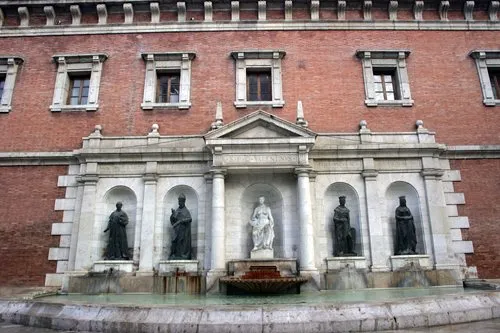
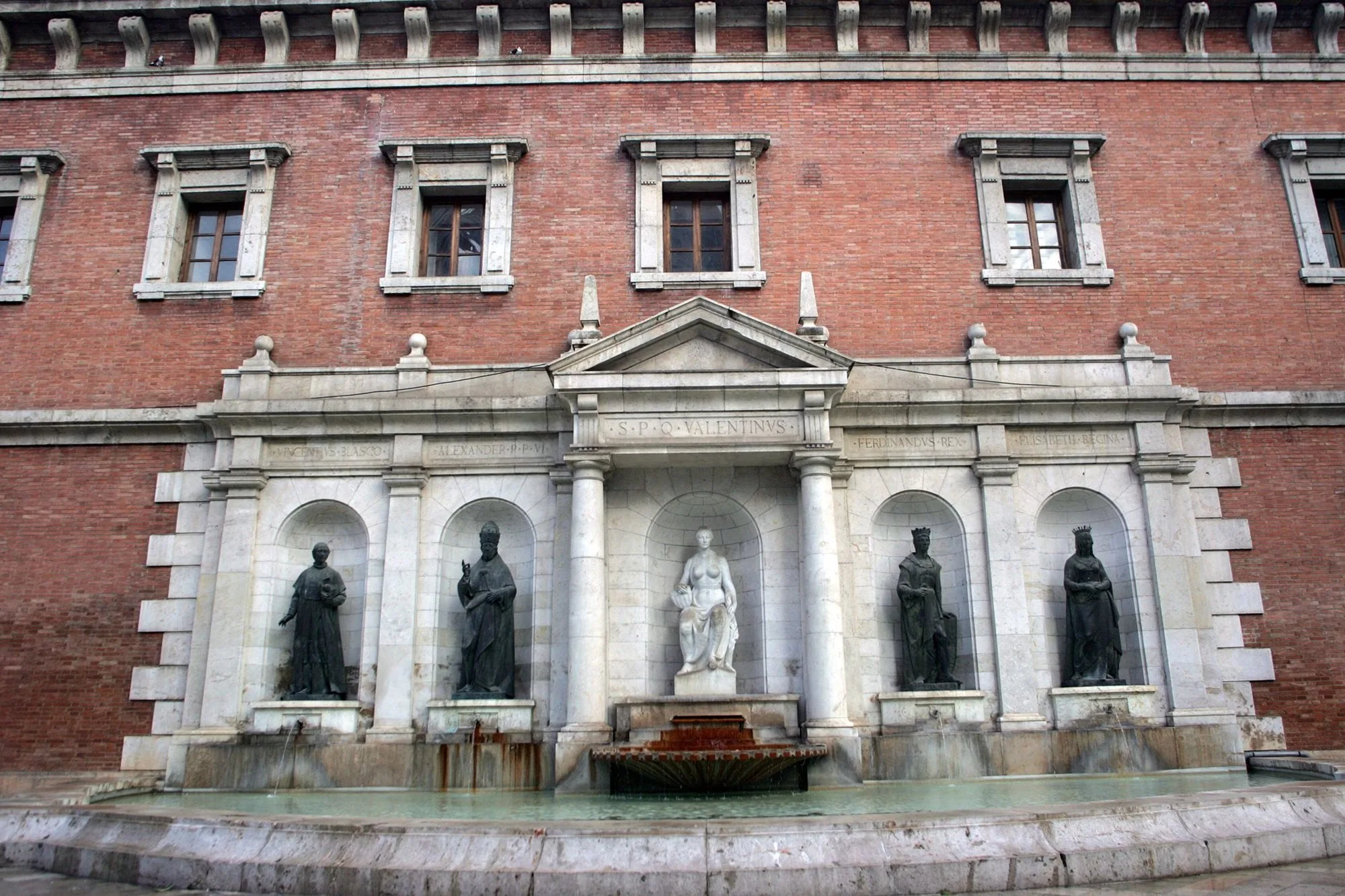
It was founded by the Blessed San Juan de Ribera in 1556. The group consists of a school and a church. Its walls and ceilings are covered by glazed tiled baseboards and frescoes by Bartolomé Matarana. It has uncountable works of art, some of them of great value. Its architecture belongs to the Herrerian School. The courtyard consists of 85 columns and two galleries.
In the centre, the beautiful sculpture of the Blessed Ribera by Benlliure is located. The Museum, which consists of the Capilla Purísima and other close rooms, includes a painting collection from the XVI and XVII Centuries and works by Juan de Juanes, El Greco and the primitive Flemish painters. Moreover, it conserves the picture of La Cena (The Saint dinner) by Ribalta and a sculpture of the Virgin by Gregorio Hernández.
Built: XVII Century
Author: Anónimo
Style: Herrerian
Category: Museum
Type: Museum
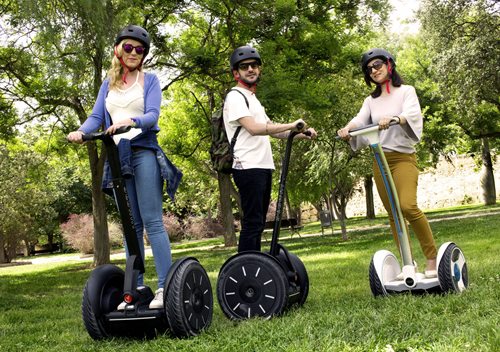
Experience Valencia's nature in a unique way with the Segway Tour: Valencia Park.
A guided Segway tour through the greenest area of the city. From the Turia Gardens to the Bioparc, passing by the Bridge of Arts by Norman Foster and the 9th of October Bridge by Santiago Calatrava.
This exceptional route features over 4,145 trees and 30,900 shrubs, making for a pleasant and enjoyable ride. And with our guide, it’s even more fun on a Segway.
You have several time slots to choose from. Sign up now!
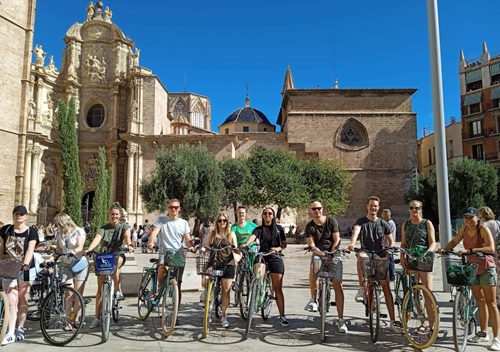
Explore Valencia in a fun and sustainable way on this 2-hour bike tour.
Ride through the historic center, cycle over 10 km along the Turia Gardens, and marvel at the City of Arts and Sciences.
Perfect for discovering the city at your own pace with an expert guide.

Address and telephone
Opening times
Prices
Services
Guided Tours.If you see any mistakes or want to add anything to this information, please contact us.
Experience Valencia's nature in a unique way with the Segway Tour: Valencia Park.
A guided Segway tour through the greenest area of the city. From the Turia Gardens to the Bioparc, passing by the Bridge of Arts by Norman Foster and the 9th of October Bridge by Santiago Calatrava.
This exceptional route features over 4,145 trees and 30,900 shrubs, making for a pleasant and enjoyable ride. And with our guide, it’s even more fun on a Segway.
You have several time slots to choose from. Sign up now!
Explore Valencia in a fun and sustainable way on this 2-hour bike tour.
Ride through the historic center, cycle over 10 km along the Turia Gardens, and marvel at the City of Arts and Sciences.
Perfect for discovering the city at your own pace with an expert guide.
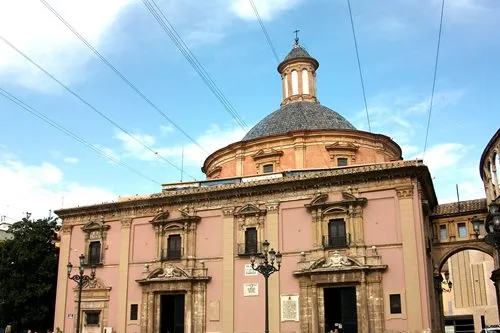
It is the sanctuary of the Virgin of Valencia.
The only church located in the old part of the town that has not been built on the ruins of former churches and convents. It has an elliptical floor and radial naves. Its vaults are decorated with frescoes by Antonio Palomino from the beginning of the XVIII Century.
The chapel is located behind the arch of the Major Altar and on both sides of the statues of the Saint Martyrs St Vicente mártir (Patron Saint of the town) and Vicente Ferrer (Patron Saint of Valencian Community) by Esteve. It has been built in Baroque style and venerates the statue of the Virgin with the baby Jesus on one arm and with a white lilies bouquet on the other one, and at her feet there are two children who represent the Saint Innocents. The basilica has the peculiarity of having the dome displaced to the Cathedral.
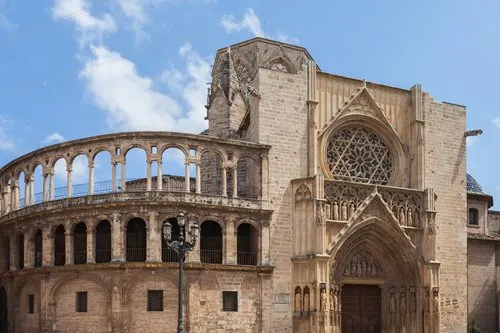
It was built on the ruins of a former Major Mosque, adopting elements from different styles, being the Gothic style the most representative one.
It has a Latin cross plan and consists of three naves, a transept and a spectacular two floors dome with fretwork traceries. The Chapter House is relevant because it is wide and is covered by an eight points vault in which the relic of the Holy Chalice is kept.
We should highlight the Puerta de los Apóstoles (Apostles´ Door) that comes from the XIV Century where members of the Tribunal de las Aguas meet every Thursday (except for Public Holidays) at midday. Another important door is the Puerta del Palau (Door of the Palace), the oldest door in the cathedral that was built in a Romanesque style with Mudéjar elements.
Finally the Torre del Miguelete (Miguelete´ s Tower) should be highlighted, from 1381 carried out by Andrés Juliá and Pedro Balaguer. It is built with stone and consists of four bodies. It is octagonal and 51 meters high. Inside, it houses a body of superposed bells. Its structure finished off with a stone belfry from the XVIII Century.
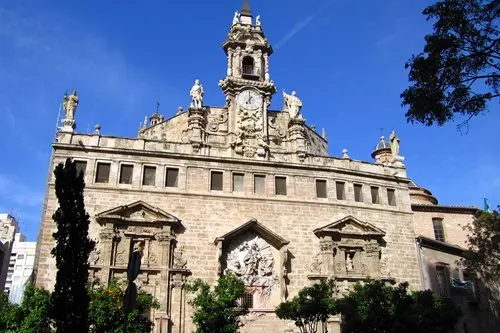
It is located in front of the Lonja de la Seda (Silk Exchange). It was built in Gothic style, but finally it was finished in Barroque style, after a fire that seriously damaged it in 1603. It only has one nave covered by rib vaults and with fine Gothic decoration outside. Inside, it is very luxurious, decorated with frescoes by Palomino.
The frescoes of the Capilla de la Comunión (Chapel of Communion) constitute José Vergara´ s masterpiece. In the façade of the Plaza del Mercado, we should highlight a central sculpture of the Virgen del Rosario, by Jacobo Bartessi. Over it, we can find the the clock tower, flanked by the two St. Johns and a weathervane placed on the upper part of the façade, known as the pardal de Sant Joan.
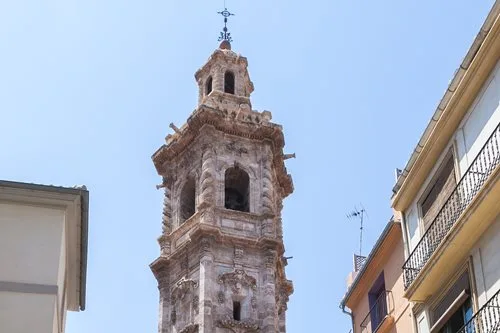
It is the oldest church in Valencia. It dates from times of the Spanish Reconquest, and only its beautiful and elegant tower and a rich Gothic door have survived.
The Bell Tower, in Baroque style from the XVII Century, could be considered as the most remarkable element of the complex and has an autonomous character with regard to the church. The church is hexagonal and has three naves and side chapels, rib vaults and ambulatory with chapels.
Finally, in the also beautiful Calle de la Paz, stand five floors that are finished off by a small temple covered by a dome cap. It can be used as entrance to the quarter and the market.