Cookie settings
We use our own and third-party cookies in order to offer our services, display videos, obtain statistics and offer personalized advertising.
For more information, please read our cookies policy.
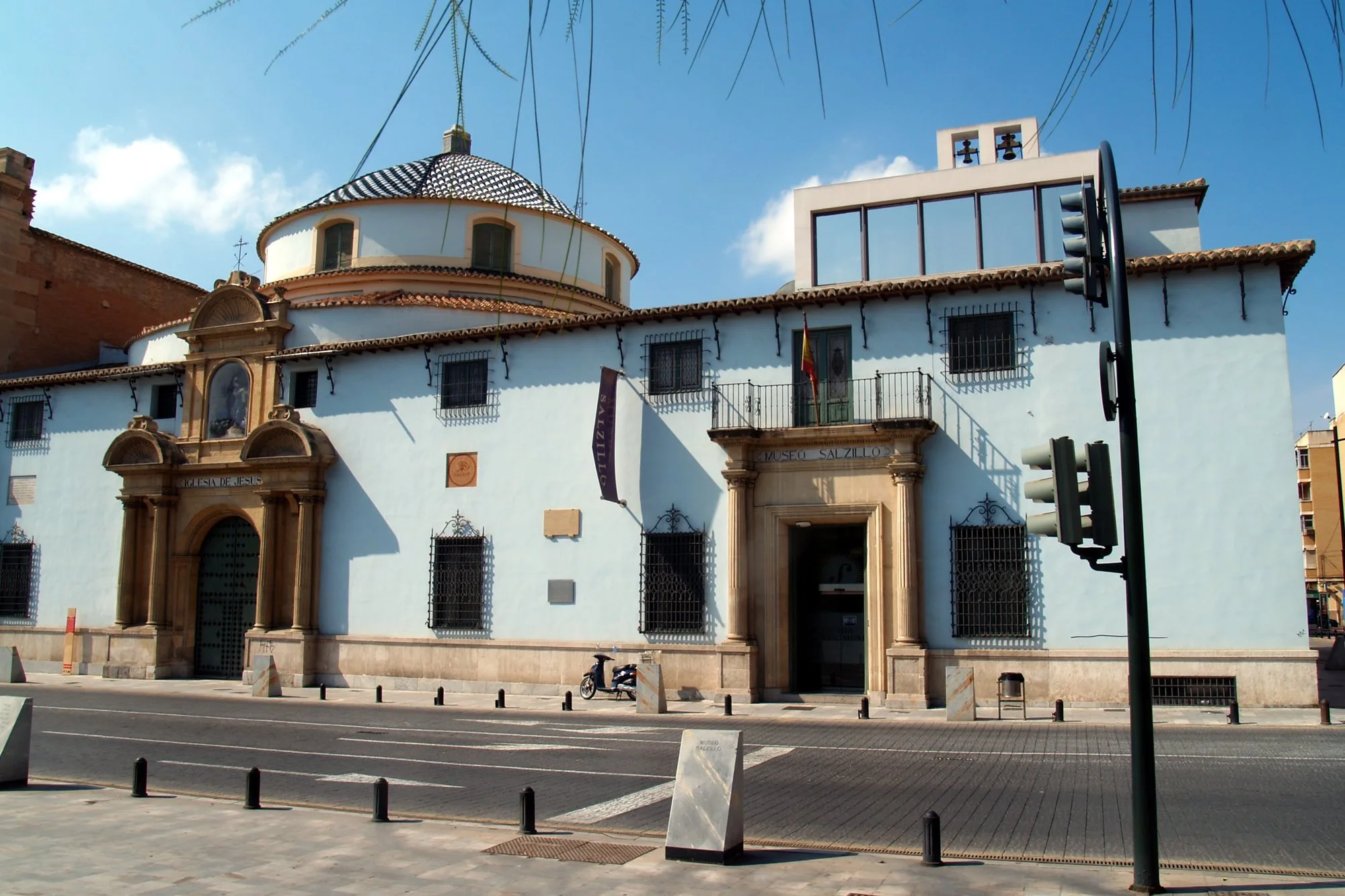
The church of Jesus has an eliptic interior. It is one of the most popular places for visitors to the city, as it holds a permanent exhibition of the most precious works of Francisco Salzillo, ranging from the well-loved set of Christmas Crib figures to the majestic groups of carvings carried throught the streets on Good Friday morning.
Except for that which gives its name to the Holy Week guild, Jesus of Nazareth, the other carvings were made by Salzillo between 1752 and 1777. there is no other morning in Murcia as glorious as that of Good Friday.
As dawn tinges the roof-tops with gold, the blossom-scented city awakes, every citizen reverent before the endless-seeming river of purple-clad penitents bowing down under the weight of the invaluable statuary as they bear it through the streets of the baroque quarters of Murcia.
Built: XVIII-XX Centuries.
Author: Anónimo
Style: Baroque
Category: Religious
Type: Church
Address and telephone
Opening times
Museum:
Tuesday to Saturday: 9.30 a.m.- 2.00 p.m.; 5.00 p.m. – 8.00 p.m.
Sunday and public holidays: 11.00 a.m.- 2.00 p.m.
Prices
General entrance: 3€.
Reduced: 2.40€.
If you see any mistakes or want to add anything to this information, please contact us.
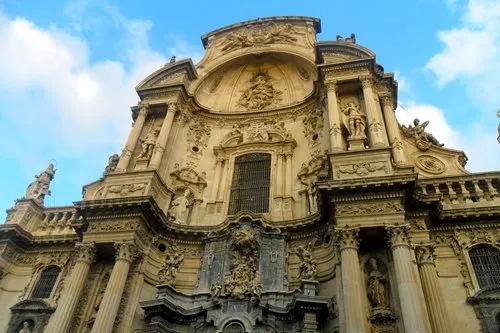
The narrow Calle Arenal, with shields and pigeons, takes us into the Plaza de Belluga, where our most highly-prized historical building stands: the Cathedral.
Bishop Pedrosa laid the foundation stone in 1388: then no-one could imagine that the work would take four centuries to finish, a long period which explains, the widely differing styles of architecture to be found in it.
It has 23 chapels each with its own artistic conception, from that of te Marqués de los Vélez, with its lacey stonework typical of the most ornate Gothic style, (1507) to the Junterones chapels (1525), one of the most original of all Spanish also belongs to the period, inspired by that of San Lorenzo by Brunelleschi.
The altarpiece of the capilla del Socorro, the choir stalls, dating from the 15th century, the wood carving of Saint Jerome by Salzillo are among its other treasures.
With the tower the renaissance came to Murcia. It took the place of another, less impresive tower which in its turn replaced the minarete of the mosque. The first stage of the present tower was built by the Florentín brothers between 1521 an 1525. the second stage with its rich Ionic capitals, garlands and statues of the saints in their niches, was finished in 1645, while a further 120 were to pass by before the third stage was commenced: the lantern which crowns the octagonal roof its 92 metres above the ground.
However, the most beautiful and admired jewel of the whole collection is the West Front (1736-1754), a lovely stone façade, work of the sculptor and architect Jaime Bort. Murian masons, painters, gilders and joiners of Spain’s Golden Age worked together on a project which has been catalogued as a work of art of international barroque.