Cookie settings
We use our own and third-party cookies in order to offer our services, display videos, obtain statistics and offer personalized advertising.
For more information, please read our cookies policy.
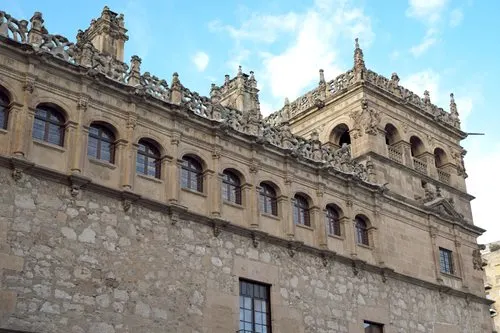
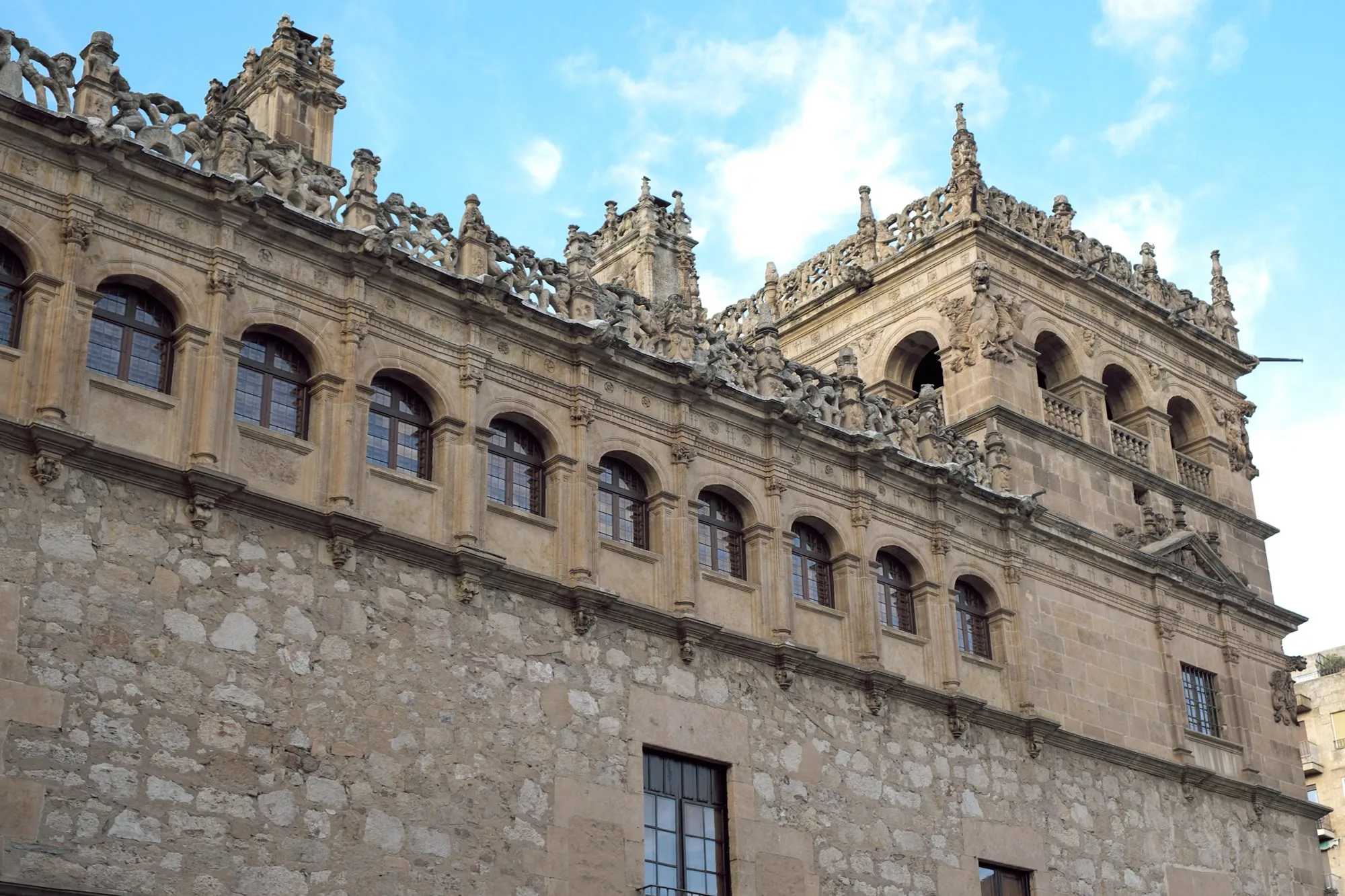
It belonged to the Monterrey family, who ordered to build it. It is the most representative construction from the Plateresque period in Spain.
It is a square building that is extended on its back by two parallel wings. It consists of three floors and four towers. The gallery of its last body consists of arcades finished off by medallions.
The Public area of the palace was decorated with windows with lintel with semicolumns on both sides. In the upper section there is a gallery. The towers has windowed balconies and are crowned by a Plateresque cresting, Inside the palace, there are many heraldry and historical elements that represent noble families such as the Casa de Zúñiga, Acevedo, Ulloa and Fonseca, among others
Despite its majesty, only a quarter of the original proyect was carried out. We should highlight the contrast between the defensive aspect of the towers and the cresting of the upper gallery, marked out by human forms of great beauty. Nowadays, it belongs to the ducal family of Alba.
Built: XVI Century (1539)
Author: Rodrigo Gil de Hontañón
Style: Renaissance
Category: Civil
Type: Palace
Address and telephone
Opening times
Guided tours with prior reservation at the Casa de Alba Foundation. Groups must be accompanied by an official guide.
Morning shifts:
At 10:30 am.
At 11:30 am.
At 12:30 p.m.
At 1:30 p.m.
Afternoon shifts:
At 5:00 p.m.
At 6:00 p.m.
At 7:00 p.m. (summer).
If you see any mistakes or want to add anything to this information, please contact us.
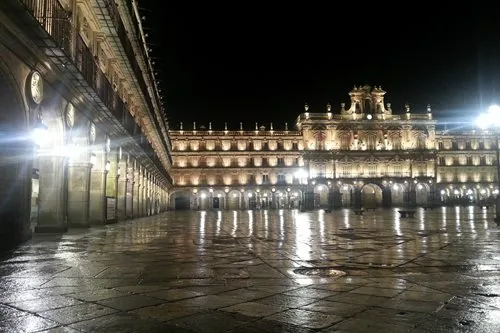
The square has the form of an irregular quadrilateral, with four facades of three floors, all of them of different length. In the centre of the façade, the one oriented to the North, we can find the city council over which is built a belfry with three bells and four allegoric sculptures of Agriculture, Industry, Music and Poetry, carried out by the architect Andrés García Quiñones, over five major arches, and crowned with the belfry.
It has 88 round arches built over strong pillars and finished off by a balustrade decorated with medallions with distinguished characters of Spanish History. Among them we should highlight Carlos I, Cervantes, Alfonso XI, Fernando VI or Santa Teresa. The ground floors are occupied by restaurants, bars and shops.

The New Cathedral has a Latin cross plan, with three naves and adjacent chapels. The main façade shows us three ogee arches.
The whole group is decorated with human and animal figures, heraldry sculptures and vegetal and geometrical ornamental motives. This cathedral is dedicated to the Virgen de la Asunción.
Inside, there are wide pillars of almost forty meters height. The Baroque dome located over the transept is 80 meters height, and produces a sensation of grandness. The choir, by Joaquín Churriguera, is deeply decorated and constitutes one of the most relevant choirs in the Spanish Baroque. The Golden Chapel is decorated with symbolical bass- relieves and glazed- tiles.
The Major Chapel is Neoclassic. On both sides there are some urns with San Juan de Sahagún, patron Saint of the town and Santo Tomas de Villanueva´ s remains. The sacristy, from the XVIII Century, keeps Maella´ s paintings and a reliquary with numerous objects of artistic and historic value.
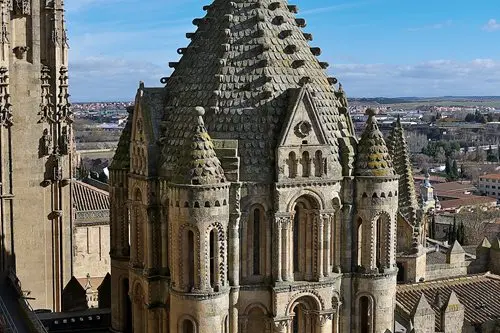
The group of cathedrals of Salamanca comprises the Old Cathedral and the New Cathedral, which share the great bells tower. The Old Cathedral or St María Cathedral is one of the most beautiful in its style. It has a Latin cross plan with three naves that are finished off in both apses, and an amazing dome over the transept that is known as the Torre del Gallo (Cock´ s tower).
Inside, we can see large naves separated by pointed arcades and covered by rib vaults. This structure of columns offers great number of capitals sculpted with marvellous sculptures carried out by several masters. The altarpiece of the Major Altar has one of the most important pictorial works in the town. It was carried out by Nicolás Florentino in 1445, and Jesus Christ and the Virgin´ s life is narrated on it. It is dominated by an image of the Virgen de la Vega in its centre.
The chapel of San Martín keeps Gothic murals of first order in Europe. It is very interesting the former cloister that was redesigned after an earthquake in 1755, with chapels such as the one of Talavera and San Bartolomé.
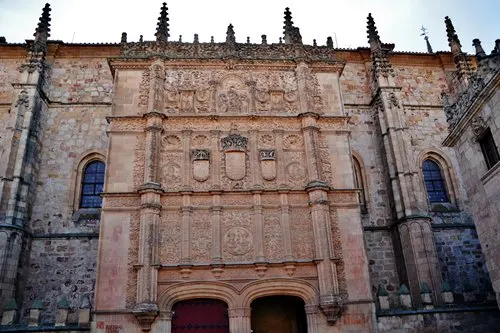
In 1218 the king Alfonso IX de León founded the University as a General School. It is a square building whose façade consists of three superimposed bodies that are separated by their corresponding freizes and crowned by a cresting. They are divided, in a vertical plan, by five bays that are framed between pilasters, and some people consider it as an allegory to the vices and virtues.
In the first body that is worked in half relief we can see the medallion with the Catholic Kings´ images. Over one of the skulls, we can see the representation of a frog, symbol that many people associate with the sin, although according to the student mythology it is linked to the success in studies.
We can find Carlos I´ s coat of arms in the second body.
In the third body, the figure of a Pope, maybe Benedicto XIII or Martín V´ s, and Venus and Hercules´ s images appear between medallions.
It seems that the façade is a huge and rich tapestry. Juan de Troyes, the master Egidio or Juan de Álava should be highlighted among its authors. The library has around 400 incunables from the XV Century, and a great number of volumes and manuscripts.
It appears enclosed by beautiful iron railings from the XVI Century.