Cookie settings
We use our own and third-party cookies in order to offer our services, display videos, obtain statistics and offer personalized advertising.
For more information, please read our cookies policy.
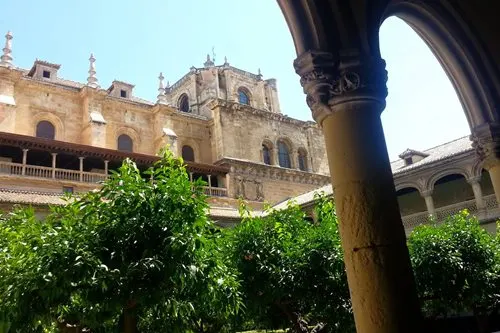
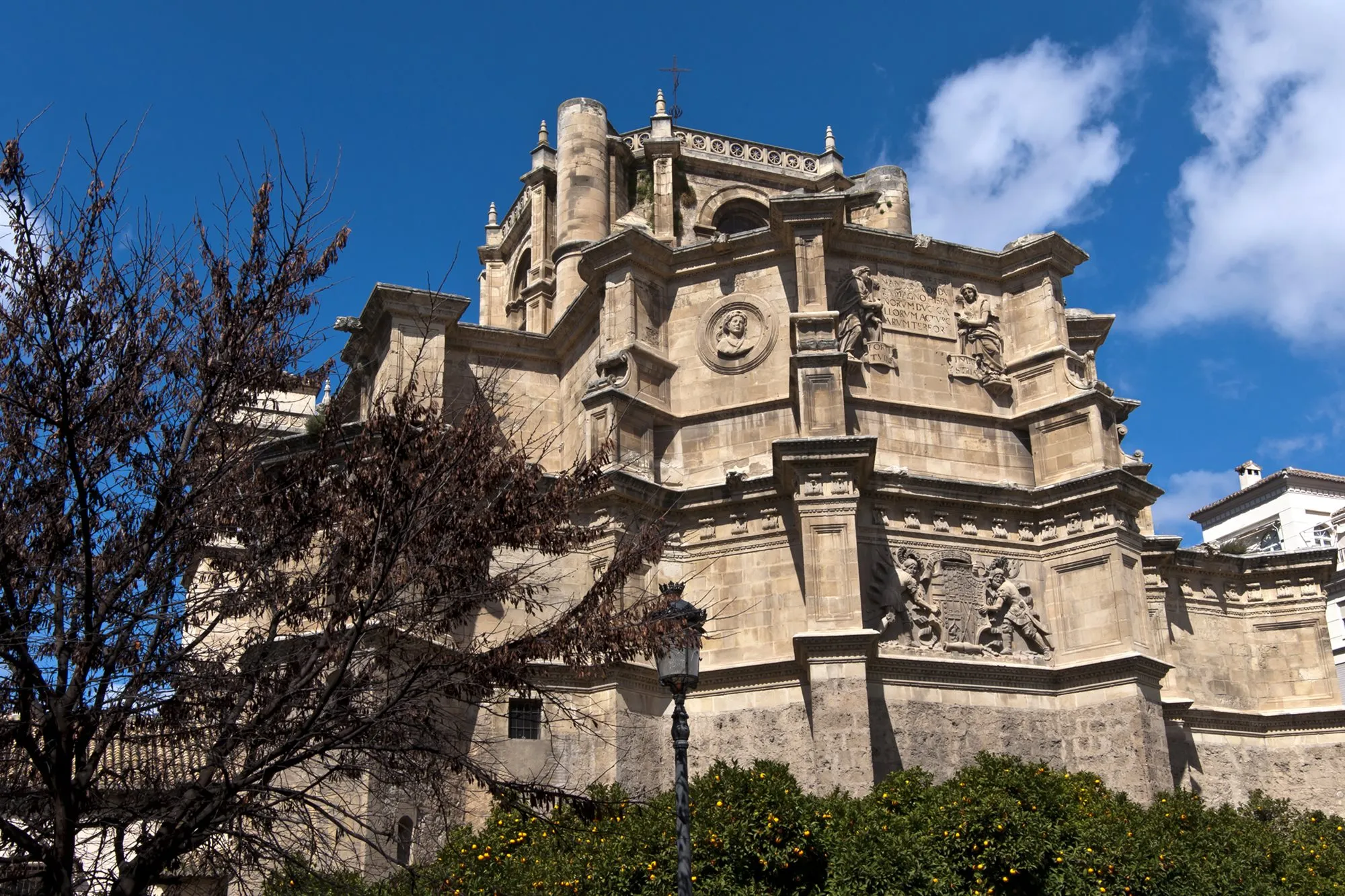
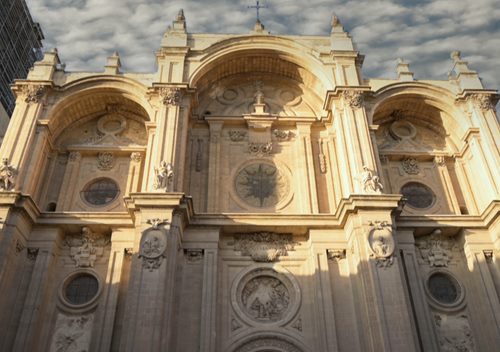
The Royal Monastery of St Jerome was founded by the Catholic Kings in 1492. It consists of a church, two cloisters with gardens decorated with fountains and orange trees, and several rooms. The façade and the tower belong to the first Renaissance.
It has a Latin cross plan with only one nave covered by Gothic vaults and side chapels. The transept and the Major chapel were carried out by Jacopo Florentino. Renaissance and Mannerist characteristics are reflected in the altarpiece of the Major Altar, from 1570- 1605.
It spreads out from the front of the apse to the vault and consists of four bodies built over an attic that flaunts several valuable sculptures, relieves and sculptures “in the round” that represents scenes related to Christ´ s life.
On its sides there are sculptures in kneeling position by Gonzalo Fernández de Córcova, known as the Great Captain, whose burial place is the crypt as well as his wife´ s, Doña María Manrique. The sculpture group of the Christ´ s funeral, by Florentino is amazing. The beauty of its courtyards and gardens, as well as its cloisters should be highlighted.
Built: XVI Century (1496- 1543)
Author: Enrique Egas, Jácopo Florentino, Diego de Siloé
Style: Gothic, Renaissance
Category: Religious
Type: Monastery

Two key monuments of the Granada’s History after its conquest by the Catholic Kings are without doubt the Monastery of the Cartuja and the San Jerónimo’s one. The first monastery is one of the best examples of the Spanish and Andalusian baroque architecture, which preserve inside paintings from featured artist like Juan Sánchez Cotán.
The Monastery of San Jeronimo is highlighted jewel from Spanish Renaissance. Its main altar is decorated with images of saints, heroes, mythological figures, historical figures and angels in honor of “the Great Captain”, who was buried in the church cruiser. In addition, in one of the cloisters of the Monastery of San Jerónimo resided the wife of Emperor Carlos I, Isabel of Portugal.
All of this and much more you’ll get to know in this private tour along with an official tour guide and in a private group.

Address and telephone
Opening times
Summer:
Winter:
Special schedule changes for Easter or other holidays: Please check the monument's official website.
Prices
General entrance ticket: 4 €.
If you see any mistakes or want to add anything to this information, please contact us.
Two key monuments of the Granada’s History after its conquest by the Catholic Kings are without doubt the Monastery of the Cartuja and the San Jerónimo’s one. The first monastery is one of the best examples of the Spanish and Andalusian baroque architecture, which preserve inside paintings from featured artist like Juan Sánchez Cotán.
The Monastery of San Jeronimo is highlighted jewel from Spanish Renaissance. Its main altar is decorated with images of saints, heroes, mythological figures, historical figures and angels in honor of “the Great Captain”, who was buried in the church cruiser. In addition, in one of the cloisters of the Monastery of San Jerónimo resided the wife of Emperor Carlos I, Isabel of Portugal.
All of this and much more you’ll get to know in this private tour along with an official tour guide and in a private group.
4 reviews
Would you like to know truly Granada?
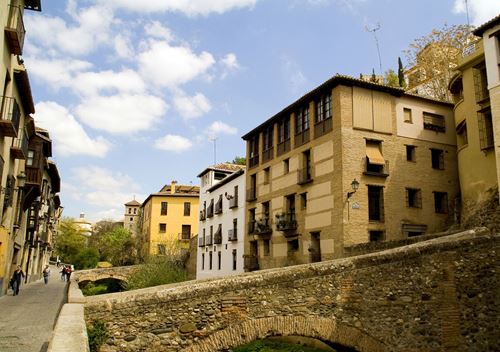
In this walking tour: Albayzin and Sacromonte we will take a walk through the Granada's Historical districts. We will discover the Granada's history and the artistic details of its buildings.
Don't join us?
Can you imagine walking through Granada with a guide just for you and choosing your preference route?
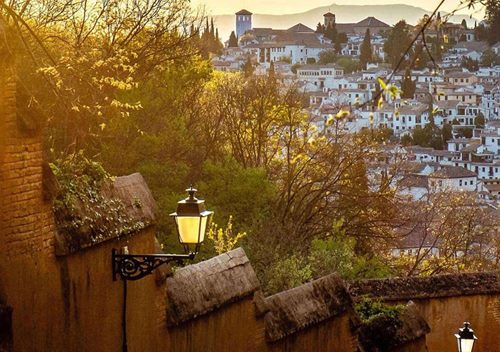
Well, it is possible with these private routes. You can choose between the Historic Center and Albayzín, Albayzín and Sacromonte, or just one of these last two historic neighborhoods declared a World Heritage Site. For more than two hours you will enjoy an exclusive guided tour just for you and yours.
For your next visit to Granada, don't hesitate and book your private route.
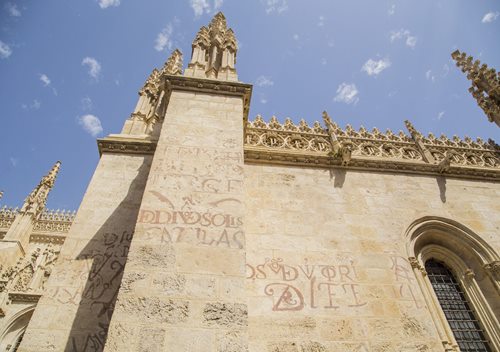
There are two monuments, which are the most visited after the Alhambra, essential to truly understand Granada: the Cathedral and the Royal Chapel. They are a symbol of the history and transformation of the city and Spain after the conquest of Granada by the Catholic Monarchs.
Don't miss out on discovering all their details and book your guided tour. You will visit both buildings and the historic center with a guide who will explain how Granada changed between the 15th and 16th centuries.
You will learn anecdotes you never imagined. Additionally, tickets are included in the price.
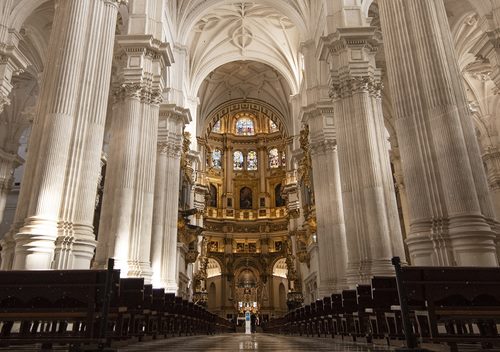
Step into two of Granada’s most iconic landmarks: the Renaissance Cathedral and the Royal Chapel, resting place of Queen Isabella and King Ferdinand.
Discover stunning art, historic architecture, and the legacy of Spain’s Catholic Monarchs. Uncover fascinating stories behind these sacred sites that shaped Spanish history.
Experience the grandeur and cultural heritage at the heart of Granada. Book your tour today and immerse yourself in the city’s religious and artistic treasures.
Skip the lines on this private tour of Granada Cathedral and the Royal Chapel with an expert guide.
Discover the beauty of Renaissance architecture and explore the artistic treasures inside.
Visit the tombs of Isabella I of Castile and Ferdinand II of Aragon, the Catholic Monarchs.
Learn the fascinating stories behind these iconic landmarks and their role in Spain’s history.
Enjoy a personalized experience at your own pace, fully immersing yourself in Granada’s religious and cultural heritage.
33 reviews
This Free Tour is ideal to discover the most emblematic places of the Granada city centre.
You will visit places as outstanding as Plaza Nueva, the Royal Chapel, the Cathedral, Alcaicería, or the Albaicín Bajo.
Do not pay anything now and put the price at the end of the route.

12 reviews
A perfect free tour to understand how changed Granada at the end of 15th Century after Catholic Kings conquest is walking through the historical neighbourhoods. A tour guide will carry to you to stroll the labyrinth and stoned streets of the Albaicin and the picturesque gypsy Sacromonte. Both neighbourhoods are declared World Heritage by UNESCO.
You'll fall in love of Granada and its leyends from the best Alhambra viewpoints.


4 reviews
Would you like to know truly Granada?
In this walking tour: Albayzin and Sacromonte we will take a walk through the Granada's Historical districts. We will discover the Granada's history and the artistic details of its buildings.
Don't join us?
Can you imagine walking through Granada with a guide just for you and choosing your preference route?
Well, it is possible with these private routes. You can choose between the Historic Center and Albayzín, Albayzín and Sacromonte, or just one of these last two historic neighborhoods declared a World Heritage Site. For more than two hours you will enjoy an exclusive guided tour just for you and yours.
For your next visit to Granada, don't hesitate and book your private route.
There are two monuments, which are the most visited after the Alhambra, essential to truly understand Granada: the Cathedral and the Royal Chapel. They are a symbol of the history and transformation of the city and Spain after the conquest of Granada by the Catholic Monarchs.
Don't miss out on discovering all their details and book your guided tour. You will visit both buildings and the historic center with a guide who will explain how Granada changed between the 15th and 16th centuries.
You will learn anecdotes you never imagined. Additionally, tickets are included in the price.
Step into two of Granada’s most iconic landmarks: the Renaissance Cathedral and the Royal Chapel, resting place of Queen Isabella and King Ferdinand.
Discover stunning art, historic architecture, and the legacy of Spain’s Catholic Monarchs. Uncover fascinating stories behind these sacred sites that shaped Spanish history.
Experience the grandeur and cultural heritage at the heart of Granada. Book your tour today and immerse yourself in the city’s religious and artistic treasures.
Skip the lines on this private tour of Granada Cathedral and the Royal Chapel with an expert guide.
Discover the beauty of Renaissance architecture and explore the artistic treasures inside.
Visit the tombs of Isabella I of Castile and Ferdinand II of Aragon, the Catholic Monarchs.
Learn the fascinating stories behind these iconic landmarks and their role in Spain’s history.
Enjoy a personalized experience at your own pace, fully immersing yourself in Granada’s religious and cultural heritage.
33 reviews
This Free Tour is ideal to discover the most emblematic places of the Granada city centre.
You will visit places as outstanding as Plaza Nueva, the Royal Chapel, the Cathedral, Alcaicería, or the Albaicín Bajo.
Do not pay anything now and put the price at the end of the route.
12 reviews
A perfect free tour to understand how changed Granada at the end of 15th Century after Catholic Kings conquest is walking through the historical neighbourhoods. A tour guide will carry to you to stroll the labyrinth and stoned streets of the Albaicin and the picturesque gypsy Sacromonte. Both neighbourhoods are declared World Heritage by UNESCO.
You'll fall in love of Granada and its leyends from the best Alhambra viewpoints.
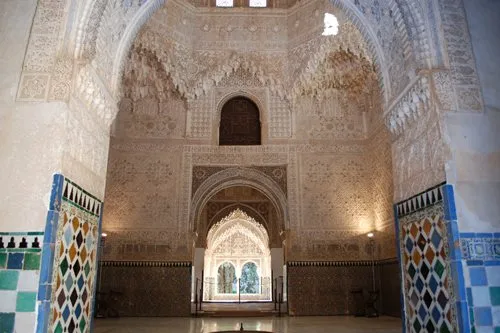
The monumental complex of the Alhambra and the Generalife is considered nowadays as one of the most beautiful and meaningful cultural landscape in the world.
The Alhambra is a real Palace City of the Nasrid dynasty that is perfectly harmonized with its gardens and fountains, distributed along the complex.
It is surrounded by forests, gardens, orchards and fountains. Its exceptional decoration involves visitors in an ethereal environment of fantasy nearly magical.
Moreover, it consists of important buildings from different times, such as the Palace of Carlos V (Palacio de Carlos V) which is considered as a jewel of the Renaissance and that was added in the XVI Century. In this Palace is located the Museum of the Alhambra, with objects that come from said monument, and the Museum of Fine Arts.
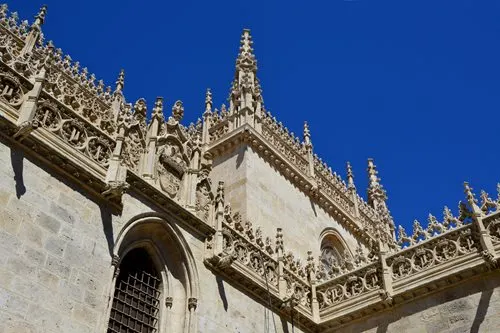
The Royal Chapel is located inside the Cathedral, over the place of the former Major Mosque.
It was built in several stages, mixing different styles such as Gothic, Renaissance and Baroque. It is rectangular and its apse is polygonal. The Major Chapel is located in an upper level. It is one of the last ogive temples built in Spain.
It is crowned with a fretwork balustrade and seigniorial windows. It façade is in Plateresque style. Inside, the chapel has a Latin croos plan. In the side chapels there is an excellent representation of Granada pictorial and sculptural art. The transept is closed by a beautiful golden grille carried out by Bartolomé de Jaén and others by Felipe de Borgoña.
In the middle of the transept, we can find the Royal sepulchres of the Catholic Kings, by the sculptor Domenico Fancelli, that have been sculpted with marble from Carrara, and Doña Juana la Loca and Don Felipe el Hermoso´ s sepulchres, a posthumous work by Bartolomé Ordoñez (1520).
Under the sepulchres we can find the Crypt, a Royal burial place until they were moved to the Pantheon of the Escorial. The façade of the sacristy seems to be a Jacobo Florentino´ s work, which houses a small museum with objects that belonged to the Catholic Kings, such as the crown and the Queen Isabel´ s sceptre, King Don Fernando´ s sword, highlighting the private collection of Flemish boards that the Queen Isabel donated to the Chapel.
It is also important the beautiful altarpiece created by Felipe Vigarny that represents the theme of the conquest of Granada, the marvelous set of chairs of the choir and the Plateresque balustrade.
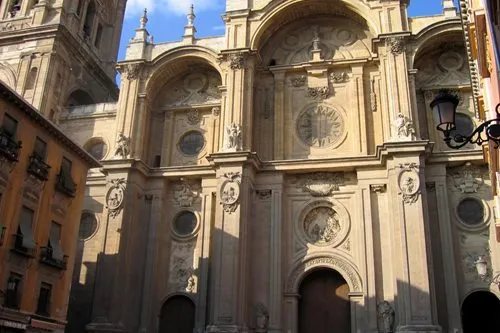
This construction was based on the Gothic model of the Toledo Cathedral, and was designed by Enrique Egas. In 1529, it was entrusted to the architect Diego de Siloé who designed a new design for the temple based on the Spanish Renaissance style and joining the circular floor with the basilical one which supposed the recognition of the architects of that time.
It has five naves that separated by 20 huge pillars with Classic columns and an ambulatory whose stained- glass windows are Flemish, by Teodoro de Holanda and Juan Campen. The amazing Baroque façade was designed by Alonso Cano and belongs to 1667. It was understood as a monumental Triumphal arch with coffered ceilings and three bays are moved between pilasters, giving intense luminous contrasts to the complex. Siloé firstly planned to build two high towers: one of them was not carried out and the other one only reached 7 meters high of 81 meters as understood.
Inside the temple, la Major Chapel, Siloé´ s masterpiece, is rounded and very high and is supported by 12 thick Corinthian pillars. Here, we can find the Catholic Kings in kneeling position, sculpted by Pedro Mena and Madrazo. The main eaves board of the sacristy is taken up by a great Crucified Christ, by Martinez Montanez. In a low shop window, we can see a small Immaculate Virgin, by Alonso Cano. The lectern is very ornamented and was carried out by Alonso Cano. We should highlight the Virgen del Pilar, Nuestra Señora de la Antigua and de la Trinidad. Close to the Cathedral we can find the Iglesia del Sagrario (Church of the Tabernacle) in a Neoclassic style, with a high dome from the Renaissance, built by Hurtado Izquierdo (1705- 1759).
In the Museum of the Cathedral we can see masterpieces of painters such as Bocanegra, Risueño, Sánchez-Cotán, Raxis, Cieza, Alonso, Pacheco and sculptures of Alonso, Pedro de Mena and Pablo Pacheco.
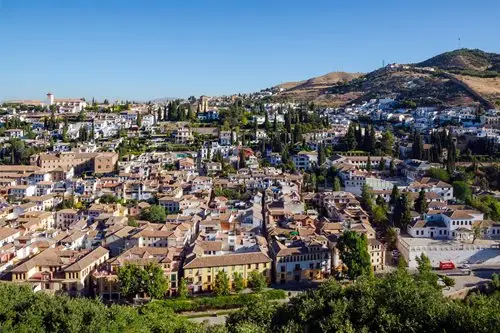
It takes up the whole hill that forms the Western part of the Cerro de San Miguel (St. Michael´ s hill) and the Southern part of the Cerro de San Cristóbal (St Christopher´ s hill).
When the Christian conquered the city of Baeza in the North of Andalusia, at the beginning of the XIII Century, the inhabitants run away to the South, settling down in the outskirts of the fortress of Granada. They called this new quarter al-Bayazzin, “place for the people from Baeza”.
However, after some time, the rest of the hill – the “old fortress”, whose name in Arab was “Alcazaba Kadima”- also took the name of “Albaicin”. It has seductive charms that make it the most attractive and evocative quarter of Granada: the peculiar distribution of its houses placed over hills in irregular levels and its rough ground; its tortuous and narrow streets, with steep slopes that keep their primitive medieval urban planning; the abundance of green spaces and white houses with the typical interior gardens known as Carmenes.
Two beautiful viewpoints should be highlighted: the Mirador de San Nicolás and the Mirador de San Miguel, with beautiful sights to the Alhambra and the lower part of the city.