Cookie settings
We use our own and third-party cookies in order to offer our services, display videos, obtain statistics and offer personalized advertising.
For more information, please read our cookies policy.
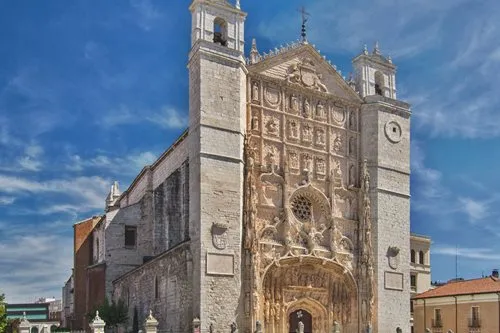
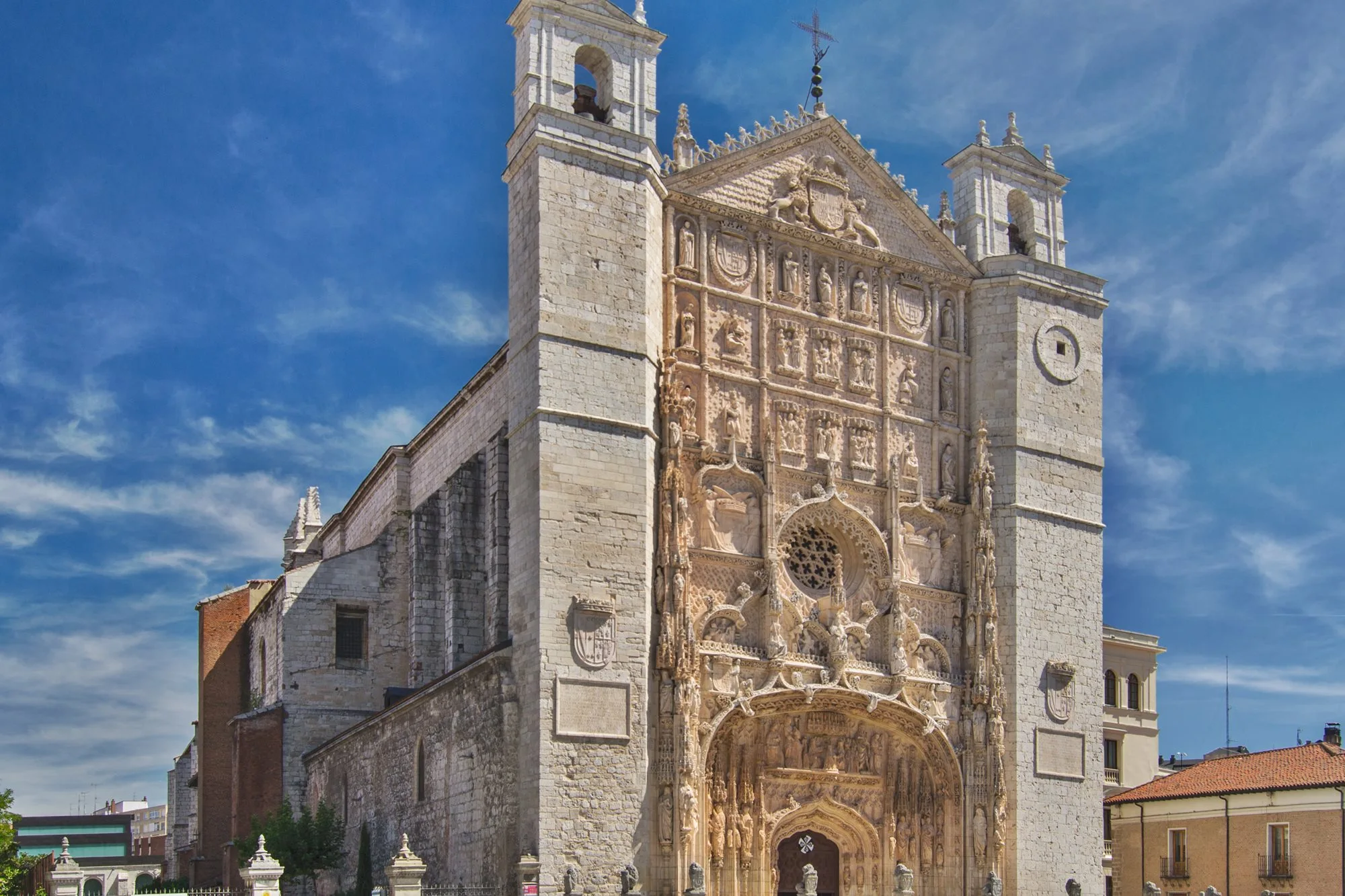
This is the church of an old Dominican convent that was founded in 1276 by Alfonso X´ s wife, Mrs Violante. The Cardinal Juan de Torquemada ordered its construction, and later, it was reformed by the Duke of Lerma.
It is a one nave church with an elongated transept and five chapels that lie between the buttresses.
The facade is framed by two small towers- pinnacle with vaulted niches and sculptures. It can be included into the group of altarpiece type and was carried out by Simón de Colonia. It belongs to the later Gothic style and is very adorned. It is divided into two parts: the first one has Spanish- Flemish influences and the second one has a more classicist influence. It is finished off with a pediment decorated with Renaissance motifs. There is a coat of arms of the Catholic Kings on a scale- shaped background.
The Sacristy has a fantastic star-shaped vault that is decorated with coats of arms of the Dominican order and with images of the Dominican Saints. The Major Chapel is the burial place of the Duke of Lerma. We can find the Cristo Yacente by Gregorio Fernández and the statues of St Catalina de Siena, St. Teresa, St. Pedro Mártir and St Vicente Ferrer in one of its chapels.
Built: 1445-1616.
Author: Juan Guas, Simón de Colonia, Francisco de Mora
Style: Plateresque, Renaissance, Spanish Renaissance
Category: Religious
Type: Church
Address and telephone
Opening times
Prices
Free Entry
If you see any mistakes or want to add anything to this information, please contact us.
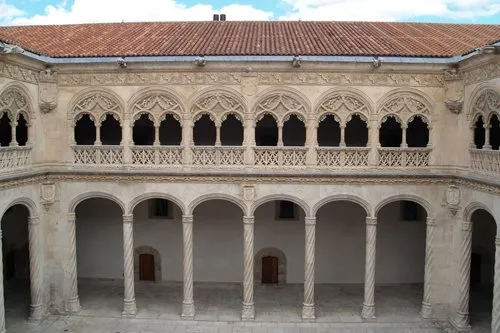
The National Sculpture Museum is established since 1993 in the former Colegio de San Gregorio, built at the end of the XV Century, which is one of the best examples of the known Spanish- Flemish Gothic style in our country. Three buildings will be added to this building (Villena Palace, Casa del Sol and San Benito el Viejo church), which will supposed to multiply the area by three.
It houses a Spanish sculpture collection from the Middle Ages to the XIX Century. The primitive nucleus of the collections belongs to the disentailed convents of Valladolid and its surroundings. We can see the Spanish- Flemish Gothic style, the first Mannerism represented by Alonso Berruguete and Juan de Juni, and the Baroque style from the XVII with important samples of authors from the Castilian artistic centres (Gregorio Fernández) and the Andalusian artists (Martínez Montañés, Alonso Cano...).
The first Renaissance is shown through works by Felipe Vigarny and Diego de Siloe in contrast with works, in Mannerist style, by Alonso Berruguete and his followers. The Last Mannerism is represented in its two styles: “Romanism” (Esteban Jordán) and “Courtly style” (Pompeo Leoni), complete the century version.
The works exhibited on the second floor define the characteristics of the Baroque sculpture from the XVIII Century and its development in the different peninsular artistic centres. Finally the route is completed by the bulls and bullfighters´ collection, altarpieces, sepulchres and the marvellous Neapolitan Nativity scene.
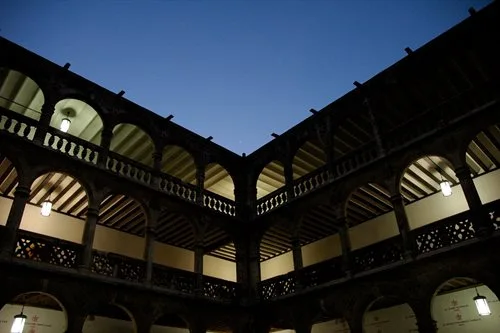
The Palacio de Santa Cruz in Valladolid is considered the first example of Renaissance art outside Italy. Formerly the headquarters of the Colegio Mayor Santa Cruz, it is currently the seat of the Rectorate of the University of Valladolid, the University of Valladolid Museum, and the Arellano Alonso African Art Museum.
The construction of the Palace was carried out thanks to the interest of Cardinal Pedro González de Mendoza. The works began in 1468 and concluded around 1491. Although initially intended as a Gothic building, despite having quite a few doubts about its authorship, everything seems to indicate that it was Lorenzo Vázquez de Segovia, who at least was responsible for the change of initially projected style.
During the 17th and 18th centuries, the building underwent an expansion process. A series of spaces were also transformed, such as the main façade. In the 20th century, it underwent significant restoration after being abandoned since 1838. Its spaciousness has allowed it to house both the museum and the Rectorate of the University of Valladolid. It is also the place where the Arellano Alonso African Art Museum is located. It also has a library that houses collections of great historical value for the city and the UVA.
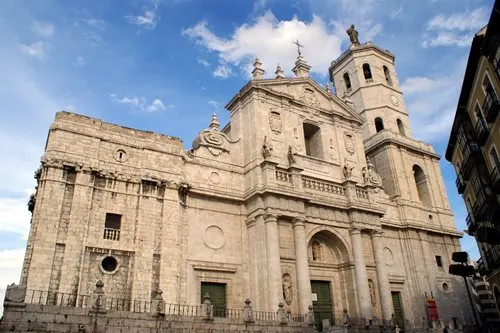
This temple was built on the ruins of the former Collegiate church from the XI Century.
It is a wide building with three naves and three apses. The façade presents two bodies in Doric Order. A Century later, Churriguera created an upper façade in Baroque style. The tower was rebuilt because of a collapse in 1841 and is crowned by a statue of the Holy Heart and has 12 meters height. It was carried out by R. Núñez.
The interior is of great sobriety and grandeur. The major chapel housed the choir of the cathedral and the set of chairs of the choir of the collegiate church. It is a splendid Gothic work that had to be adapted to the continuous moves that it suffered. Perhaps its most important element is the major altarpiece by the sculptor Juan de Juni.
In the major altar there is the Assumption by Zacarías Velázquez. In the sacristy there is a beautiful silver monstrance that could consider as a Juan de Arfe´ s masterpiece. In the archive we can see the scale model and projects that Herrera carried out in this cathedral.
Book your hotel