Cookie settings
We use our own and third-party cookies in order to offer our services, display videos, obtain statistics and offer personalized advertising.
For more information, please read our cookies policy.
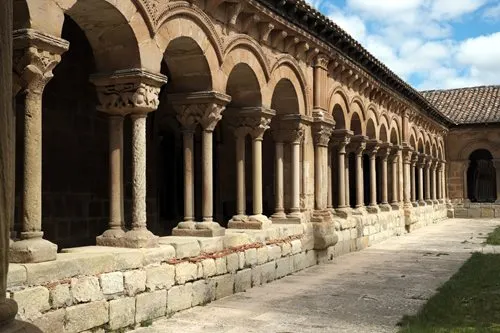
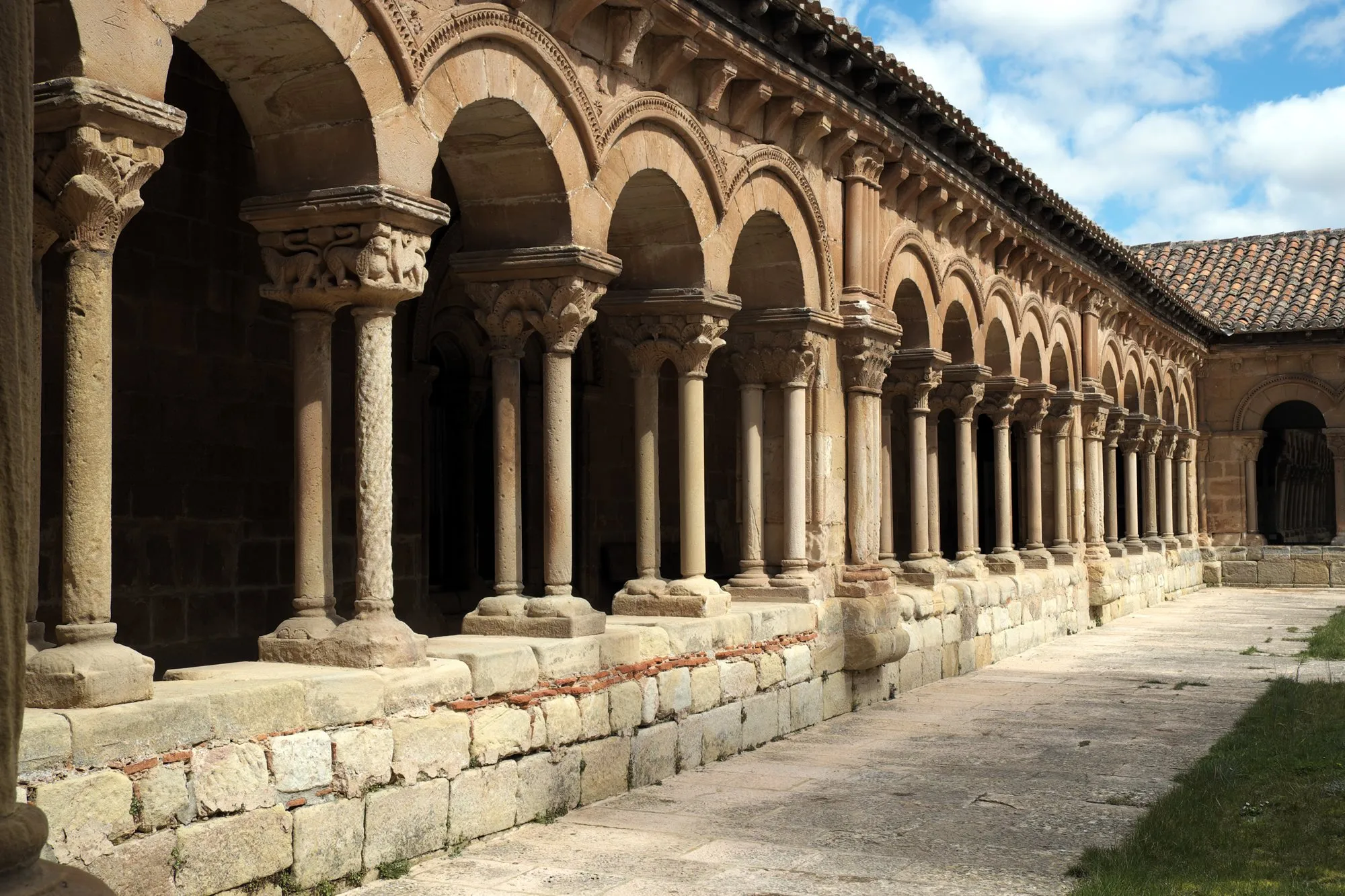
This Cathedral was built on the ruins of an old Romanesque church. The current construction comes from the XVI Century. Its marvellous cloister from the XII Century, part of the apse, the door and the windows of the Chapter House and the cloister have arrived to our days.
The Church had a Basilical structure, with three naves of the same height that were covered by star- shaped vaults.
The Southern façade is Plateresque, with a round arch with archivolts and a high freize, where is placed St. Pedro´ s sculpture. It is decorated with rich grotesque motifs.
The altarpiece placed in the Epístola nave is also Plateresque and is a Francisco del Río´ s work.
Together with the altarpiece, the major altar is also important.
In the current chapel of St Saturio is kept the best painting in Soria, a triptych of Flemish influence that was ordered by the marquis of Lozoya to Correa de Viva.
As result, we have a church with Basilical structure with five naves, covered by star- shaped rib vaults that are leaned on cylindrical columns. San Pedro collegiate church became cathedral in 1959.
Built: XVI Century (1520 - 1577).
Author: Anónimo
Style: Renaissance
Category: Religious
Type: Cathedral
Address and telephone
Opening times
Prices
If you see any mistakes or want to add anything to this information, please contact us.
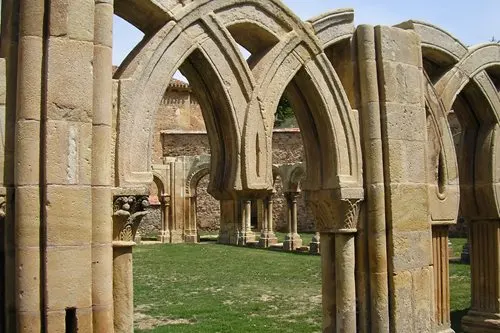
This complex was founded by the Knights Templar in 1134. Two centuries later, the Knights Hospitaller ordered to build the cloister of San Juan de Duero.
one of the most attractive tourist elements in the town of Soria, and a construction that is unique in the European Romanesque: Round arches, horseshoe arches and ogive ends that are supported by pillars decorated with sculpted capitals. It shows a mixture of influences: Romanesque, Mudéjar and the Arab from Amalfi (Italy).
The church has a single nave, chancel and a semicircular apse. We should highlight the two small temples that are attached to the walls in the base of the nave. One of them is crowned by a semi- spherical vault and the other one is crowned by a conical vault. The interior of the cathedral (where there are gravestones, mosaics, etc…) offers side altars that are covered each by ciboria (baldachin that crowns an altar or tabernacle in the primitive Christian temples) and Romanesque capitals.
The temple of the monastery has become the headquarters of the medieval section of the Museum of Numancia.