Cookie settings
We use our own and third-party cookies in order to offer our services, display videos, obtain statistics and offer personalized advertising.
For more information, please read our cookies policy.
It was destroyed by the bombing of 1808. It was built over the former Roman – Christian necropolis that housed the remains of Santa Engracia and of other eighteen martyrs from the III and IV Centuries and it was the place where the two Paleochristian marble sarcophaguses from the IV Century were found and that today are kept in the crypt.
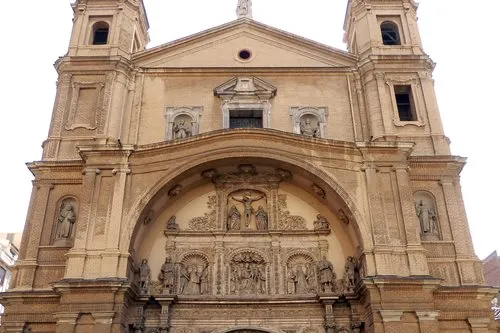
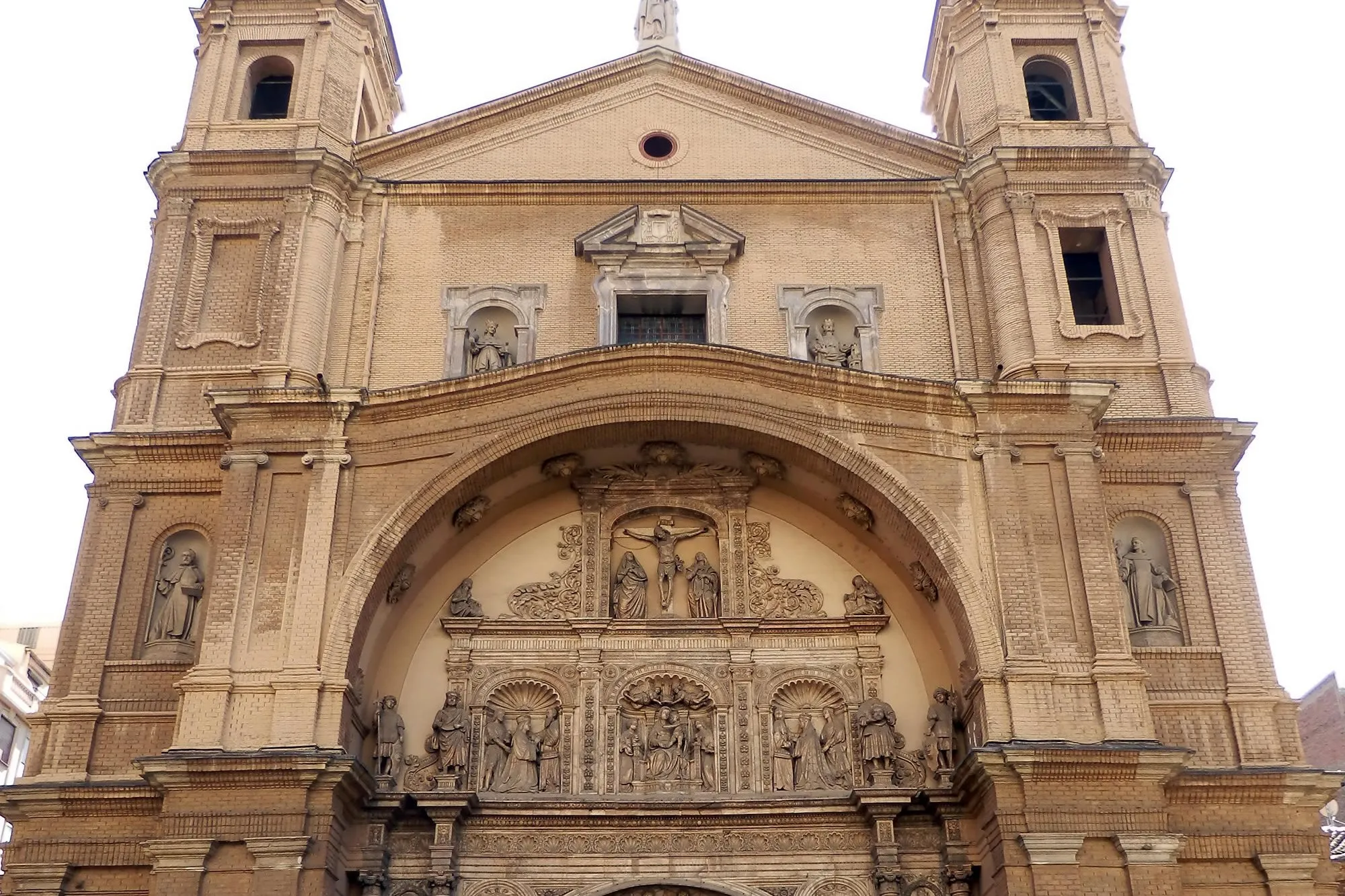
The Monastery Jerónimo de Santa Engracia was founded by Juan II de Aragón. From the old temple only the Plateresque façade has survived. It is a façade- altarpiece that reflects the royal sponsorship of the monastery and its origin of martyrdom. The image of Santa Engracia – today missing- dominated the entrance from the mullion of the door.
The royal patronage is reflected in the coats of arms that are located in the hairnet of the arch of access and the images of the Catholic Kings in kneeling position, Fernando and Isabel, accompanied by San Juan Bautista and Santa Catalina de Alejandría, as well as by the founders of the Order, San Jerónimo y Santa Paula, flanking the Virgin enthroned in the centre.
The Calvary crowns the group with the Faith and the Hope on both sides.
Built: XVI Century (1512)
Author: Gil Morlanes el Joven
Style: Renaissance
Category: Religious
Type: Church
Address and telephone
Opening times
Prices
Free entry.
If you see any mistakes or want to add anything to this information, please contact us.

It was built as a leisure residence of the Taifas Kings, under the rule of the king al-Muqtadir. It conserves part of its primitive fortified precincts.
Later, it was reformed by the Christian Kings and most of it reformation was carried out by Fernando el Católico becoming a Christian alcazar of royal ownership. The palace has a great rectangular courtyard, with reservoirs on both ends next to two side porticoes with Late Gothic and polilobed arcades.
The exterior towers are rounded except for the Troubadour Tower that should be highlighted because of its height and rectangular floor, of great dimensions and organized in several floors. In the Northern portico, there is a small oratory of octagonal floor, with the mihrab in one of its sides decorated with atauriques (Islamic decoration based on vegetal motives).
From Christian times, it conserves a staircase of honour, several rooms decorated with sober coffered ceilings, and especially the Throne Room, that could be placed among the best works of this kind.
Nowadays, this palace is the headquarters of the Regional Parliament of the Autonomous Community of Aragon.
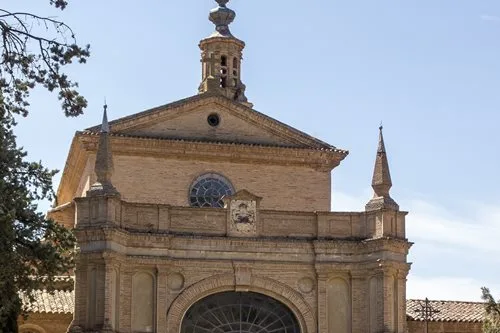
It was founded in 1564 by Don Hernando de Aragón, Fernando III de Aragon el Católico´ s brother. It has a Latin cross plan with only one nave that is divided into three bays, with a small enlargement like most of the transept of the Aragon churches, and a total length of 43.60 meters.
The plaster façade shows the scene of the Holy Assumption, designed in Baroque style, in a very typical style in Aragon from the end of the XVII Century. This work has been attributed to Ramírez de Arellano.
It is covered by a star- shape rib vault which is richly decorated with golden wood keystones that show the coat of arms of the founder.
The altarpiece of the church was built between 1755 and 1765 and is divided into three bodies, The chapel of the Agnus Dei, located behind the chancel, covered by a barrel vault, has a decoration based on paintings that are allegoric to the celestial and Eucharistic vision.
This church would be decorated by Goya in 1774, creating a season of 11 oils on linen from which only seven of them have survived, because the church was abandoned during the Spanish War of Independence and the subsequent Ecclesiastical Confiscation.

It is the first Christian Cathedral of Zaragoza. It is dedicated to St Salvador. It was built on the ruins of the roman forum temple, the Visigothic church and the Muslim Major Mosque.
The bishop Pedro Torroja starts the Cathedral in a Romanesque style, with three naves, transept and three semicircular apses. Between the XIV and the XV Century starts the construction of the current Gothic Cathedral, so a new central nave and two side naves are added. Its Baroque tower was built by Contini in 1686. The base dome, from the end of the XV Century, is a Juan Botero´ s work of art and is a star of eight points. In the middle of the XVI Century, the pillars and the vaults are reformed.
Inside, the Major Altar has a fabulous altarpiece by Meter Johan, with several sepulchres of Martyrs, archbishops and princes. The choir is closed by railings, with an artistic set of chairs in carved oak by Navarro. We should highlight the Plateresque Chapel of Zaporta and the Baroque Chapel of St Agustín as well as St. Valero´s among the chapels.
The Chapel of St. Bernardo has a great alabaster altarpiece. In the Chapter House there are great paintings of Ribera, Zurbarán and Goya. There is an excellent museum in the Sacristy, with masterpieces and especially with a Gothic and Renaissance Flemish tapestry collection.
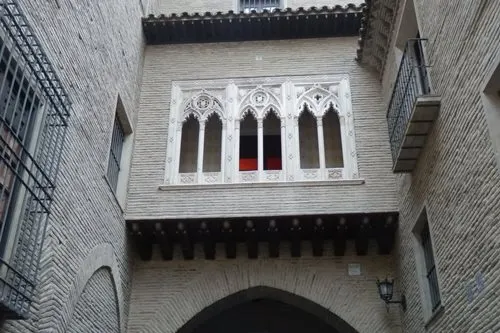
It is one of the most emblematic places of the town. It comes from the XIII Century, when it was planned to build a building that could connect the cathedral with the new dean´ s house, who was the president of the chapter with a rank lower than the prelate.
The current arch, very restored, has the form carried out in the XIV Century, and the windowed balcony is its most eye- catching element, with windows with Gothic Mudejar tracery.
Nowadays, it is ownership of a financial organization and after its restoration it has become a museum and a residence for distinguished visitors.
Book your hotel