Cookie settings
We use our own and third-party cookies in order to offer our services, display videos, obtain statistics and offer personalized advertising.
For more information, please read our cookies policy.
This monastery is originally Visigothic. It was devastated by the Arabs and was rebuilt by St. Domingo, whose burial place is a sepulchre that was excavated in the stone. It is directed by Benedictine Monks that celebrate Gregorian masses.
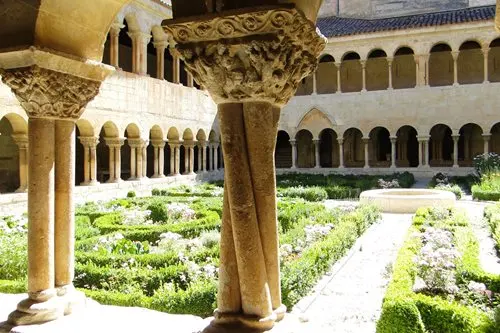
Its Romanesque cloister, whose lower floor is the most important one, comes from the XI and XII Centuries, and it has beautiful capitals sculpted with a wide range of motifs over double columns. Round arches are leaned on capitals that, at the same time, are leaned on double shaft columns. In the lower cloister we can distinguish two phases of construction: during the first phase the Northern and Eastern galleries were built
The second one was developed during the following century when the Southern and Western galleries were built. We should highlight the 64 capitals collection of this cloister and the relieves that decorate the internal faces of the four pilasters that form the angles of the gallery. Six of the relieves with the scenes of La Ascensión and Pentecostés, El sepulcro and El descendimiento, Los discípulos de Emaús and La duda de Santo Tomás would be assigned to the first master. The second master would be the author of the rest of the relieves: La anunciación a María and El árbol de Jesse. The capitals, and specially the second artist´ s, are masterpieces of the Romanesque iconography and the most admirable and eye- catching element of the whole cloister.
In the XVIII the Romanesque church was destroyed and rebuilt by the architect Ventura Rodríguez in Neoclassic style. It also has an excellent library and a pharmacy from the XVIII Century that has a collection of pots from Talavera and a pharmaceutical laboratory.
Built: XI Century
Author: Anónimo
Style: Romanesque
Category: Religious
Type: Monastery
Address and telephone
Opening times
Reopening from 1st July 2020:
Prices
Services
Guided Tours.If you see any mistakes or want to add anything to this information, please contact us.