Cookie settings
We use our own and third-party cookies in order to offer our services, display videos, obtain statistics and offer personalized advertising.
For more information, please read our cookies policy.
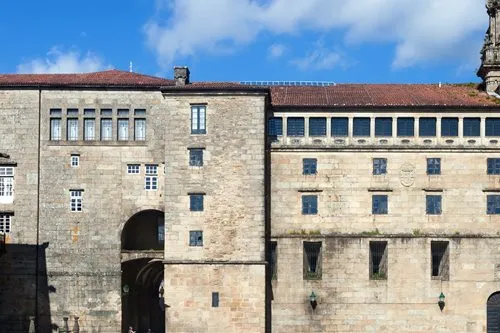
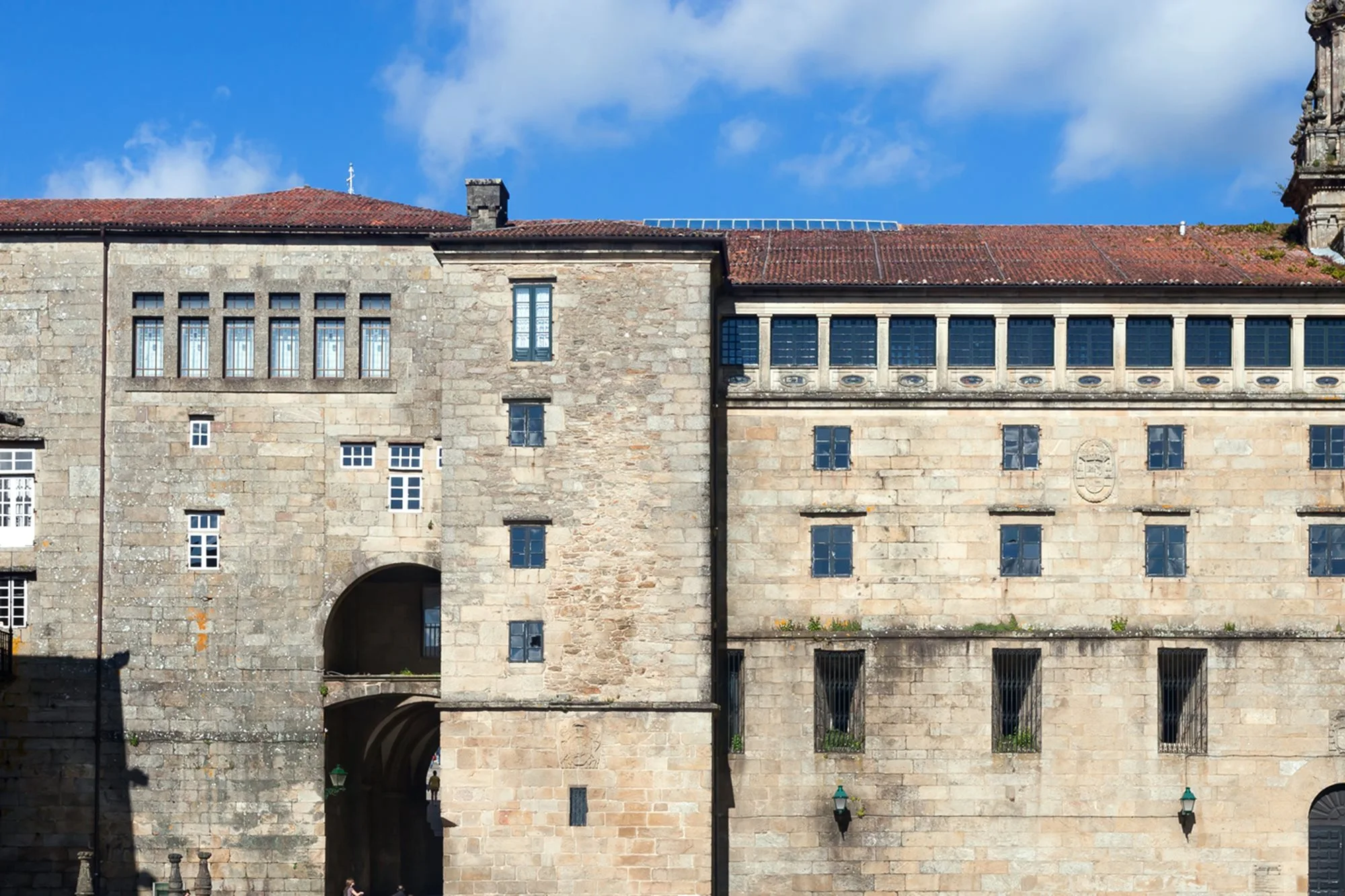
It was built after the riots that ruined the old Archbishop Palace.
In this building, we should highlight its rib vaults that cover a wide space with the only support of the Palace Arch. Among them, we should highlight the fantastic granite creation in arch ribs and details, walls with an interesting sculpture collection very related to San Mateo´ s world because of its Gothic naturalism, perfectly sculpted.
In the XVIII Century, the Romanesque facade was recovered by a Baroque one and the third floor was built. We should highlight the Salón de Armas (Arms Room) and the Salón de Fiestas (Parties Room), with rib vaults and a large Refectory.
Built: XII Century
Author: Anónimo
Style: Romanesque
Category: Civil
Type: Palace
Address
Plaza del Obradoiro, s/n. 15705 Santiago de Compostela (A Coruña)Opening times
Prices
If you see any mistakes or want to add anything to this information, please contact us.
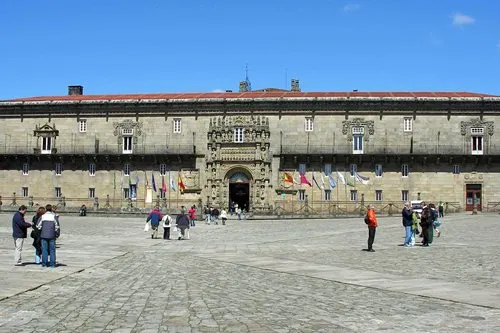
In the XVI Century the Catholic Kings built the Foundation of the Royal Hospital and for it they built the building that nowadays occupies the Hostal de los Reyes Católicos (Catholic kings´ hospital), which became a great luxury hotel (Tourist Hotel).
This building has been built in Plateresque style to which Renaissance elements have subsequently been added. It has a very original floor in which the central part is occupied by the chapel with Latin cross plan flanked by two interior courtyards where the rooms typical of the hospital were located.
Inside it is also grandiose: with four cloisters of great beauty, where we can find a beautiful chapel of Latin Cross plan as well as elegant halls, rooms and a luxurious dinning room.
The dome is decorated in Plateresque style as well as the rib vault of the chapel that was built with lithographic stone from Coimbra.
Outside, there is a huge stone mural, with a Triumphal arch so typical of the Renaissance art decorated with figures that present the place as a hospital where body and soul´ s pain could be cured. The figures of the Catholic Kings also appear in this façade as the promoters of its construction.
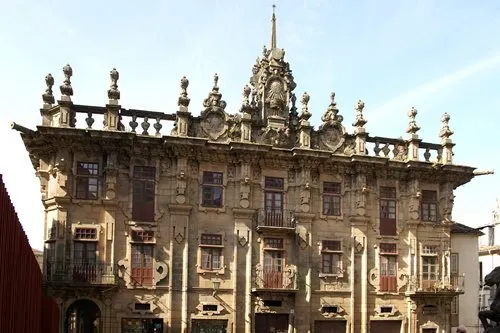
This building was built in order to embellish the town, so its function is decorative and its aim is to close one of the sides of the beautiful Plaza de las Platerías, with its typical Galician Baroque style.
It is located in front of the Cathedral. Its façade is in Compostela style from the XVIII Century. This building inspired Valle- Inclán to write the story “Mi hermana Antonia”.
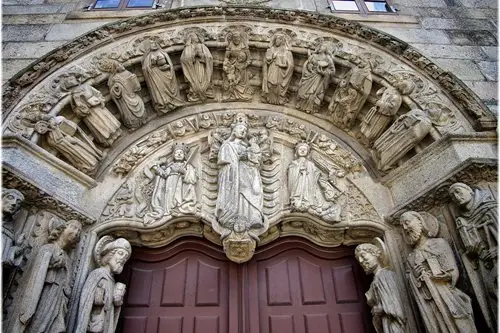
The college is also known as Estudio Vello. It was founded by the archbishop Fonseca in 1501 in order to accommodate poor students. It is located in Plaza del Obradorio. The main façade is in Romanesque- Gothic style. In the centre of the archivolt appears the virgen with Baby Jesús surrounded by Saints, in the tympanum the Inmaculate is represented.
Over the door, we can find the coat of arms of its founder. The college of San Jerónimo was occuping the Hospital Viejo or de Azabachería´ s lands until 1651 and housed the Facultad Menor de Artes (Minor Faculty of Arts).
Nowadays, it is the headquarters of the Deanship of the University of Santiago de Compostela.
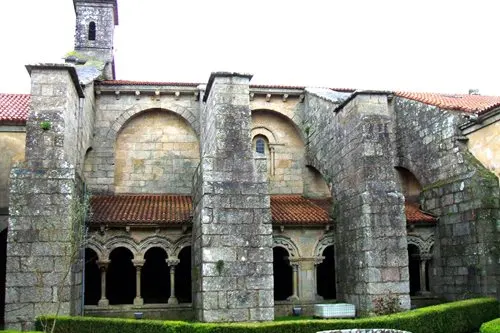
This Collegiate Church was founded in the XII Century, and is located outside the town, next to the river Sar.
It has a basilical structure and three naves divided by pillars decorated with natural motives. Outside, the solid flying buttresses that protect the Northern walls attract the attention of the visitor.
The interior columns are visibly inclined, what grants a peculiar attractive to the place and obliged to rebuild the barrel vault in the XVI.
Inside, we can see that it is a temple of great dimensions that impresses because of its columns lean, given a feeling of instability.
The Master Mateo left his mark in the decoration of the capitals of the cloister.
A collection of archaeological and liturgical pieces is exhibited inside. We should highlight the baptismal font from the XII Century, located on the right of the main entrance.