Cookie settings
We use our own and third-party cookies in order to offer our services, display videos, obtain statistics and offer personalized advertising.
For more information, please read our cookies policy.
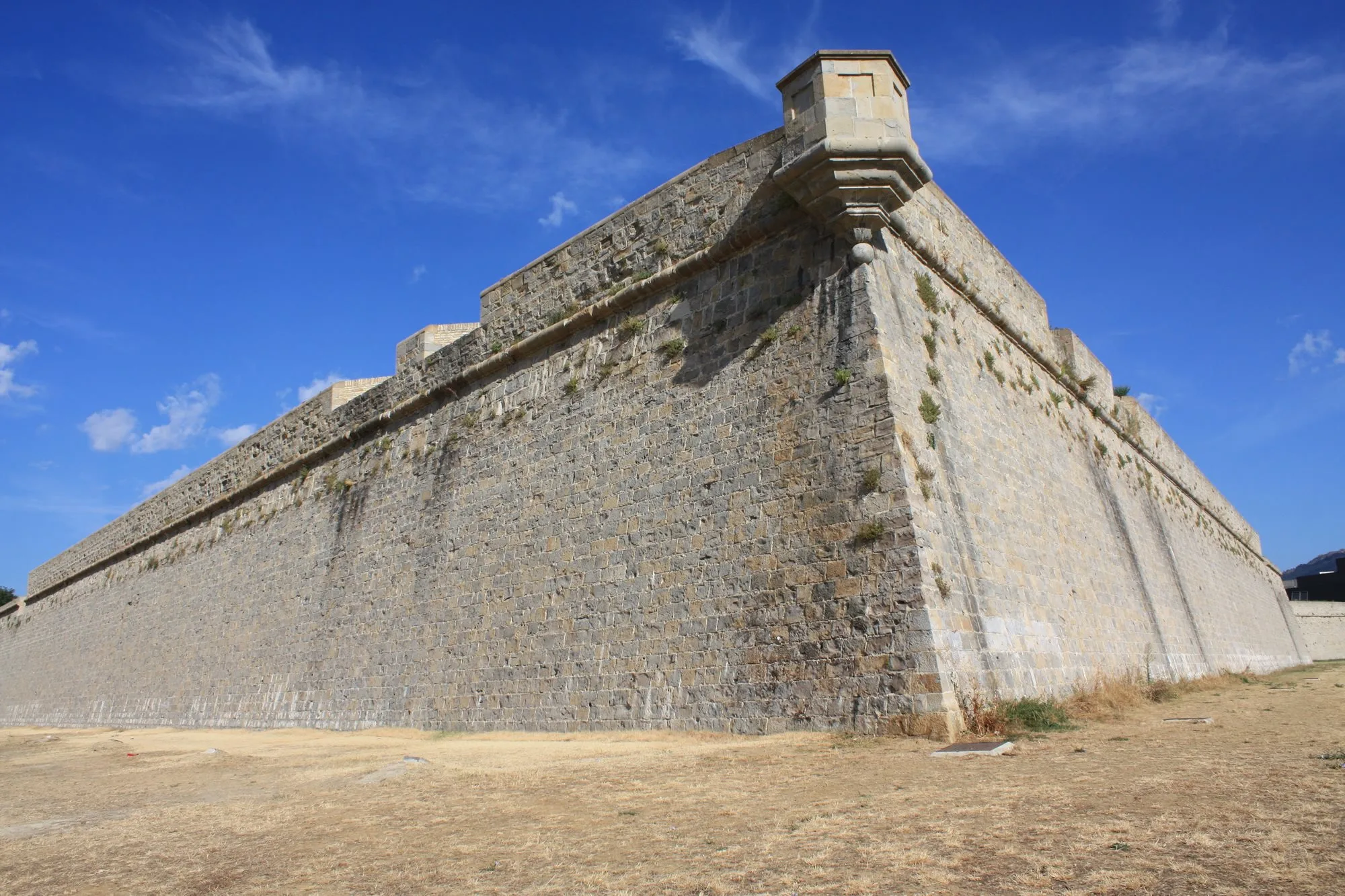
It is the best example of military architecture from the Spanish Renaissance.
It was built during Felipe II´ s reign in order to face the French army, replacing Fernando el Católico´ s castle. It has a combined surface area of 280 000 square meters. Its structure has the form of a regular pentagon with five bastions in its corners, from which only three of them have arrived to our days.
The construction of the First Enlargement of the town supposed the demolition of two of them.
It keeps the stone siege with a batter that surrounds it. It has two doors: the main one is oriented to the old part of the town, and the second one is the emergency door. Inside, other fortifications and smaller buildings are used nowadays as public leisure and culture places. In the XVIII Century, it became a prison for distinguished men, such as the count Floridablanca.
Built: XVI Century (1571)
Author: Giacomo Palearo (el Fratín)
Style: Renaissance
Category: Civil
Type: Palace
Address and telephone
Opening times
Prices
Free Entry
If you see any mistakes or want to add anything to this information, please contact us.
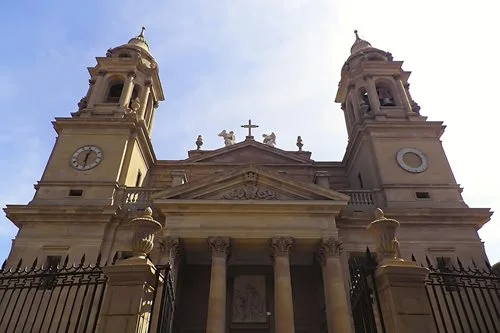
The Cathedral of Saint Mary of the Assumption stands out for being considered the most complete cathedral complex preserved in Spain.
In the heart of the historic city centre of Pamplona lies the Pamplona Cathedral, specifically on the main area of what was the Roman nucleus. The current construction is believed to have originated as a church around the 6th century. Despite this, the oldest remains known are from the 9th or 10th century. Following the Andalusi expulsion, a Romanesque compound was erected, which apparently competed in size with the Cathedral of Santiago de Compostela. This structure partially collapsed around 1390. The precinct would be rebuilt and transformed by order of Charles III of Navarre. All of this was done under the purest Gothic parameters, inspired by other European cathedrals, such as that of Bayonne.
The main facade dates from the 18th century, when the original Romanesque one was replaced with a neoclassical design. This transformation was the work of the Madrid architect Ventura Rodríguez. This sparked great controversy, as it was considered and is still considered that a unique 10th-century heritage piece was lost. Fortunately, capitals and other elements of it are preserved in the Museum of Navarre.
In conclusion, we find a series of rooms and elements resulting from a combination of styles from different eras. The Royal Crypt, the Barbazana Chapel, and the Gothic cloister are particularly noteworthy. From its origin to the present day, it is a stopping point for anyone on a pilgrimage to Santiago de Compostela.

Book your hotel
