Cookie settings
We use our own and third-party cookies in order to offer our services, display videos, obtain statistics and offer personalized advertising.
For more information, please read our cookies policy.
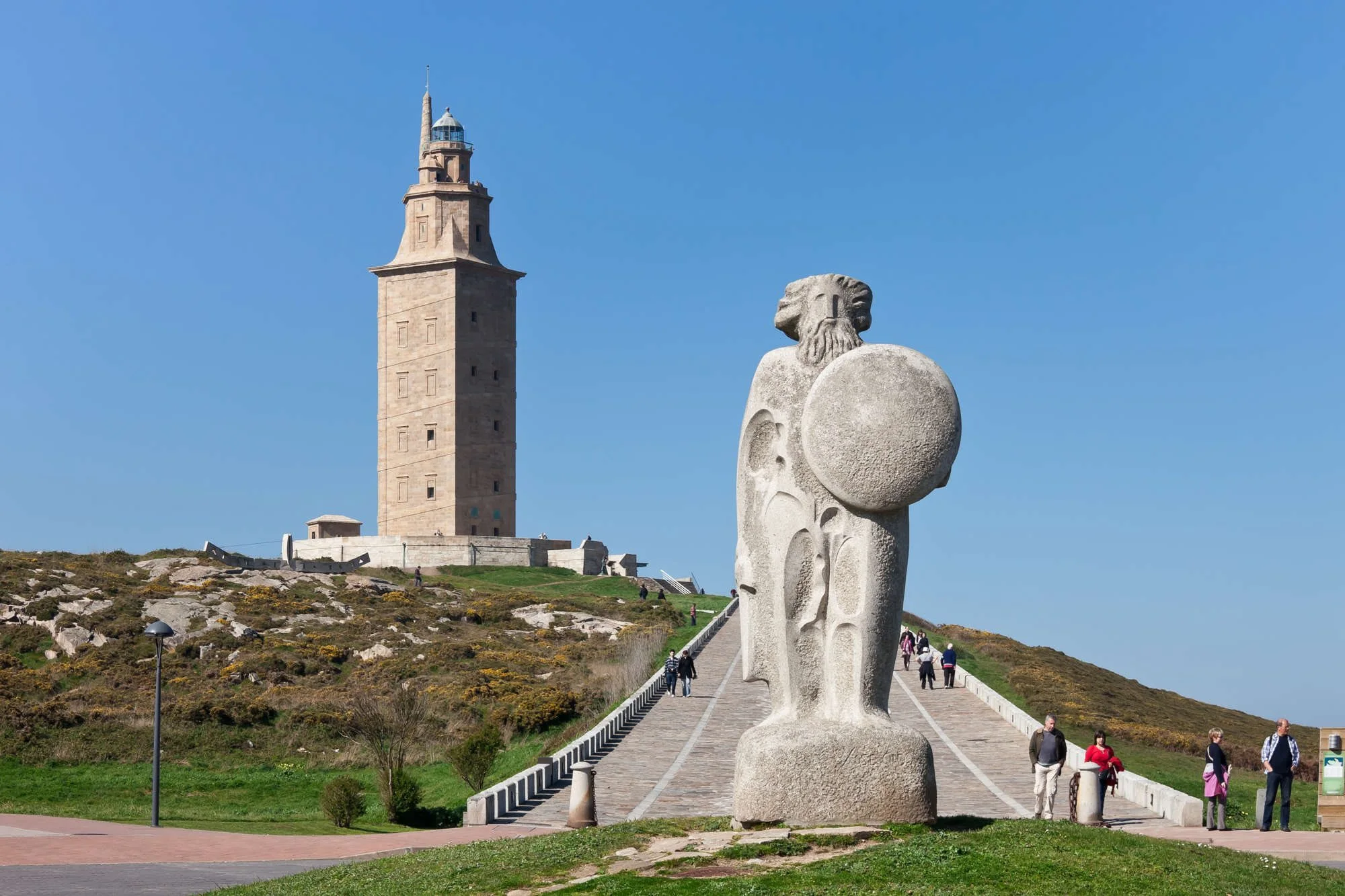
The Tower of Hercules is the only Roman lighthouse and the oldest still in operation.
Its height is 55 metres (36 metres of its Roman construction and 19 from its 1789 restoration for the modernisation of the maritime signalling system). Its focal height is 106 metres above sea level. Its plan is quadrangular, with each side measuring around 11.75 metres. Above this quadrangular part rises another polygonal section on which the lighthouse rests.
Until the 20th century, it was called the Bigantia Lighthouse (Farum Brigantium, now La Coruña). The name Tower of Hercules comes from several legends about its construction. One of them tells that Hercules arrived at the Galician coasts surrounding this tower, where he buried the head of the giant Geryon after defeating him. This legend would fall within the continuity of the Roman legacy over the Tartessian-Phoenician of Geryon.
Some historians believe that the site of this tower was where the Tower of Breogán was located, which appears in the mythological cycle of Ireland, from which Ith (son of Breogán) is said to have seen the Irish coasts.
Although it was rebuilt by the Romans, this tower has an unknown origin. At the base of this tower, a votive stone was found, whose inscription identified the architect Caius Sevius Lupus, hailing from Aeminium (Coimbra).
In the Middle Ages, it ceased to function as a lighthouse and became a fortification. But in 1682, architect Amaro Antune was commissioned by the Duke of Uceda for its restoration. This restoration was completed during the reign of Charles III. The neoclassical part was finished in 1791 by Eustaquio Giannini, which corresponds to the current façade.
The Tower of Hercules was a candidate in 2007 to be declared a World Heritage Site, with such declaration taking place two years later. On 9 September 2008, it was twinned with the Statue of Liberty in New York and, sixteen days later, with the Lighthouse of Morro in Havana.
Around it, we can also see a Sculpture Park, acting as an open-air museum. In this park, there are more than fifteen works by prominent 20th-century artists, such as Manolo Paz and Francisco Leiro.
Built: 1st, 17th and 18th centuries AD.
Author: Amaro Antune, Eustaquio Giannini, Cayo Sevio
Style: Neoclassical, Roman Classic
Category: Civil
Type: Lighthouse, Tower
Address and telephone
Opening times
Prices
Services
Guided Tours.If you see any mistakes or want to add anything to this information, please contact us.