Cookie settings
We use our own and third-party cookies in order to offer our services, display videos, obtain statistics and offer personalized advertising.
For more information, please read our cookies policy.
This cathedral, that was built when Mr Diego Peláez was bishop in 1075, is the most valuable and meaningful example of the Spanish Romanesque art. The influences of the French Romanesque are represented along all the stages of the Way of Saint James that drives to the Santiago de Compostela Cathedral. In this way, St. James the Moor-slayer´ s image is born, a symbol of fight against the Islam that was spread along the route.
This cathedral has the typical plan of the pilgrimage churches: a Basilical structure with a Latin cross plan that consists of three naves just like its transept. The ambulatory is located in the apse, with radial chapels that allow surround the main altar to visit the apostle´ s tomb that is placed under the main altar.
The elevation is an architectonic good choice: round arches, alteration of pillars with cross form, with half adjacent columns and circular columns. Two huge windows correspond to each arch. A 22 meters high rostrum is placed over the side naves and the transept´ s naves in order to offset the thrust of the barrel vaults of the central nave. The thrust are covered by quarter-of-sphere vaults.
The main entrance is situated in the Portico de la Gloria that was built in 1180 by the Master Mateo. It is divided into three arches, the central one is referred to the Apocalypse with hundred of figures presided by Christ. The mullion supports the weigh of the central tympanum and is presided by a monumental image of St. James. The Master Mateo also builds the crypt that lets save the drop of the land and over it, is situated the last stretch of the naves. And the portico is situated between the two towers.
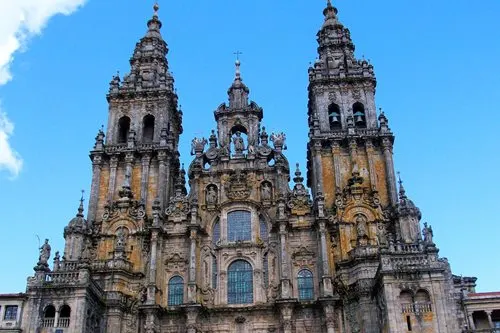
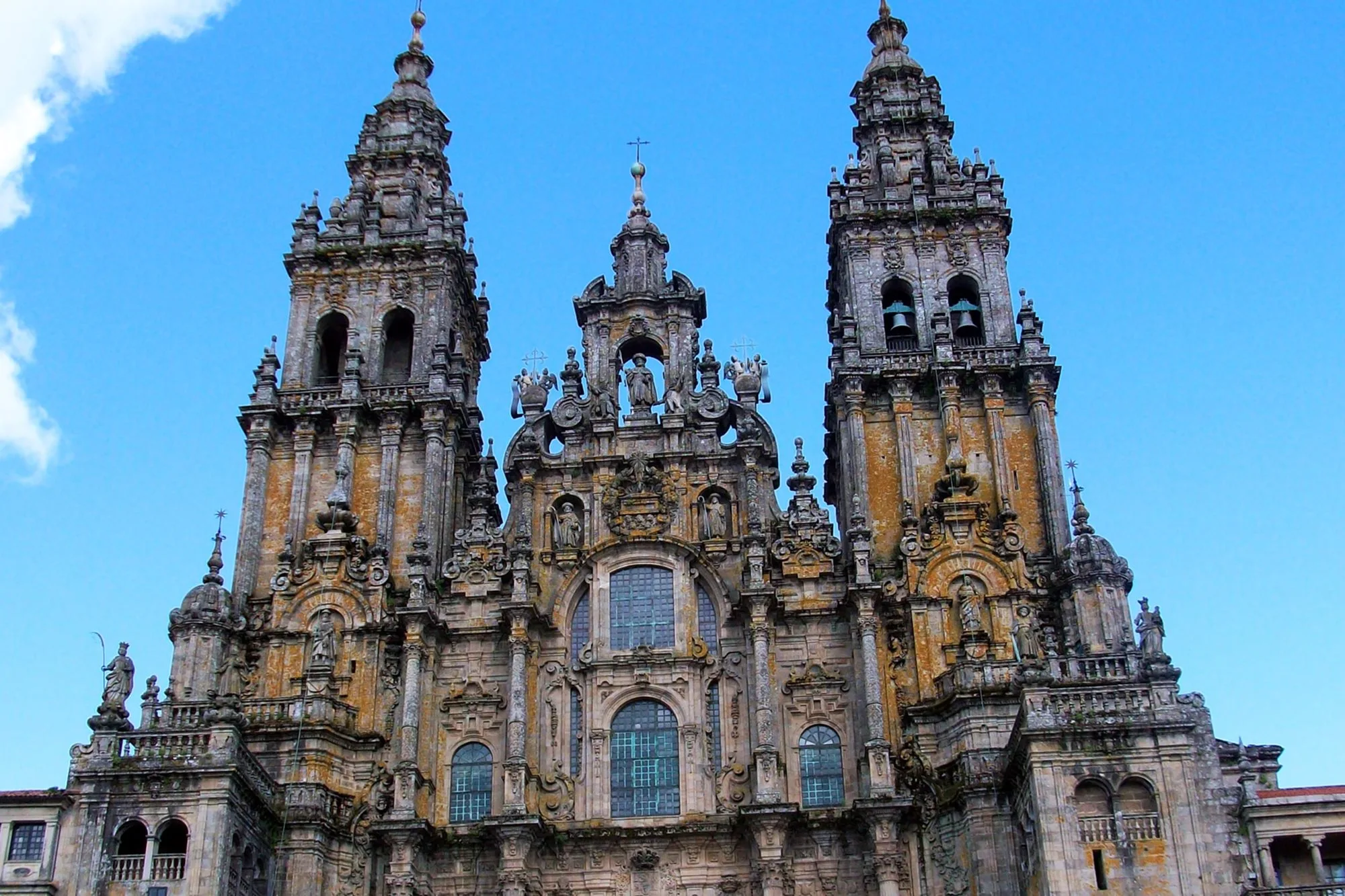
The Great Barroque facade of the Obradorio, from the XVIII Century, is a Fernando Casas y Novoa´ s work of art. Above, in the middle, the Statue of the Apostle St. James stands. In the middle, we can see the urn and the star (representing the light that the hermit Pelayo saw) between angels and clouds.
In the Platerías facade, we could stress the way the sculpture is projected from the frame of tympanum where the Redemption is represented. The divine nature is represented in the left tympanum, and the sculptures of the Jesus Christ and Apostles are the dominant element. We can see scenes of the Creation of Adam and the elegant sculpture of the King David in the jambs.
The Easterm facade or the Quintana facade has two doors. The Holy Door is dedicated to St. James and at his side are the apostles Teodoro and Anastacio. On each side of the door twenty four seated statues of the Apostles, patriarchs and prophets. The other door is the Royal Door, which name is referred to the coat of arms that stands in it.
The Northern facade or the Azabachería façade, previously called Gate of Paradise, was the entrance where the pilgrims went in. It is placed in North side of the Cathedral and it was, during many years, the main door to the temple. In the square, the pilgrims cleaned their hands and clothes. The name of this façade comes from the “azabacheros”´ association, in which material Compostela was well- known.
Address and telephone
Opening times
Prices
Free entry.
If you see any mistakes or want to add anything to this information, please contact us.
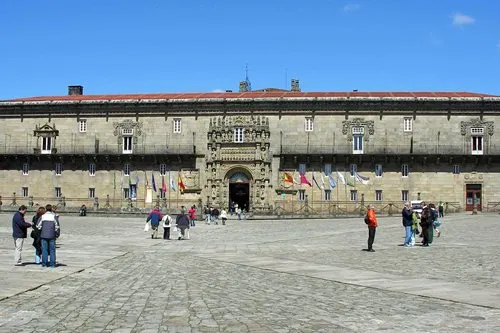
In the XVI Century the Catholic Kings built the Foundation of the Royal Hospital and for it they built the building that nowadays occupies the Hostal de los Reyes Católicos (Catholic kings´ hospital), which became a great luxury hotel (Tourist Hotel).
This building has been built in Plateresque style to which Renaissance elements have subsequently been added. It has a very original floor in which the central part is occupied by the chapel with Latin cross plan flanked by two interior courtyards where the rooms typical of the hospital were located.
Inside it is also grandiose: with four cloisters of great beauty, where we can find a beautiful chapel of Latin Cross plan as well as elegant halls, rooms and a luxurious dinning room.
The dome is decorated in Plateresque style as well as the rib vault of the chapel that was built with lithographic stone from Coimbra.
Outside, there is a huge stone mural, with a Triumphal arch so typical of the Renaissance art decorated with figures that present the place as a hospital where body and soul´ s pain could be cured. The figures of the Catholic Kings also appear in this façade as the promoters of its construction.
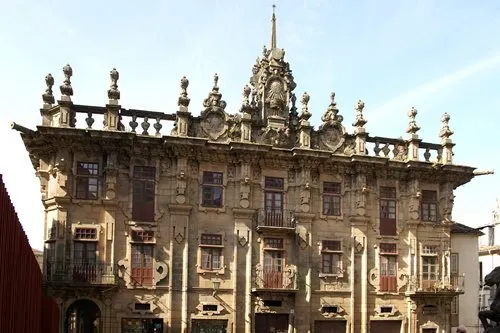
This building was built in order to embellish the town, so its function is decorative and its aim is to close one of the sides of the beautiful Plaza de las Platerías, with its typical Galician Baroque style.
It is located in front of the Cathedral. Its façade is in Compostela style from the XVIII Century. This building inspired Valle- Inclán to write the story “Mi hermana Antonia”.
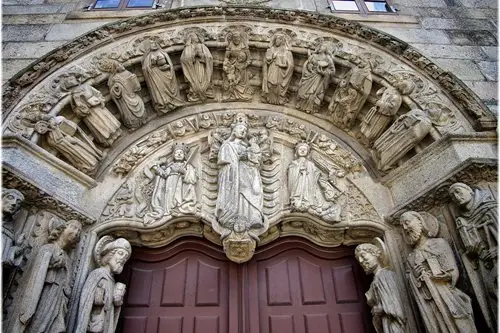
The college is also known as Estudio Vello. It was founded by the archbishop Fonseca in 1501 in order to accommodate poor students. It is located in Plaza del Obradorio. The main façade is in Romanesque- Gothic style. In the centre of the archivolt appears the virgen with Baby Jesús surrounded by Saints, in the tympanum the Inmaculate is represented.
Over the door, we can find the coat of arms of its founder. The college of San Jerónimo was occuping the Hospital Viejo or de Azabachería´ s lands until 1651 and housed the Facultad Menor de Artes (Minor Faculty of Arts).
Nowadays, it is the headquarters of the Deanship of the University of Santiago de Compostela.
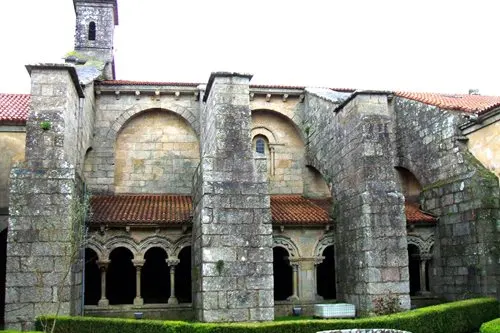
This Collegiate Church was founded in the XII Century, and is located outside the town, next to the river Sar.
It has a basilical structure and three naves divided by pillars decorated with natural motives. Outside, the solid flying buttresses that protect the Northern walls attract the attention of the visitor.
The interior columns are visibly inclined, what grants a peculiar attractive to the place and obliged to rebuild the barrel vault in the XVI.
Inside, we can see that it is a temple of great dimensions that impresses because of its columns lean, given a feeling of instability.
The Master Mateo left his mark in the decoration of the capitals of the cloister.
A collection of archaeological and liturgical pieces is exhibited inside. We should highlight the baptismal font from the XII Century, located on the right of the main entrance.

Book your hotel