Cookie settings
We use our own and third-party cookies in order to offer our services, display videos, obtain statistics and offer personalized advertising.
For more information, please read our cookies policy.
Commonly known as the Sanctuary of the Saliente, it is one of the most important pilgrimage centres in the southeast of Spain.
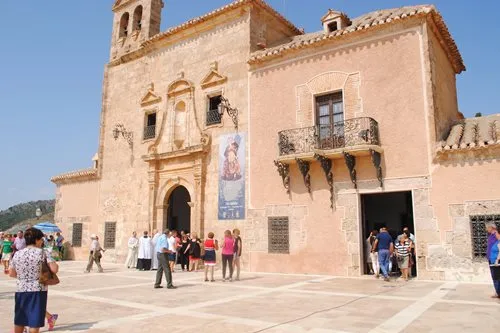
The Monastery of Our Lady of the Forsaken of the Saliente is located on top of Mount Roel on the Sierra de las Estancias. This temple is the main architectural jewel of Albox, built in the 18th century and declared a historic-artistic monument.
Inside the Virgin of the Forsaken's chapel, the baroque image of the Virgin is preserved, which gives the chapel its name. Every 8th of September, the pilgrimage of the Virgin of the Saliente takes place. The image of this Virgin is an object of great popular devotion among the faithful in the province of Almería and other nearby districts.
The layout of this temple is rectangular. Its construction began in 1769 by order of Bishop Claudio Sanz y Torres, following designs by the architect Vicente Sánchez. It comprises a cloister on the southeast side with facilities, enclosure and service area on the north around a courtyard, and the rest flanks the temple on the west side.
Architecturally, it is a set of great beauty yet simple. It combines materials typical of rural craftsmanship, such as tufa stone, with those used for the churches of the era in Granada. The exterior showcases a play of volumes and the simplicity of its lintelled openings, framed with brick.
Its main façade opens onto the Roel esplanade and is surrounded by retaining walls. It features two windows topped by a triangular pediment, framing the empty central niche located above the entrance (whose arch is framed by pilasters). The niche is crowned by a curved pediment; this connects to the corners of the entrance's entablature with long curved elements, ending in volutes. Next to the main door are the old chaplain's quarters with a decorative wrought-iron balcony.
The church has a Latin cross plan with a single nave. Its walls are lined with Tuscan pilasters on plinths, which simulate supporting an entablature encircling the interior perimeter. Between the spaces of the pilasters are the chapels, three on each side of the nave, sheltered by shallow semicircular arches. The nave is covered with a barrel vault with transverse arches and lunettes. The crossing is covered by a domed vault supported on pendentives. The main chapel, whose altar was baroque but was restored after being burnt during the Spanish Civil War, is covered by a quarter-sphere vault with two ribs.
The church's head is trefoil in plan. Behind it is the chapel dedicated to Our Lady of the Forsaken, whose plan is decagonal and is covered with a ten-panel vault with ten ribs.
The cloister has a rectangular plan, is porticoed and features four naves of lowered arches on robust pillars. In the centre of the cloister is the well that supplied water to the monastery. Today it is the wishing well, central to many legends. The most renowned is to make a wish and throw a coin into the well for it to come true.
Built: 1769
Author: Vicente Sánchez
Style: Baroque
Category: Religious
Type: Monastery, Sanctuary
Address and telephone
Opening times
Prices
Free entrance.
If you see any mistakes or want to add anything to this information, please contact us.

Book your hotel