Cookie settings
We use our own and third-party cookies in order to offer our services, display videos, obtain statistics and offer personalized advertising.
For more information, please read our cookies policy.
Torre d’en Galmés is the largest Talayotic settlement found in the Balearic Islands. Its area covers up to 62,000 square metres.
It is located on a hill close to the Alayor-Son Bou road. Nearby, there is also a preserved dolmen and the ruins of a Talayotic building known as “Sa Comerma de sa Garita”.
It dates from the pre-Talayotic to the Roman era. Some remains correspond to the Middle Ages, but most of the remains preserved today are from the Iron Age.
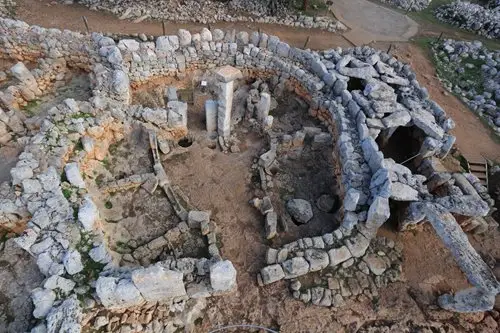
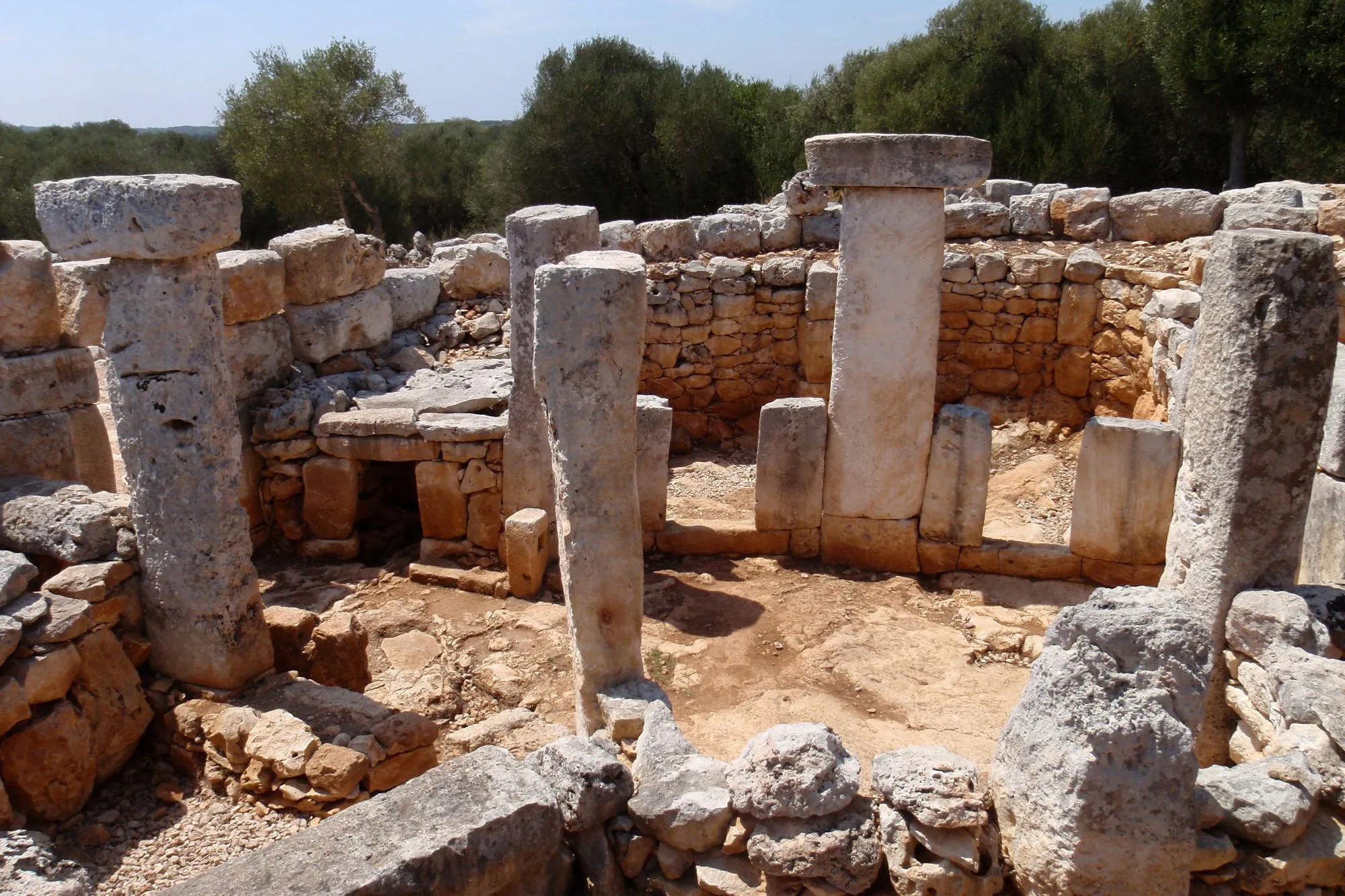
It includes remains of various types, such as three hypostyle or colonnaded halls, three talayots, a system for collecting rainwater, a taula enclosure, twenty-seven documented houses, and several caves excavated into the rock.
The three talayots dominate the settlement at the highest point, fulfilling their function as watchtower lookouts over the territory. According to G. Rosselló (director of the excavations in the 70s and 80s), this three-talayots enclosure could have been for public use, where the inhabitants congregated for celebrations and ceremonies. Near these, there is the taula enclosure dedicated to religious worship.
The structures preserved throughout the settlement for the houses are circular. Some houses found on the lower side of the hill have a hypostyle hall, which served as storage or for other auxiliary use. Rainwater was collected by making use of natural filters excavated in the rock. It was carried to large reservoirs via canals.
The sanctuary floor plan is horseshoe-shaped. The central element was originally a large “T” composed of two superimposed stone slabs (today the vertical slab is broken). This “T” measures 1.95 metres in height, 1.50-1.60 metres in length, and 0.40 metres in thickness. The stone that served as a capital is lying in front of the supporting stone and was reused as a grave in late Roman or medieval times.
The circular houses have the entrance facing south and were built using the Cyclopean technique (with large stones without mortar). Radiating walls from a central courtyard separated the rooms.
Among the objects found at this site, a bronze figure of the Egyptian god Imhotep stands out. It was found precisely at the sanctuary or taula enclosure and is the only one found at an archaeological site outside Egypt. Both for this figure and others found, it is inferred that someone practising rituals of worship to Imhotep lived here.
Today, Torre d’en Galmés continues to be studied by teams from Boston University and the Menorca Museum. It is musealised and open to the public, supported by the interpretation centre.
Built: Pre-Talayotic Period (before 1,400 BC) - Iron Age (1,200 - 500 BC).
Style: Talayotic culture
Category: Civil
Type: Archaeological Site
Address and telephone
Opening times
From Tuesday to Friday, from 9:15 am to 3:00 pm.
Prices
If you see any mistakes or want to add anything to this information, please contact us.

Book your hotel