Cookie settings
We use our own and third-party cookies in order to offer our services, display videos, obtain statistics and offer personalized advertising.
For more information, please read our cookies policy.
The Talayotic settlement of Son Catlar is named due to its location south of the houses of a farm with the same name. Its area is 4.4 hectares. It is one of the three settlements of this type, along with Torre d’en Galmés and Trepucó.
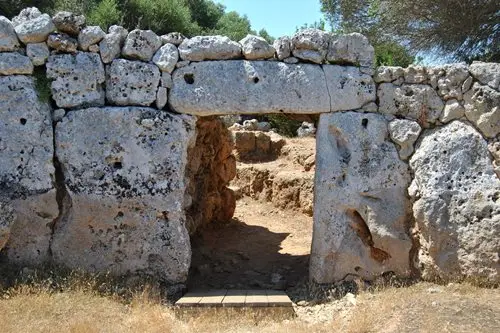
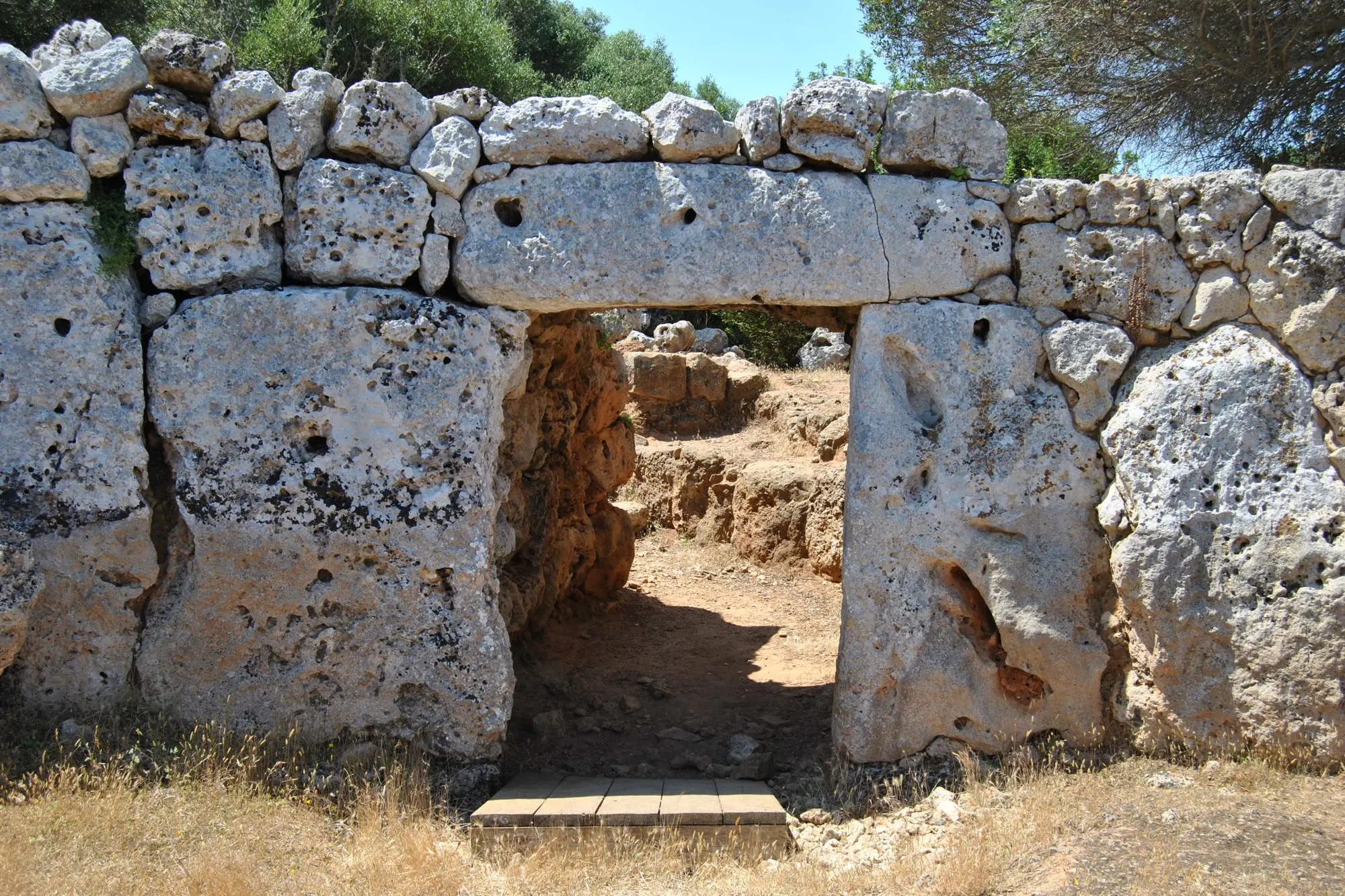
It is surrounded by a 900-metre-long, 6-metre-wide, and 3-metre-high wall. This wall features various construction techniques, but the talayotic style predominates, consisting of a plinth, vertical stones, and horizontal stones in rows. It also features various defensive elements for potential Mediterranean conflicts since the 4th century BC.
The latest research on the more recent defensive structures suggested they may correspond to Menorca's role during the Punic Wars or the Roman conquest of the Balearic Islands, around 123 BC.
The wall, constructed using Cyclopean technique (large stones without mortar), consists of a series of defensive elements in a remarkably good state of preservation: bastions, outer walls, towers, bayonet gates, artillery platforms, sally ports, and sentry boxes. Therefore, it is a very important site to study the pre-Roman era in Menorca.
Two rectangular towers are located on the eastern part of the wall. In the northwest, there are two bastions in two directions, flanking one of the corners of the settlement. Both the towers and bastions are from the same era, built using Carthaginian techniques and methods. The lock of the wall is located in the north part and has an inner corridor that is covered by row approximation.
Son Catlar preserves three talayots:
- One is situated in the north of the settlement and separated from the wall. Its floor plan is oval and the portal is destroyed. In its upper chamber a column is preserved in the centre.
- A second talayot is in the southern part of the settlement, circular in plan and attached to the wall. It has an entrance with a corridor where flat slabs covering the roof are preserved. On its west side there is a chamber whose roof was made by bedding approximation.
- The third talayot, whose shape is like a wall bastion, is in the eastern part of the site.
Within the settlement, among other construction foundations, the taula enclosure stands out with two accesses. In the centre of this enclosure, the taula itself is preserved.
There is a hypogeum or almost circular underground gallery, with a descending access corridor. Inside it there are niches excavated in the wall.
Other elements that are preserved include a stela with an engraving almost attached to the west outer wall of the settlement. Furthermore, outside the wall there are other foundations of Talayotic houses and a small necropolis next to the farmhouse.
Built: Bronze Age, the 5th and 4th centuries BC.
Style: Talayotic culture
Category: Civil
Type: Archaeological Site
Address and telephone
Opening times
Free access.
Prices
Free of charge.
If you see any mistakes or want to add anything to this information, please contact us.

Book your hotel