Cookie settings
We use our own and third-party cookies in order to offer our services, display videos, obtain statistics and offer personalized advertising.
For more information, please read our cookies policy.
The province of Burgos is famous because, thanks to its site in Atapuerca, many remains and data have been gathered that have helped trace part of the history of humanity, besides having been a key location for various feats in the history of Spain.
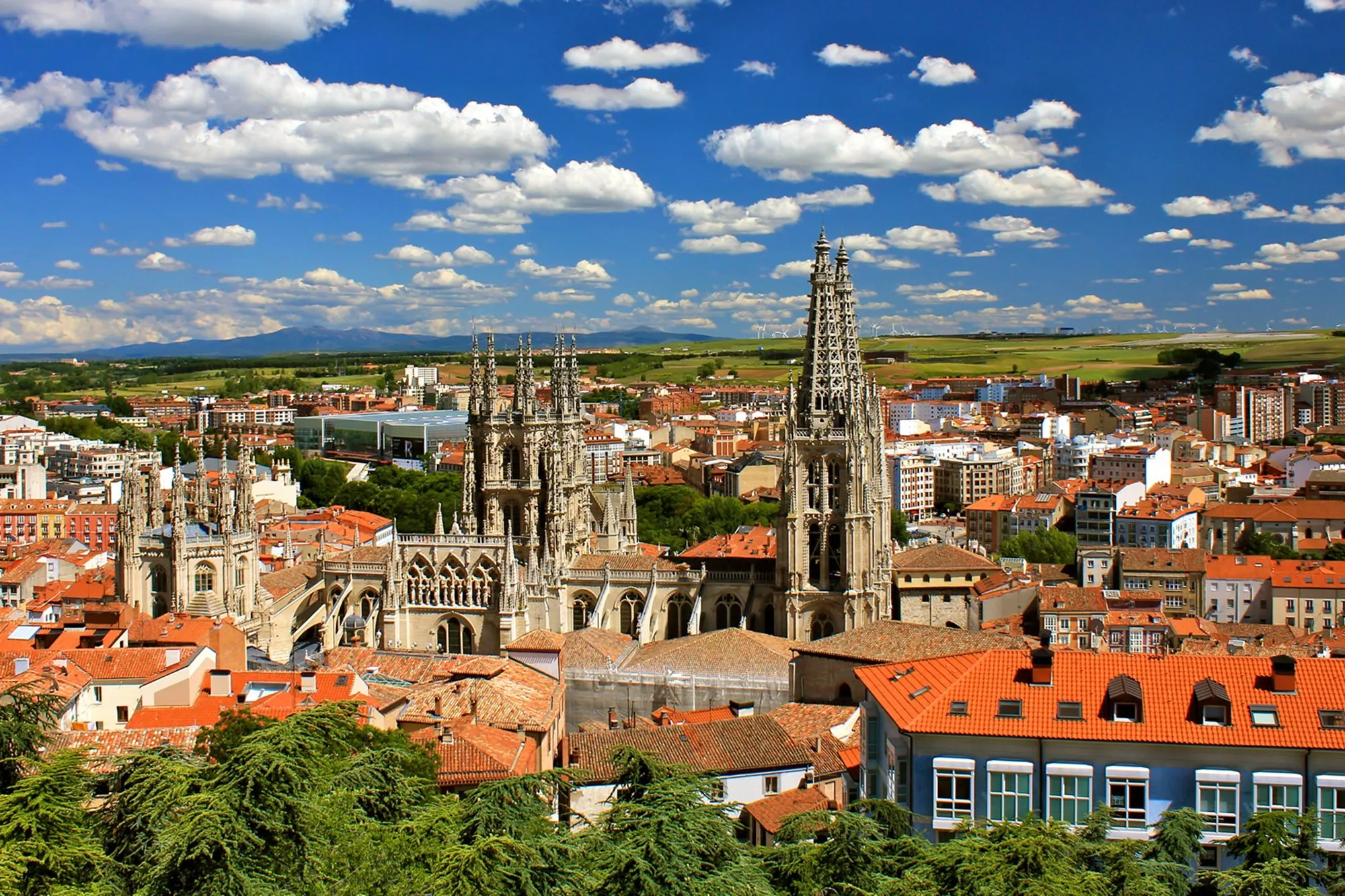
In its capital, the Santa María Arch is the gateway to the historic centre of the city. The Burgos Cathedral stands out as the first Gothic-style cathedral on the Peninsula and a true gem of architecture.
The Carthusian Monastery of Miraflores is the monastery where the remains of King John II and his wife Isabel of Portugal rest, parents of Isabel the Catholic, whose alabaster tombs are placed in front of a beautiful high altarpiece that also serves as a pantheon.
Other religious buildings in the capital include the monastery of Santa María la Real de las Huelgas, Romanesque in style and home to valuable artworks; and the Church of San Esteban, Gothic in style.
The castle of Burgos, currently in ruins, offers a fantastic viewpoint from which you can appreciate a beautiful view of the city of Burgos.
The Cordón House, a 15th-century palace, is very interesting from a historical perspective: Philip the Handsome died there, the Catholic Monarchs received Columbus upon his return from his second voyage to America, and the Cortes gathered there in 1515.
Among the more recent buildings, the Main Theatre of Burgos, built in the 19th century, stands out.
In Santo Domingo de Silos you will find the Silos Monastery, widely known for its cloister, a Romanesque masterpiece. The Silense Glosses, one of the oldest testimonies of the Castilian language, were also found there. Additionally, the Church of the Assumption, in San Vicente del Valle, is very interesting. This small Visigothic temple has a series of architectural features that make it extremely special, along with the beauty of the setting where it is located.
Other major attractions of the province include the Museum of Human Evolution. This museum helps us understand the origins of human beings from remains found at the Atapuerca archaeological site. You can also visit the ruins of the Roman city of Clunia, the marvellous Romanesque route of Esgueva, the Foundation for the study of Dinosaurs in Castile and León, where you can observe dinosaur footprints; the wineries of Aranda del Duero, dug underground with many intricate passageways over eight centuries old; and the hermitages and dolmens scattered throughout the province.
Ojo Guareña and Monte Santiago, located in the Puerto de Orduña, are natural areas in the province of Burgos. In Ojo Guareña, you can visit numerous caves and hermitages carved into the rock; and in Monte Santiago, the Salto del Nervión, a 300-metre-high waterfall.
The Castilian-Leonese city of Burgos is undoubtedly a true heritage gem. Namesake capital of the province, it is located at a privileged point connecting the plateau with the Basque Country and France.

Book your hotel