Cookie settings
We use our own and third-party cookies in order to offer our services, display videos, obtain statistics and offer personalized advertising.
For more information, please read our cookies policy.
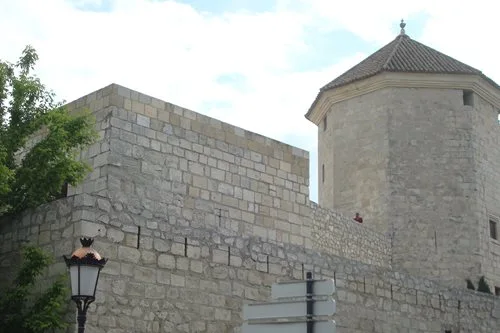
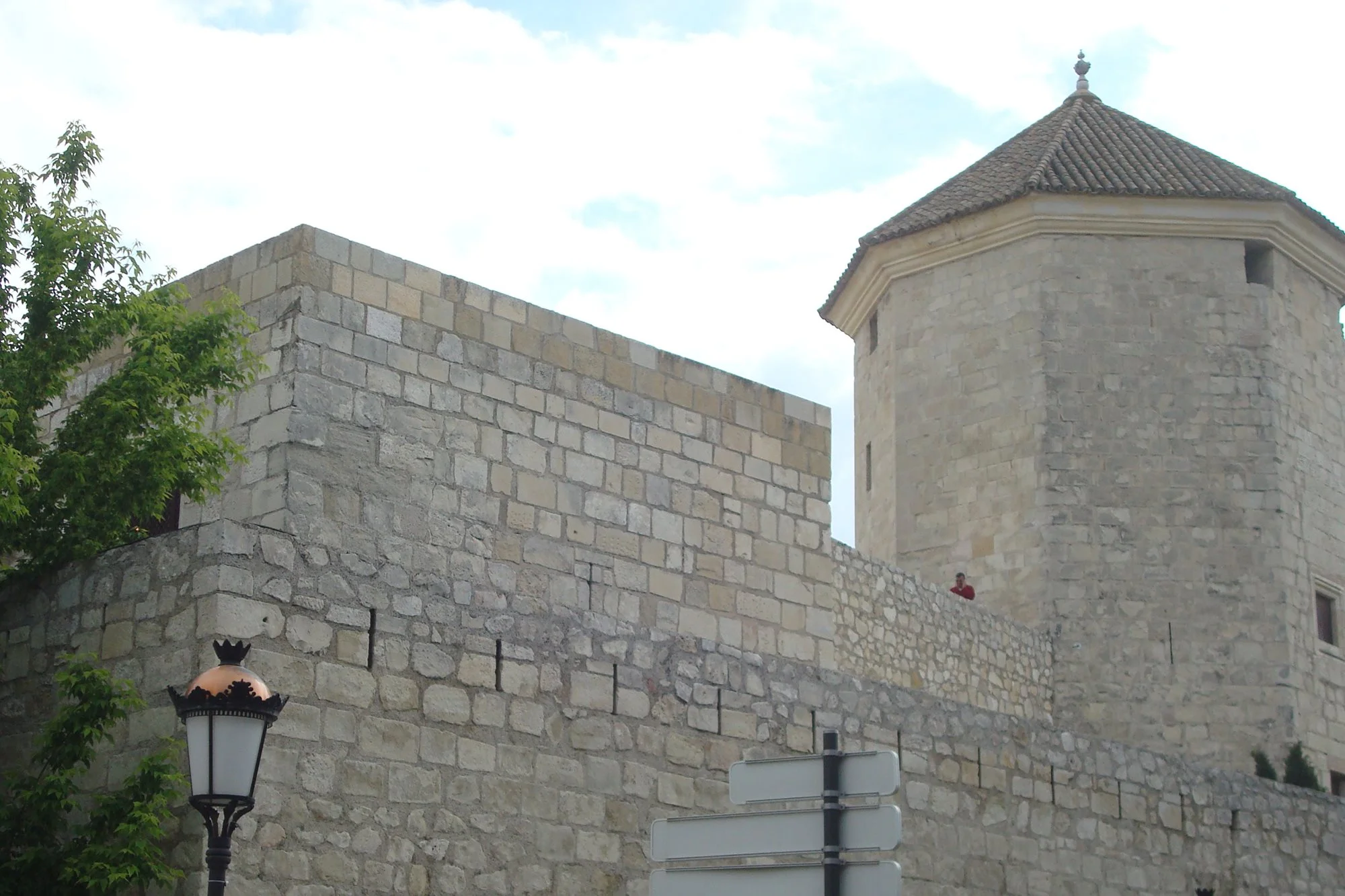
The Castillo del Moral or Castillo de Lucena is located in the historic centre of this locality, near the Plaza de España and the Church of San Mateo.
It was built after the Almoravids arrived in Lucena in the year 1148, although the existence of Iberian and Roman remains underground is not ruled out. Its layout is rectangular with four towers and a central parade ground.
A very representative element of this castle is the Torre del Moral. Not only because it is the most prominent in terms of shape and octagonal roof, but also because it was the place where the Nasrid Sultan Boabdil was imprisoned during the Battle of Lucena.
Today this monument houses the Archaeological and Ethnological Museum of Lucena, after its museumisation between 2001 and 2003.
Built: 12th century.
Style: Almoravid, Islamic military architecture, Medieval
Category: Military, Museum
Type: Archaeological and Ethnological Museum, Castle
Address and telephone
Opening times
Prices
Services
Audio guides, Permanent exhibitions.If you see any mistakes or want to add anything to this information, please contact us.
The Jewish necropolis of Lucena is the largest and best-preserved funerary site of this culture in Europe. It covers a total area of over 3,700 square metres.
It was discovered on 20 October 2006, when the new Ronda Sur was being constructed in Lucena. The discovery was entirely by chance, as a local citizen was walking his dog on the Cerro Hacho, which had a human femur in its mouth. The police and the municipal archaeologist were notified and it was confirmed that the bone came from a Jewish cemetery dating between the year 1000 and 1050. At that time, Lucena was known as Elí Hoshaná, the "Pearl of Sefarad". These were times of great Jewish prosperity in the city.
In total, 346 graves were discovered. Of these, 196 contained the remains of the deceased, oriented towards Jerusalem. One of them was a man who measured between 2 and 2.20 metres tall, possibly suffering from gigantism. The University of Granada studied these remains. Among the archaeological finds was one of the few Jewish tombstones found in the Iberian Peninsula. Its inscriptions were analysed by Dr. Jordi Casanovas Miró, a scholar of Semitic Philology. Today, this tombstone (dating from the 8th and 9th centuries) can be seen at the Lucena Interpretation Centre.
The remains from the graves were exhumed, however, the Jewish community protested. Finally, in December 2011, it was decided to reinter these remains according to Jewish ritual, with the support of the Federation of Jewish Communities of Spain. The area occupied by the necropolis thus remains a sacred place.
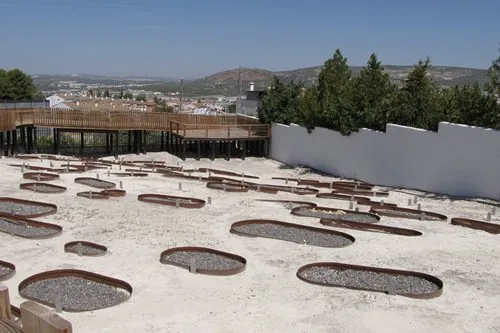
Later, preparations began to open the site to the public. The perimeter of the area was fenced in. A Wailing Wall was built. Information panels about the Sephardic community in Spain and Lucena, and the Talmudic school, were also installed.
Researchers identified three types of graves and two subtypes:
Four types of graves were recreated according to the different burial methods discovered.
On 27 September 2013, the necropolis was opened to the public, being one of the few that can be visited, along with those of Plasencia and Segovia.
Thanks to the discovery of this necropolis and its enhancement, Lucena belongs to the Network of Jewish Quarters of Spain.