Cookie settings
We use our own and third-party cookies in order to offer our services, display videos, obtain statistics and offer personalized advertising.
For more information, please read our cookies policy.
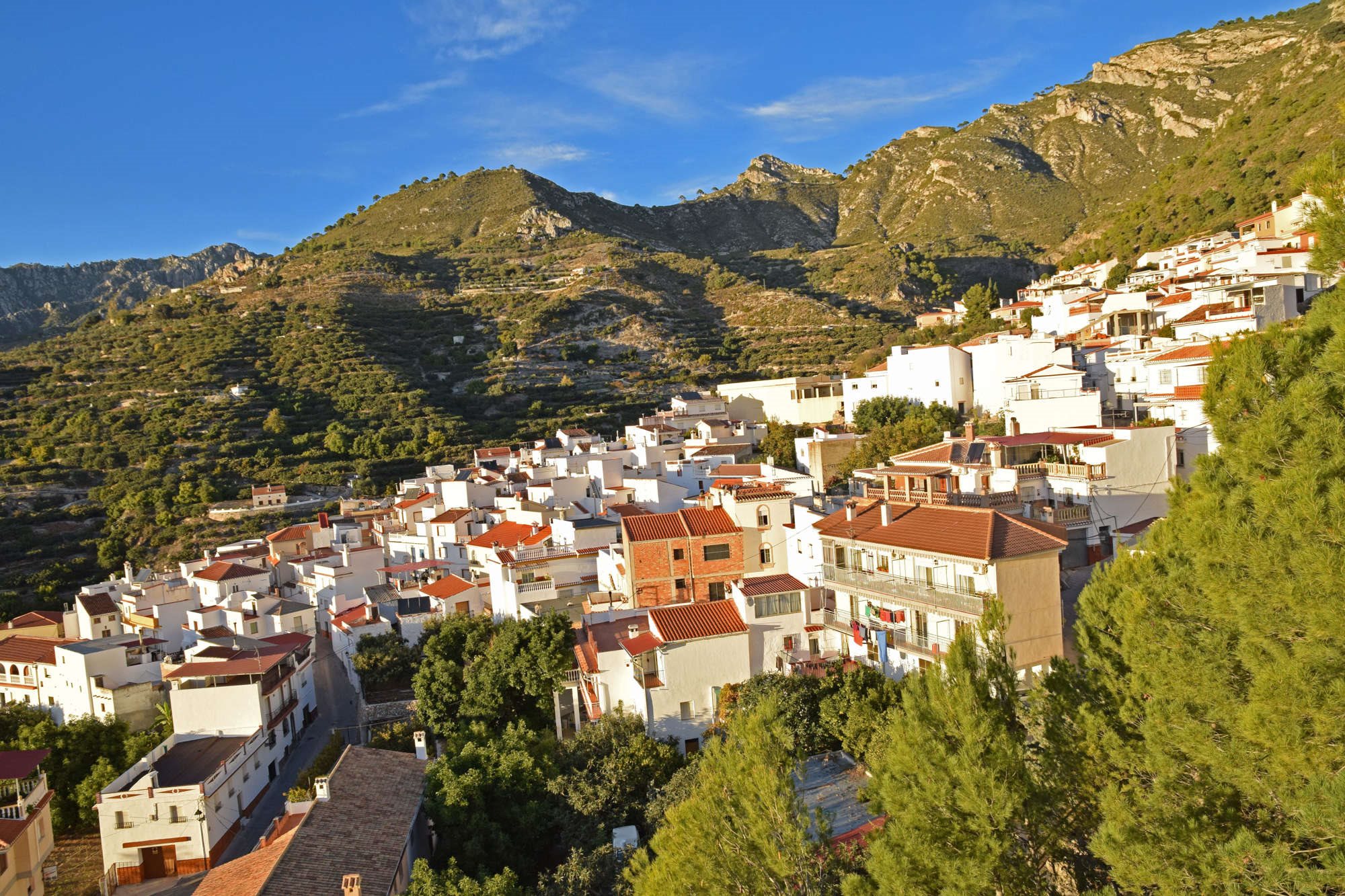
Lentegí is a picturesque village on the Costa Tropical, Granada. It combines natural beauty, tradition, and history. Its white houses perched on the mountain and a privileged climate make it a perfect destination for tranquillity, adventure, and Granadian culture.
The origin of Lentegí dates back to the Roman era, when it was known as Lentiscētum, meaning "place where mastic trees abound". Although already in the Agárico Bronze Age there is evidence of prehistoric life in this place, as witnessed by a necropolis discovered in 1933 whose remains are preserved in the Museum of Archaeology and Ethnology of Granada. During the Arab period, the village was part of the Kingdom of Granada, and its strategic location made it a key place in the defence of the area.
Despite the War of the Moriscos and their subsequent expulsion in the 16th century leaving the village devastated, it was repopulated with other inhabitants from the peninsula and gradually restored. Lentegí today retains its historic agricultural character, including subtropical crops and loquat since the 1970s of the last century.
The Church of Our Lady of the Rosary was built over a 13th-century mosque. It is dedicated to the patron saint of the locality, the Virgin of the Rosary, and to Saint Joseph. It was built with three naves, but today only the central one remains.
Another corner that forms part of the heritage and rural way of life in Lentegí is the Fuente del Gato, an old watering place that still refreshes visitors and field workers. The Era del Peñón is also noteworthy, a natural viewpoint where grain used to be threshed and which today is a recreational area surrounded by native flora. Other interesting spots to enjoy Lentegí’s nature and landscapes include the mirador Tajo de la Lola and the recreational area El Sequero.
The village’s festivals are another unmissable cultural attraction, such as the Fiestas Patronales in Honour of the Virgin of the Rosary and the Chestnut Day, celebrations where music, gastronomy, and devotion mix in a unique festive atmosphere. Not forgetting the traditional summer festivities, as in most municipalities. On the first weekend of August, Lentegí celebrates its popular paella, accompanied by youth activities and a night dance.
Its gastronomy, based on local subtropical and traditional products such as loquats, custard apples, almonds, and olives, offers traditional flavours that reflect the agricultural richness of the region. Dishes such as fennel stew, chickpeas with cod, and choto are genuine delights for the palate.
As the highest village in the Valle del Río Verde, Lentegí is a privileged destination for lovers of active tourism such as hiking, canyoning, and other adventure activities. Its mountains and rivers create a spectacular landscape where you can explore natural routes and enjoy breathtaking panoramic views.
Those wishing to practise climbing can enjoy the Via ferrata Tajo de la Viña in Lentegí and the spectacular views over the Valle del Río Verde. It has more than three hundred metres in length and a 48-metre vertical drop; along with exciting elements such as the stairway to heaven, pendulum, or two suspension bridges.
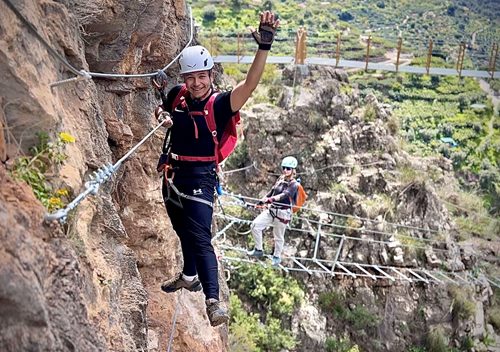
If you're in Lentegí or looking to start climbing via ferratas near the Tropical Coast, keep reading.
The Via Ferrata Tajo de las Viñas is rated K3 and features hanging bridges, a stairway to the sky, and a pendulum. It's perfect for beginners who want to experience the thrill of adventure in the stunning natural surroundings of the Granada Coast.
You'll be guided by a professional mountain guide specialized in climbing. All necessary equipment and safety measures are included—so there's no excuse not to book this adventure!

Book your hotel
