Cookie settings
We use our own and third-party cookies in order to offer our services, display videos, obtain statistics and offer personalized advertising.
For more information, please read our cookies policy.
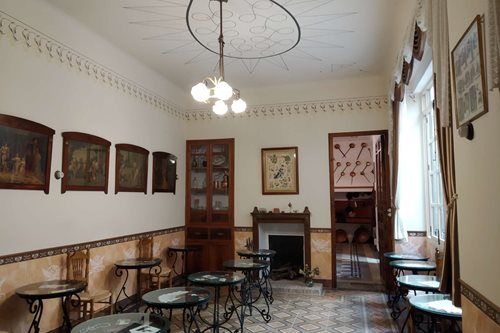
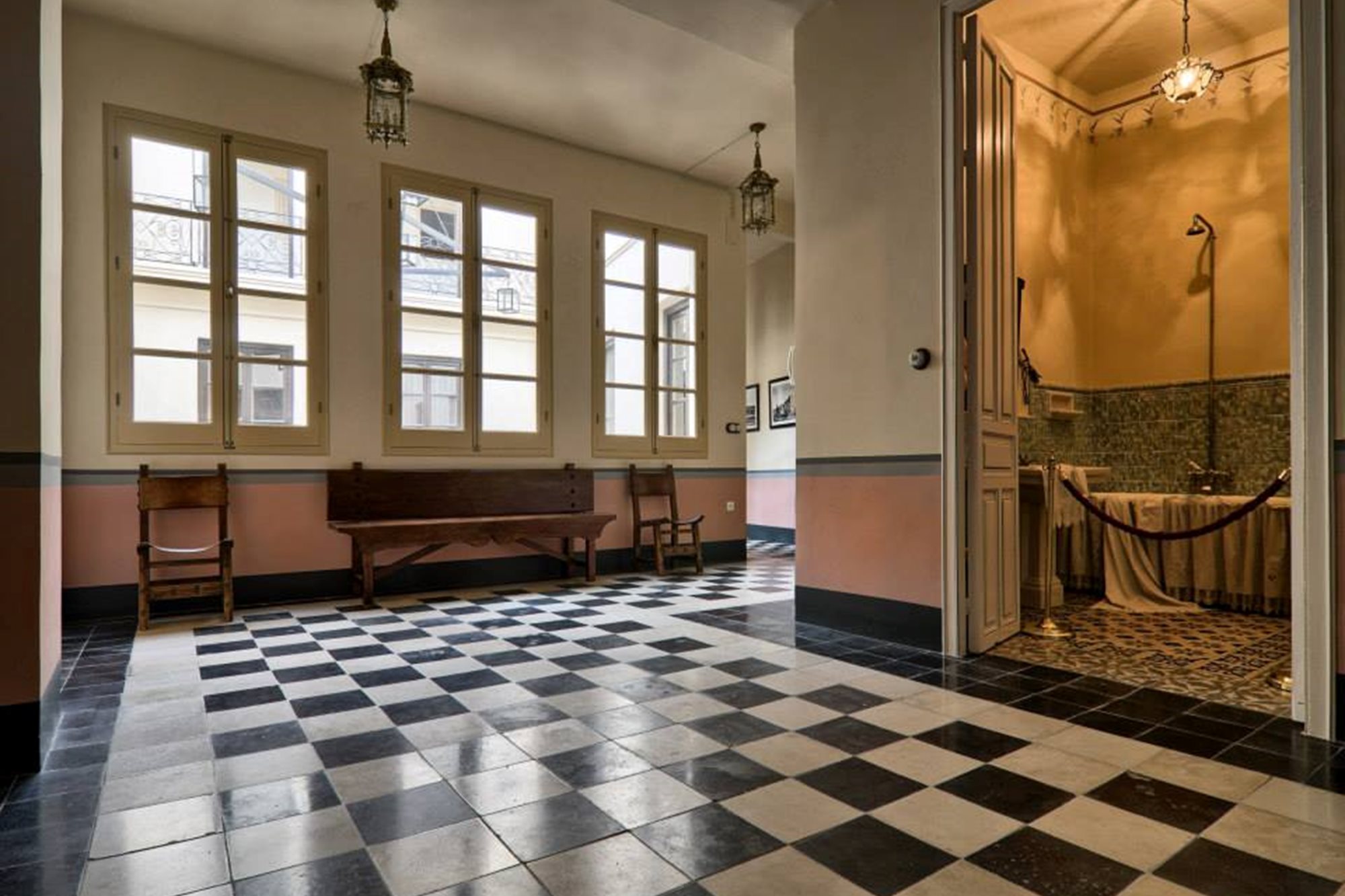
The Palacete de la Hilandera is a jewel of modernist architecture hidden in the historic centre of Alcalá la Real. Situated on Calle Real, one of the main arteries of this town.
It is a bourgeois mansion built at the end of the 19th century. Today it can be visited, and you can admire the furniture, paintings, grills, and stuccoes of that era (late 19th – early 20th century).
Its interior is divided into several thematic rooms. One of these rooms is dedicated to 19th century photography, another is dedicated to crafts and handiwork. Here, pieces made in various techniques are displayed.
Moreover, this mansion hosts craft workshops such as embroidery, oil painting or bobbin lace. It can also be booked for celebrations.
Built: 19th century.
Style: Modernist
Category: Civil
Type: Mansion-house
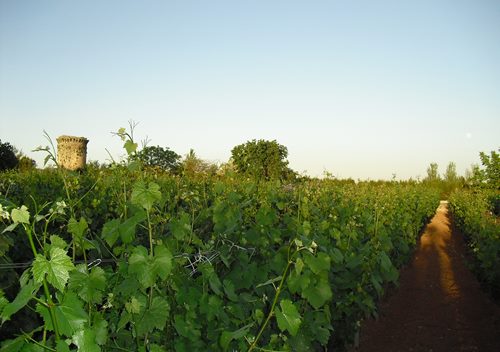
If you like to discover locally produced wines, Alcalá la Real is the perfect place for you. You'll visit Marcelino Serrano's vineyards and winery, where you'll taste three of his own wines and sample typical local aperitifs. You'll discover the complex world behind wine production, its curiosities, anecdotes, etc. All from the hand of experts, such as the winegrower and oenologist Marcelino Serrano, and Blanca María Serrano, oenologist, Technical Engineer in Agro-food Industries and Oenology Graduate from the University of Cordoba.

Address and telephone
Opening times
Services
Guided Tours.If you see any mistakes or want to add anything to this information, please contact us.
If you like to discover locally produced wines, Alcalá la Real is the perfect place for you. You'll visit Marcelino Serrano's vineyards and winery, where you'll taste three of his own wines and sample typical local aperitifs. You'll discover the complex world behind wine production, its curiosities, anecdotes, etc. All from the hand of experts, such as the winegrower and oenologist Marcelino Serrano, and Blanca María Serrano, oenologist, Technical Engineer in Agro-food Industries and Oenology Graduate from the University of Cordoba.
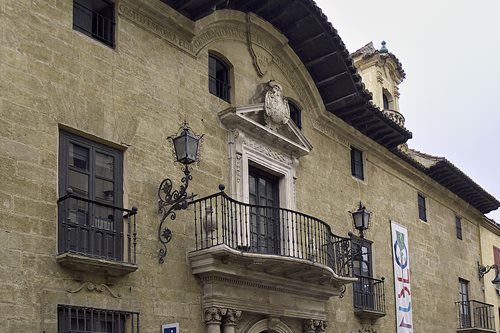
The Abbot's Palace we see today is a reconstruction by Abbot Esteban Lorenzo de Mendoza y Gatica in the last third of the 18th century; as the previous one, which was located within the Fortaleza de la Mota, was in ruins.
For the new palace, several houses from the central Carrera de las Mercedes street were added, merging into a single building and façade. Its use continued until the Abbey of Alcalá la Real was suppressed in 1851. After years of not having a known use, it was converted into an abbatial archive and residence for the Vicar of the Ecclesiastical Territory.
It was restored by Devastated Regions after the Spanish civil war and by the Junta de Andalucía at the end of the 1980s. Its latest rehabilitation was awarded an architecture prize by the Association of Architects.
The façade is divided into three floors. The lower one has lintelled windows and two side doors adorned with mouldings. The second or main body opens outwards with balconies and the upper one with small square windows. A sober arrangement contrasting with the monumental main portal in the centre, whose bay is framed by a semi-circular arch flanked by paired columns on pedestals. A cornice rests on the arch and columns, with the spandrels decorated with vegetal motifs. Above the cornice stands a large curved balcony, with a lintelled bay crowned with a triangular pediment displaying a coat of arms. The entire façade is sheltered by a prominent eave that curves over the main portal.
Today, this palace houses the Archaeological Museum and the Tourist Information Office of Alcalá la Real. The museum was created to exhibit, conserve and disseminate the archaeological, ethnological, palaeontological, ethnological and scientific heritage of Alcalá la Real.
Its collection is organised in several exhibition spaces, supported by new technologies. These spaces are: Flour Room, Geology, minerals and fossils, Palaeolithic, Neolithic, Copper, Bronze, Iberian World, Roman World, Medieval. Among the outstanding pieces, we can find a sculpture of Hercules rescued from the Roman site of the Domus Herculana. Also, the famous Tesorillo de la Ermita Nueva, a 10th-century caliphal treasure that exemplifies medieval life.
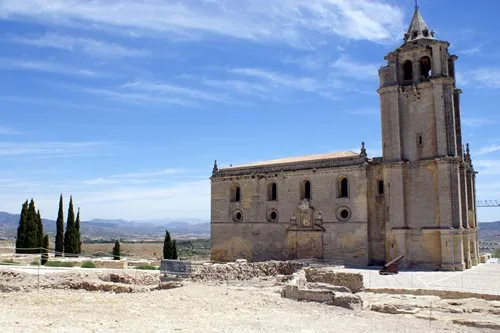
Fortaleza de la Mota is the most prominent monument in the history of Alcalá la Real. A town in Jaén which once marked the border between the Kingdom of Castile and that of Granada.
Alcalá la Real retains the urban structure of the old Andalusian city on the Cerro de la Mota (at 1,029 metres above sea level), which is the high fortified neighbourhood (Citadel of the Mota), and a lower external core where the population is located.
The Fortaleza de la Mota (also known as Alcazaba de la Mota, Castle of Alcalá la Real or Monumental Complex of the Mota) is a Nasrid Monumental Complex (13th and 14th centuries). It was built using previous fortifications. In 1931 it was declared a National Monument, and since 1993 it is a Site of Cultural Interest.
It was one of the largest walled perimeters in Andalusia, as it had more than one ring of wall. Today it is surrounded by just one.
Access to the castle is through a semi-circular archway entrance called the “Puerta de la Imagen”. This entrance is formed by a slightly pointed arch and is located at the base of the Tower of Homage.
This Tower of Homage is square in shape and has only one floor. It is topped with battlements. Its roof is a dome over pendentives. It retains a round-headed elongated opening to the exterior.
Also preserved in this fortress are two smaller towers. The towers are connected by a stretch of wall. This stretch of wall forms a bailey within the fortress. Remains of the quarters that once surrounded the castle can be seen.
Within the walled enclosure, the Abacial Major Church also stands out, of Renaissance style after being built over a Gothic temple.
Currently, this Monumental Complex houses the Frontier Life Interpretation Centre.