Cookie settings
We use our own and third-party cookies in order to offer our services, display videos, obtain statistics and offer personalized advertising.
For more information, please read our cookies policy.
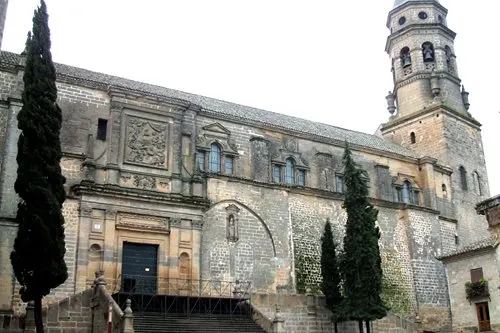
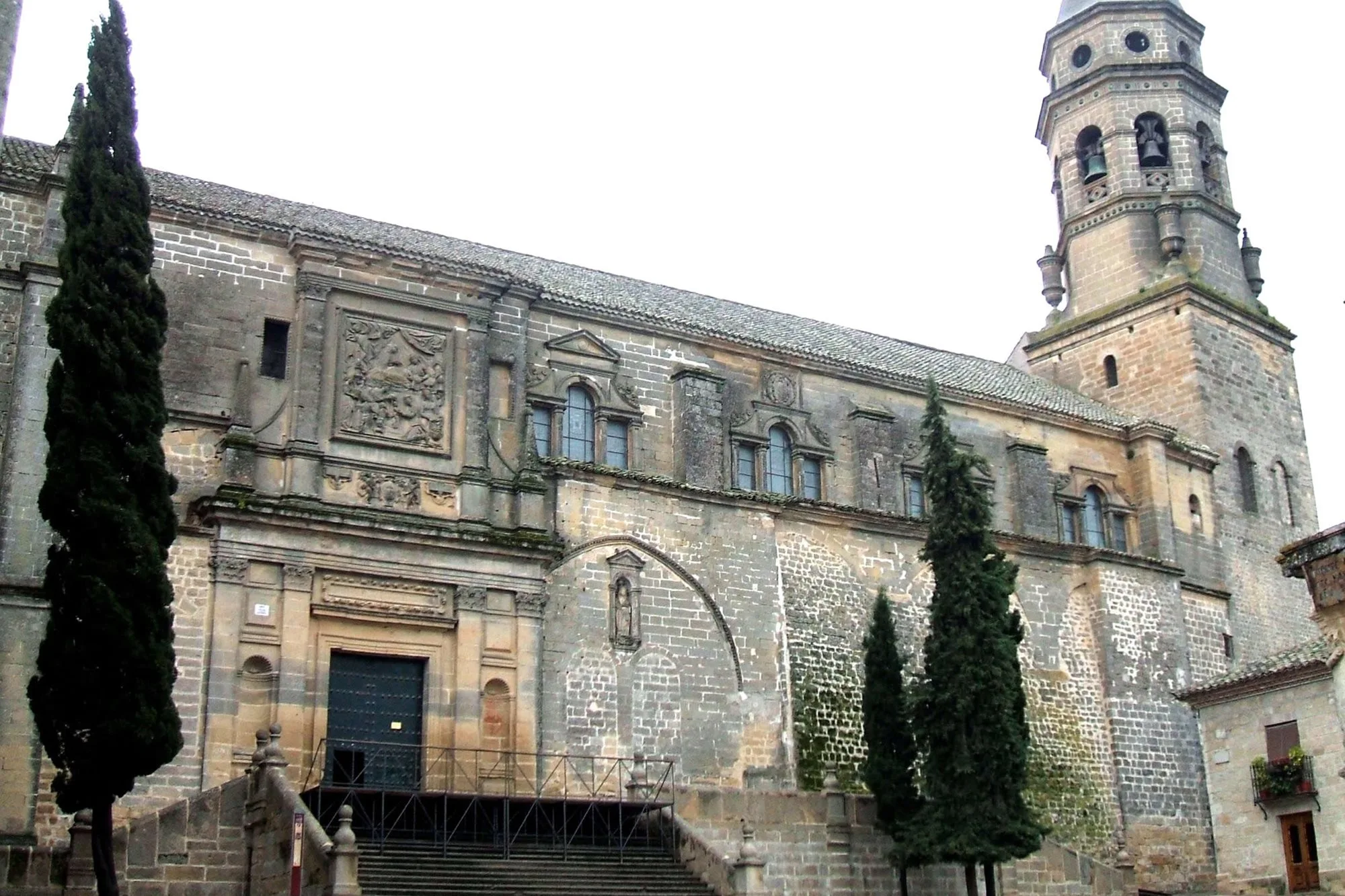
The Cathedral of the Nativity of Our Lady is a true symbol of the Historic Centre of Baeza and the oldest Catholic place of worship in Andalucía.
Its monumentality rises in the Plaza de Santa María, having been built on the site of the old Aljama mosque (main mosque). It has been declared a Site of Cultural Interest since its publication in the Gaceta de Madrid on June 4, 1931.
It was consecrated in 1147 for Christian worship by order of King Alfonso VII. It was then under the dedication of Saint Isidore. Already in 1227, it was definitively consecrated as the "Nativity of Our Lady". In that same year, it was designated as the seat of the Diocese of Jaén, until the transfer of said seat to the capital of Jaén in 1249.
The floor plan of this cathedral is basilical with three naves covered by barrel vaults.
Its oldest part is the lower body of the tower, which corresponds to the minaret of the previous mosque. This body is of a cubic and solid plan, framed by four shafts. Also preserved from that time are three blinded and hidden arches.
Both elements, the lower body of the tower and the blinded arches, belong to the 11th century. In the 13th century, gargoyles were added to the cornice.
It features three façades. The most notable is the north entrance that faces the Plaza de Santa María, consisting of two bodies with Corinthian pilasters. A beautiful relief of the Nativity of the Virgin crowns the door.
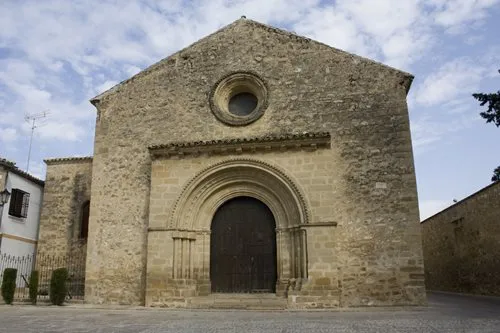
The west façade has a small Gothic-Mudéjar door, called the Moon door (13th century). The most remarkable feature of this entrance is its beautiful rose window, also in Gothic-Mudéjar style.
The south façade or Door of Forgiveness gives access to the Gothic cloister. This cloister stands out for its robust appearance, with its simple pointed arches flanked by prismatic buttresses.
In the 16th century, the cathedral was more extensively remodeled, following the designs of Andrés de Vandelvira, Francisco del Castillo, and Alonso de Barba among others.
The Renaissance construction is evident in its façade and the barrel vaults inside. The naves are divided by square pillars with attached Corinthian columns. The hallmark of Vandelvirian architecture is also observed in the Golden Chapel and Saint Joseph's Chapel.
The Golden Chapel was founded by Dean Pedro Muñoz and is covered by a dome-shaped vault and another barrel vault with coffers. Meanwhile, Saint Joseph's Chapel is decorated with religious sculptures and caryatids.
Its Cathedral Museum holds paintings and valuable religious objects, such as a collection of tunics or old costumes. It is located in the chapter house and the cloister.
Built: 12th - 16th Centuries.
Author: Alonso Barba, Francisco del Castillo, Andrés de Vandelvira
Style: Gothic, Mudéjar, Renaissance
Category: Religious
Type: Cathedral
Baeza is the city of which Antonio Machado wrote ‘Campo de Baeza, I'll dream of you when I don't see you’. With this guided tour you will understand why the illustrious poet expressed his longing for Baeza, a city declared a World Heritage Site together with Úbeda, thanks to its great monumental and historical heritage of its splendid Andalusian Renaissance.
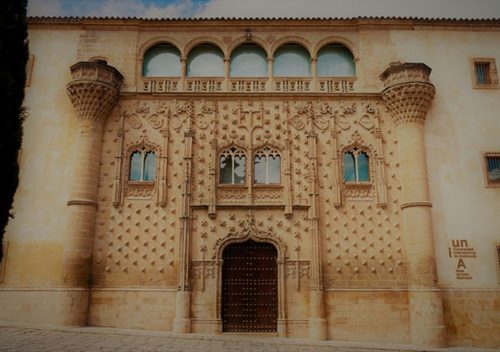
Cobbled streets, a Cathedral of Romanesque origin and later transformed into Renaissance, palaces with beautiful ‘altarpiece-doors’ in honour of the nobles who lived there. It will seem as if you are walking through a Castilian city but in the middle of the olive groves of Jaén. You will also be able to taste the local olive grove's ‘green gold’. A perfect visit to get to know the culture and tradition of Baeza to the full.

Address and telephone
Opening times
Prices
If you see any mistakes or want to add anything to this information, please contact us.
Baeza is the city of which Antonio Machado wrote ‘Campo de Baeza, I'll dream of you when I don't see you’. With this guided tour you will understand why the illustrious poet expressed his longing for Baeza, a city declared a World Heritage Site together with Úbeda, thanks to its great monumental and historical heritage of its splendid Andalusian Renaissance.
Cobbled streets, a Cathedral of Romanesque origin and later transformed into Renaissance, palaces with beautiful ‘altarpiece-doors’ in honour of the nobles who lived there. It will seem as if you are walking through a Castilian city but in the middle of the olive groves of Jaén. You will also be able to taste the local olive grove's ‘green gold’. A perfect visit to get to know the culture and tradition of Baeza to the full.