Cookie settings
We use our own and third-party cookies in order to offer our services, display videos, obtain statistics and offer personalized advertising.
For more information, please read our cookies policy.
It is one of the four universities founded in the 16th century in Andalusia, alongside Granada, Seville, and Osuna, within the group of “minor universities.”
Initially, it was the College of First Letters under the advocacy of the Holy Trinity - represented in the medallion on the façade. It operated until it was abolished in 1824 by Royal Decree.
Later, it became a College of Humanities and a free Institute where Antonio Machado taught classes, and subsequently it was a Secondary Education Institute.
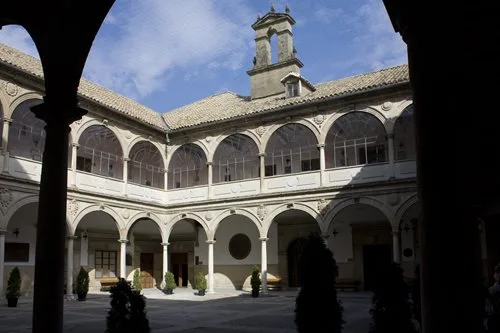
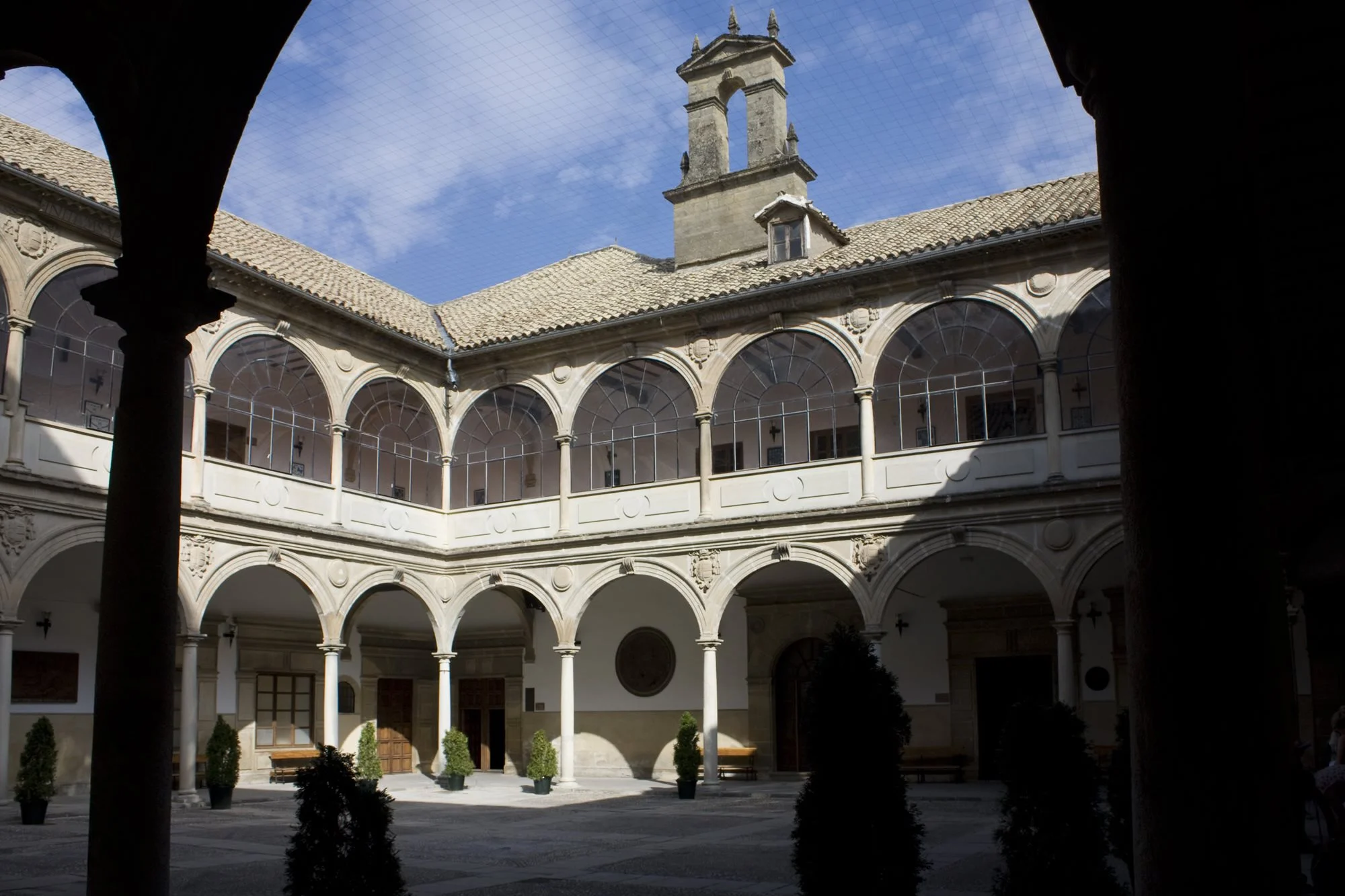
The building is a good example of Mannerism in Baeza, commissioned by the Administrator and Canon Don Pedro Fernández de Córdoba, where the Franciscan convent of San León once stood. It follows the architectural typology of Renaissance palaces, structured in two storeys around a large courtyard. The galleries of both storeys overlook the courtyard with beautiful semi-circular arches on Doric columns and with mirrors in their spandrels.
Among the various rooms surrounding the courtyard, the staircase and the square-plan auditorium stand out. The ceiling of the latter is wooden, crafted with beams, knuckles, and braces with a horizontal panel of hexagons and coffered ceilings.
The façade is made of ashlar stone, with a semi-circular arched doorway. The extrados of this arch is adorned with fluting and acanthus on the keystone. The doorway is framed with double pilasters, supporting an entablature interrupted in the centre by the medallion with the relief of the Holy Trinity. Above it, there is a rectangular window with a parapet and entablature resting on paired Ionic columns. The window is topped with a mixtilinear pediment, curved at the sides and straight at the vertex.
This façade is completed by four rectangular windows and mouldings on the first floor or body. On the second body, the windows are lintelled and with pediments. Some pediments are straight and others mixtilinear, alternately. These last ones harmonise with the upper body of the doorway. There is a third body, with four lintelled windows between fluted pilasters over corbels.
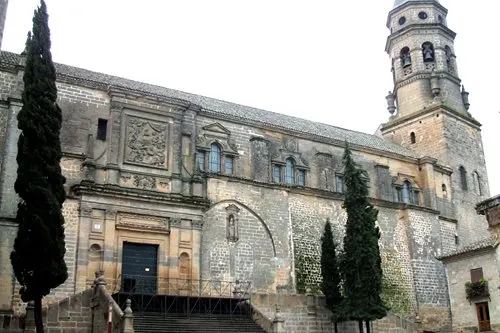
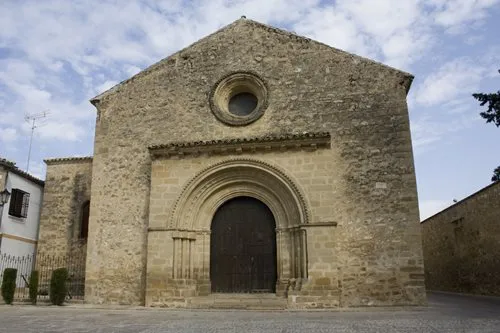
On the left side of the façade stands the chapel of San Juan Evangelista, finished at the beginning of the 17th century. It is a single-nave building with a barrel vault roof, while the chancel is covered with a dome on pendentives supported by four paired, fluted columns with a composite capital. On the Gospel side, there is a large niche closed with a sculpture inside it. At the foot lies the choir, situated over a lowered vault decorated with coffers and lunettes, and with four Doric columns on each side.
On the same plane as the south façade is a semi-circular arched door framed between Corinthian columns and with a grooved extrados. Above its entablature, there is a rectangular body, whose lower part features geometric decoration and in the upper part three circular windows that illuminate the high choir.
As for the west façade, it also has a semi-circular arched doorway, but its extrados is adorned with rhombuses, framed between Corinthian columns and with a pediment. The tower has a first body up to the roof in a square plan, while beyond this it is octagonal in plan.
Built: 1593.
Style: Mannerism
Category: Civil
Type: University
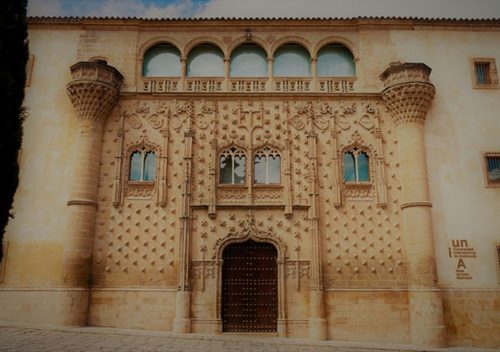
Baeza is the city of which Antonio Machado wrote ‘Campo de Baeza, I'll dream of you when I don't see you’. With this guided tour you will understand why the illustrious poet expressed his longing for Baeza, a city declared a World Heritage Site together with Úbeda, thanks to its great monumental and historical heritage of its splendid Andalusian Renaissance.
Cobbled streets, a Cathedral of Romanesque origin and later transformed into Renaissance, palaces with beautiful ‘altarpiece-doors’ in honour of the nobles who lived there. It will seem as if you are walking through a Castilian city but in the middle of the olive groves of Jaén. You will also be able to taste the local olive grove's ‘green gold’. A perfect visit to get to know the culture and tradition of Baeza to the full.

Address
Calle Conde Romanones, 1, 23440 Baeza (Jaén)Opening times
If you see any mistakes or want to add anything to this information, please contact us.
Baeza is the city of which Antonio Machado wrote ‘Campo de Baeza, I'll dream of you when I don't see you’. With this guided tour you will understand why the illustrious poet expressed his longing for Baeza, a city declared a World Heritage Site together with Úbeda, thanks to its great monumental and historical heritage of its splendid Andalusian Renaissance.
Cobbled streets, a Cathedral of Romanesque origin and later transformed into Renaissance, palaces with beautiful ‘altarpiece-doors’ in honour of the nobles who lived there. It will seem as if you are walking through a Castilian city but in the middle of the olive groves of Jaén. You will also be able to taste the local olive grove's ‘green gold’. A perfect visit to get to know the culture and tradition of Baeza to the full.