Cookie settings
We use our own and third-party cookies in order to offer our services, display videos, obtain statistics and offer personalized advertising.
For more information, please read our cookies policy.
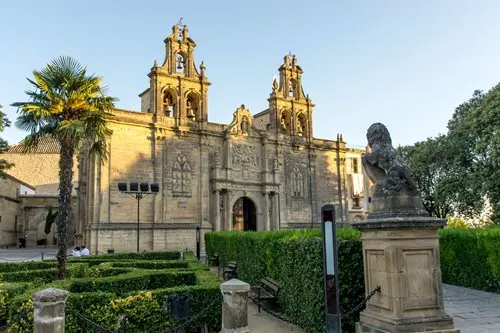
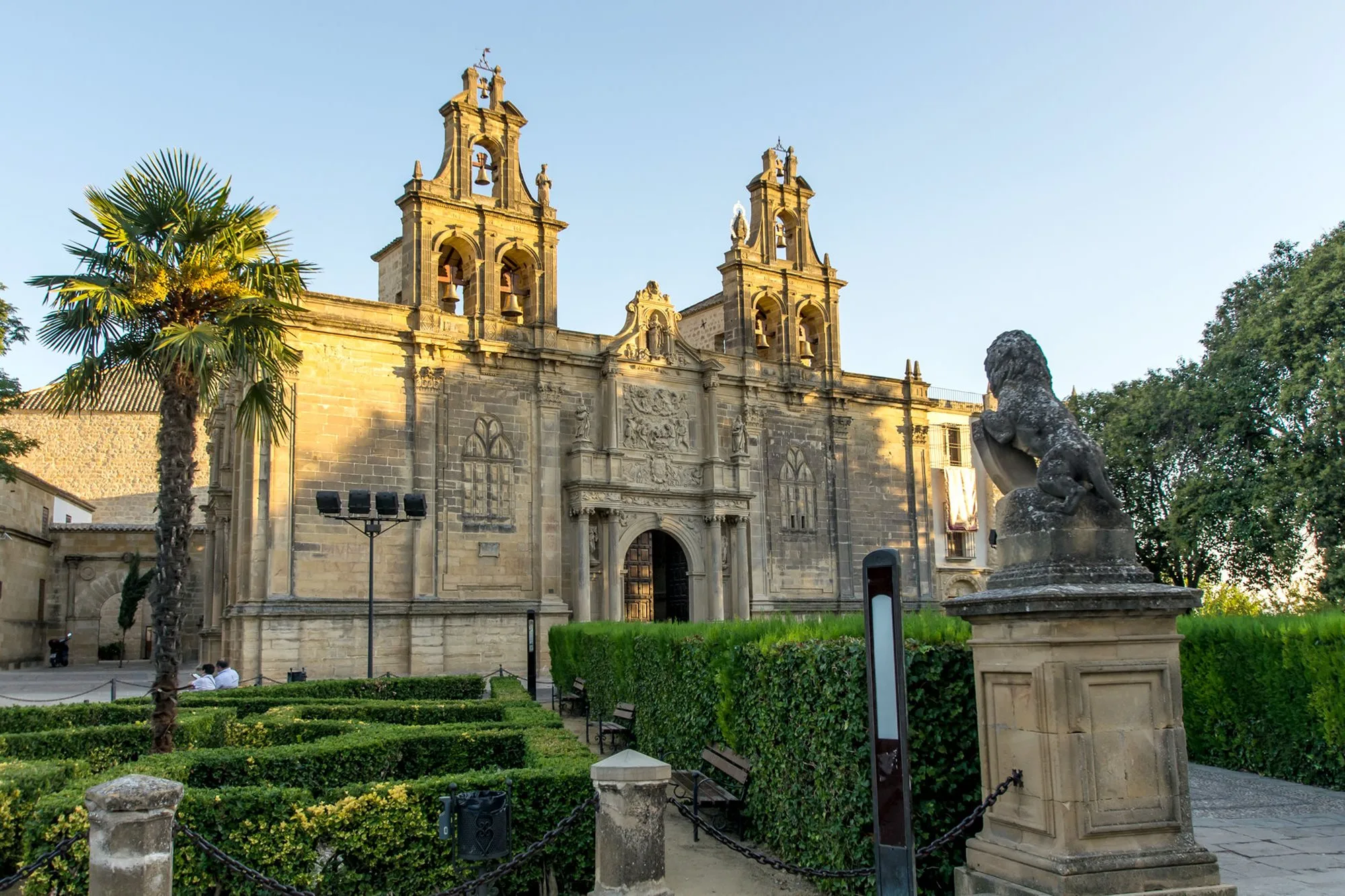
The Basilica and Royal Collegiate Church of Santa María de los Alcázares is the main church of this city and the third in the diocese of Jaén.
It is located in Vázquez de Molina Square. It is declared a National Monument and part of the World Heritage Site.
This basilica is the clearest example in Úbeda of the overlapping of styles, as a result of its long history: Gothic, Mudéjar, Renaissance, Baroque, and Neo-Gothic.
It was built over the original Great Mosque that was located within the Alcázar. Therefore, it was isolated from the rest of the city until the beginning of the 16th century, except for a postern gate, which is still preserved in the cloister. Through this postern gate, it is said that King Ferdinand III the Saint entered to consecrate the mosque for Christian worship, after conquering the city in 1233.
Remains of the defensive barbican of the Alcazaba are still preserved, including an Almohad tower that can be seen outside the Chapel of the Holy Burial.
Its monumental Renaissance façade framed by two outstanding bell gables - made in the 19th century - was started in 1510 and completed in 1645, following the design of Pedro de Vera. The relief of the Adoration of the Shepherds is the work of Luis de Zayas.
Of the same Renaissance style is its lateral façade, better known as “La Consolada”. This was made by Pedro de Cobo, also with images by Luis de Zayas.
Both façades preserve the episcopal coats of arms of Don Sancho Dávila, Bishop of Jaén.
The interior of the church is in the Gothic-Mudéjar style and has five naves on quadrangular columns.
Inside we can find Gothic chapels with wrought-iron grilles by Master Bartolomé, a native of Jaén. The old wooden coffered ceiling was replaced in the 17th century by a barrel vault. In this vault can be seen the coats of arms of the first bishops of Jaén and of Don Diego de los Cobos, Bishop of Úbeda.
The foundations of the old mosque were used for the construction of the irregularly shaped cloister. Its Gothic arcade is from the late 14th century, while the traceried vaults resting on these arches date from 1512.
In 1983, the basilica was closed to worship for restoration, due to the threat of collapse of its pillars. This restoration was first carried out by Ilsicio Ruiz Albusac, and later by Enrique Venegas.
Today, the image of the patron saint of Úbeda, Our Lady of Guadalupe and del Gavellar, brought from her hermitage, is venerated in this basilica. In its chapels, there are processional images for Holy Week, made by Mariano Benlliure, Francisco Palma Burgos, Jacinto Higueras, and other contemporary sculptors.
In 2014, it was declared a Minor Basilica of Úbeda in the diocese of Jaén.
Built: 13th – 19th centuries.
Author: Pedro de Vera, Pedro de Cobo y Luis de Zayas
Style: Baroque, Gothic, Mudéjar, Neoclassical, Renaissance
Category: Religious
Type: Collegiate Church, Minor Basilica
Address and telephone
Opening times
Prices
If you see any mistakes or want to add anything to this information, please contact us.
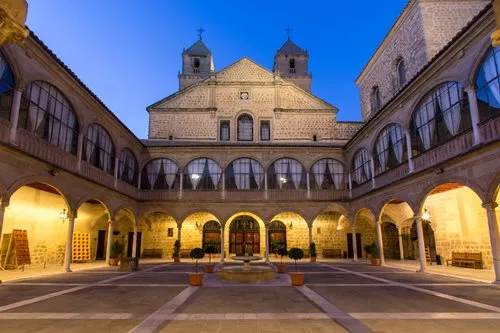
The Hospital de Santiago is considered a pinnacle building of the architect Andrés de Vandelvira.
It started in 1562, as stated on the staircase, and was finished in 1575.
Don Diego de los Cobos (bishop of Jaén) ordered the construction of this building as a hospital for the poor and sick, while also serving as a palace and church-pantheon.
Due to its form, it has come to be called "The Escorial of Andalusia". It is a construction with an austere appearance, almost without ornamentation, yet with a great volume. It is structured over two floors around a large courtyard and a central chapel. Its two imposing towers at the ends of the main facade stand out on the exterior. One of them is notable for its colourful glazed ceramic roof. Another two towers frame the central chapel, these being quadrangular and topped with a hipped roof.
Its main entrance is a semicircular arch with a double voussoir. A tabernacle stands out inside, where the relief of Santiago Matamoros is found. In line with the entrance door, there is a chapel, with a three-door grille to access it. This grille was the work of Juan Álvarez de Molina, following Vandelvira's design.
Its courtyard features a double and open gallery of arches. These arches rest on columns of marble from Carrara. There are two more side courtyards that remain unfinished to this day.
The chapel stands out for its unique originality, presenting a plan in the shape of an inverted H, and two transverse towers that shift towards the centre of the chapel.
A surprising cloister staircase with a double flight rises from one side of the courtyard and is covered with a large "hanging" vault. This vault was decorated with frescoes shortly after being built. The frescoes are attributed to Pedro de Raxis and Gabriel Rosales. Both are documented for the painting of the main altarpiece (a work by Blas Briño and Luis de Zayas), which was destroyed in 1936.
In the vaults of the church, sacristy, and ante-sacristy, similar paintings in a Mannerist style with Italo-classical influence are preserved. These paintings constitute some of the few examples of mural painting from the Spanish Renaissance.
The Hospital de Santiago was declared a National Historic-Architectural Monument in 1917. Today it is used as a Cultural Centre, hosting Exhibitions, Conferences, Symphonic Concerts, Piano, Singing Cycles, and other activities.
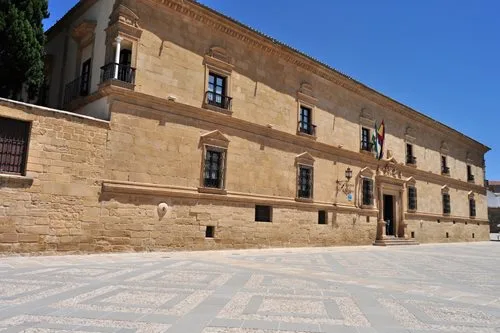
Also known as the Palace of the Marquis of Donadío, it is one of the most important Renaissance palaces in Úbeda. Since 1929, it has been a Parador Nacional de Turismo.
It is a clear example of the simplicity and sobriety of Castilian architecture at the turn of the 16th to the 17th century.
It was built in the mid-16th century by Andrés de Vandelvira, commissioned by Fernando Ortega Salido (dean of the Malaga Cathedral, Chantre of the Church of Santa María de los Reales Alcázares, and first chaplain of the Sacra Capilla del Salvador).
The layout of this palace is rectangular, like most that exist in Úbeda.
Its central courtyard is square and with a more intimate and elegant character. The galleries of the two floors of the palace overlook the courtyard through semicircular arches. The columns are influenced by Granada for their slenderness, thus uniting the Nasrid tradition with the Renaissance.
On the South side rises the main façade, divided into two horizontal sections. The main entrance is preceded by a staircase. It is lintelled and framed by two Doric columns on pedestals. Two angels crown it, holding the arms of D. Ezequiel Fernández de Liencres y Pando de Castañeda, I Marquis of Donadío, whose family owned this palace for a century.
The windows of this palace are also of sober elegance, with a simple frame and triangular pediment on the ground floor; while on the upper floor they are topped with mixed linear pediments with a simple frieze in the centre.
Curiously, the rings for tying horses and corner balconies, very typical of the palaces of the era, also stand out on its exterior.
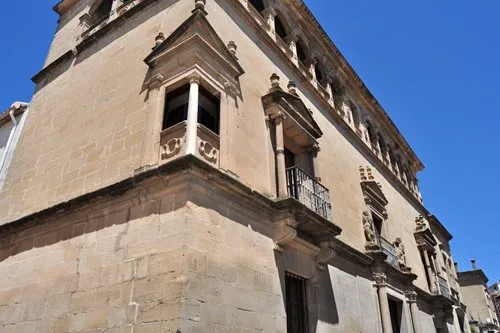
The Palacio Vela de los Cobos is a prime example of a Renaissance palace in the heart of Úbeda's historic centre, a UNESCO World Heritage city.
It was built in the mid-16th century by the stonemason Jorge Leal following the designs of Andrés de Vandelvira, architect for Francisco de los Cobos (secretary to Charles V). It is constructed with stone ashlar.
The building is structured into three floors arranged around a central courtyard with columns and arches. The grandeur and elegance of the façade, like in the majority of palaces from the period, increase as you go up each level.
In the centre of the ground floor, the main lintelled doorway stands out, framed with Corinthian columns. The windows on either side of this floor are also lintelled.
The second floor has four balconies: the central one, aligned with the main door, is framed with pilasters, upon which sculptures supporting heraldic shields rise. The side balconies are flanked by detached columns. On the ends of this floor, angled balconies open up, supported by a marble mullion. Both the pilasters and the balcony columns are of the Ionic order. Above each lintel, there is a triangular pediment with candelabra at its vertices.
The upper floor features a gallery of semicircular arches, also with a marble mullion at each of its angles.
A large cornice and balustrade top off the whole building.
Today, this palace houses an interesting collection of artworks and a library. Its interior also offers tourist apartments.
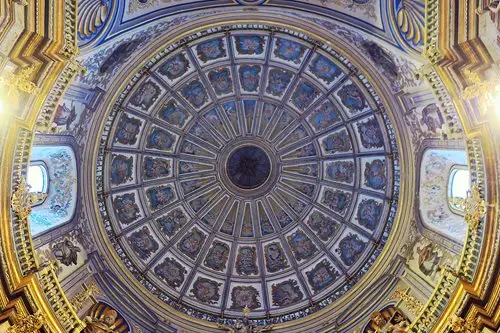
The Sacred Chapel of the Saviour is located in the emblematic Plaza Vázquez de Molina in Úbeda (Jaén). It is one of the most symbolic monuments of the city.
At the same time, it is the most ambitious temple of private religious Renaissance architecture in Spain.
It was built in 1536 under the patronage of Francisco de los Cobos, personal secretary to Emperor Charles V. His idea was to create a pantheon attached to his private palace, located in the same square. It was declared a historic-artistic monument in 1931.
It forms part of a broad artistic programme of the 16th century, along with the aforementioned Francisco de los Cobos Palace, a Hospital and a University. This programme aimed to spread the fame, fortune, and glory achieved by Francisco. To this end, he sought out first-rate artists.
Initially, the project of the Sacred Chapel of the Saviour was commissioned to Diego de Siloé (1536), but it was carried out by Andrés de Vandelvira from the year 1540. Its church is a single nave, with a large centralised chancel, where the main altar is located. 1559 was the year of its consecration.
The sculptural decoration was carried out by the French sculptor Esteba Jamete. Other prominent artists of the time also participated in the project, such as Berruguete (author of the original altarpiece of the main altar), the ironworker Villalpando or the Italian painter Julio de Aquiles.
To the left of its main façade, the great Dean Ortega Palace, first chaplain of the temple, was erected.