Cookie settings
We use our own and third-party cookies in order to offer our services, display videos, obtain statistics and offer personalized advertising.
For more information, please read our cookies policy.
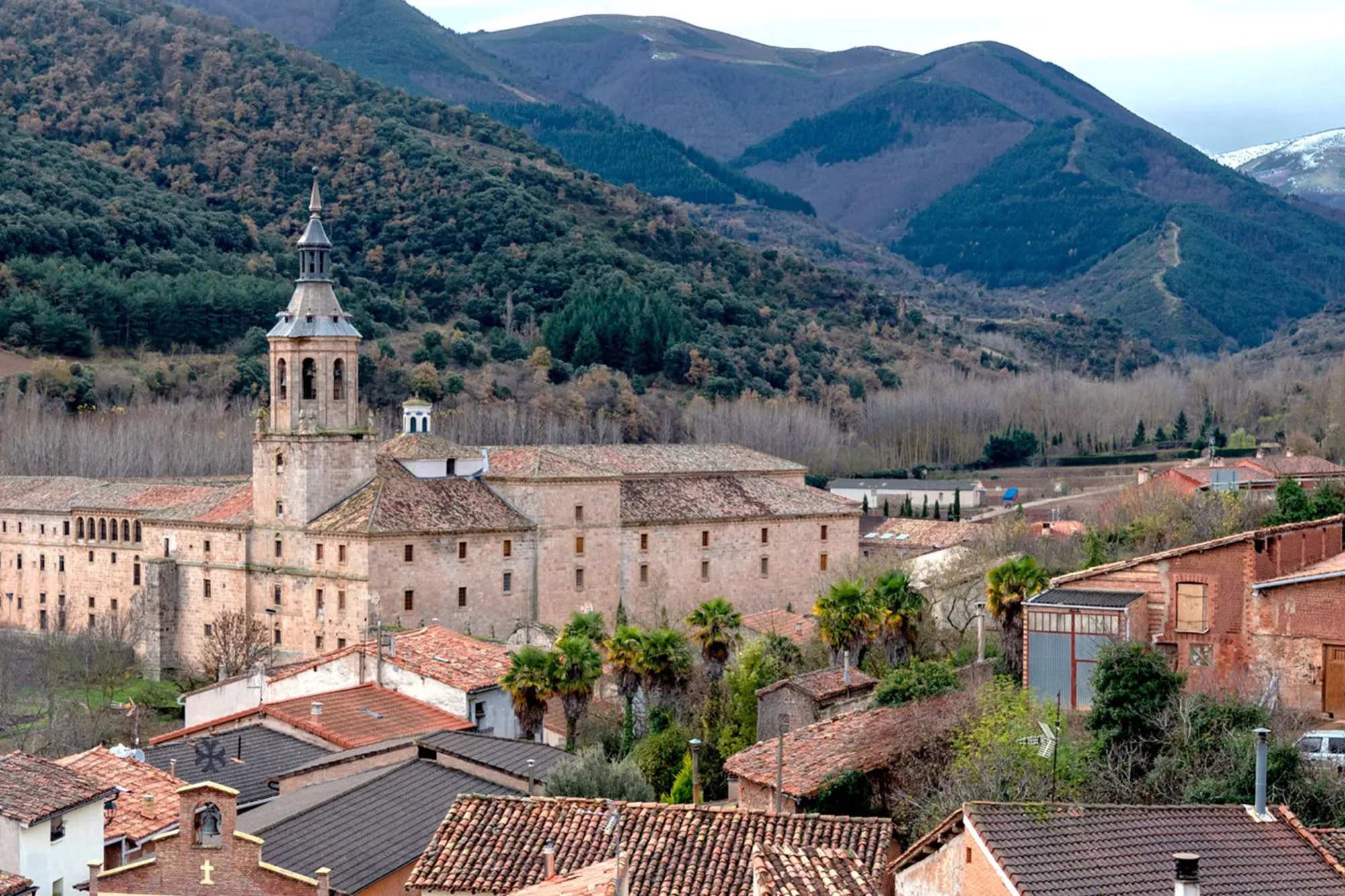
The village of San Millán de la Cogolla is located on the bank of the Cárdenas River. In addition to its magnificent natural surroundings, the Sierra de la Demanda, San Millán de la Cogolla is famous for housing the Monastery of San Millán, comprising the monasteries of Suso (upper) and Yuso (lower).
The Monastery of San Millán de Suso, dating back to the 6th century and initially a group of small caves, was the first to be built. It was gradually expanded, hence it contains Visigothic, Mozarabic, and Romanesque elements. This monastery also preserves original caves where several unidentified graves are found. These grottoes served the saint who founded and gave rise to the village, the hermit San Millán, as a place of retreat and prayer. The library and archive of San Millán de Suso constitute one of the finest monastic collections. It was here in 1911, within the so-called Codex 60, that the Glosas Emilianenses, the first words in Spanish, were discovered. This is why San Millán de Suso is known as the "cradle of the language".
The Monastery of San Millán de Yuso was ordered to be built by the Navarrese king García III, who exhumed San Millán's remains from his tomb in Suso to transfer them to the Monastery of Santa María Real de Nájera, which he had just founded. During the transfer of the saint's remains, the oxen pulling the cart carrying the coffin stopped at a certain point and King García III took this as a sign that the saint did not want to leave San Millán, so he ordered a monastery to be erected on that site. It is a larger building than that of Suso and was originally Romanesque, but in the 16th century, it was demolished and rebuilt in Herrerian Renaissance style. However, in the Monastery of Yuso, two Romanesque artworks can still be seen: the casket of San Felices and that of San Millán.
The Monastery of Yuso is the current headquarters of the International Research Centre of the Spanish Language.
The aforementioned Monastery of Santa María Real is located in Nájera. Of Mozarabic and Romanesque origin, it was originally founded in a cave. The monastery was rebuilt in 1442 in a Gothic style. This monastery is notable for its altarpiece and its choir in a Gothic and flowery style.
Twenty minutes from the town of San Millán de la Cogolla is the Monastery of Valvanera, in the town of Anguiano. This monastery is one of the most important spiritual centres in La Rioja and houses the famous statue of the Virgin of Valvanera, patron saint of the autonomous community.
Near San Millán, there is the Monastery of Our Lady of Mercy, a Late Gothic style monastery, designed by Juan Gil de Hontañón.