Cookie settings
We use our own and third-party cookies in order to offer our services, display videos, obtain statistics and offer personalized advertising.
For more information, please read our cookies policy.
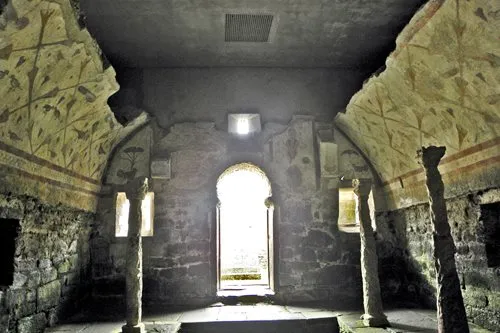
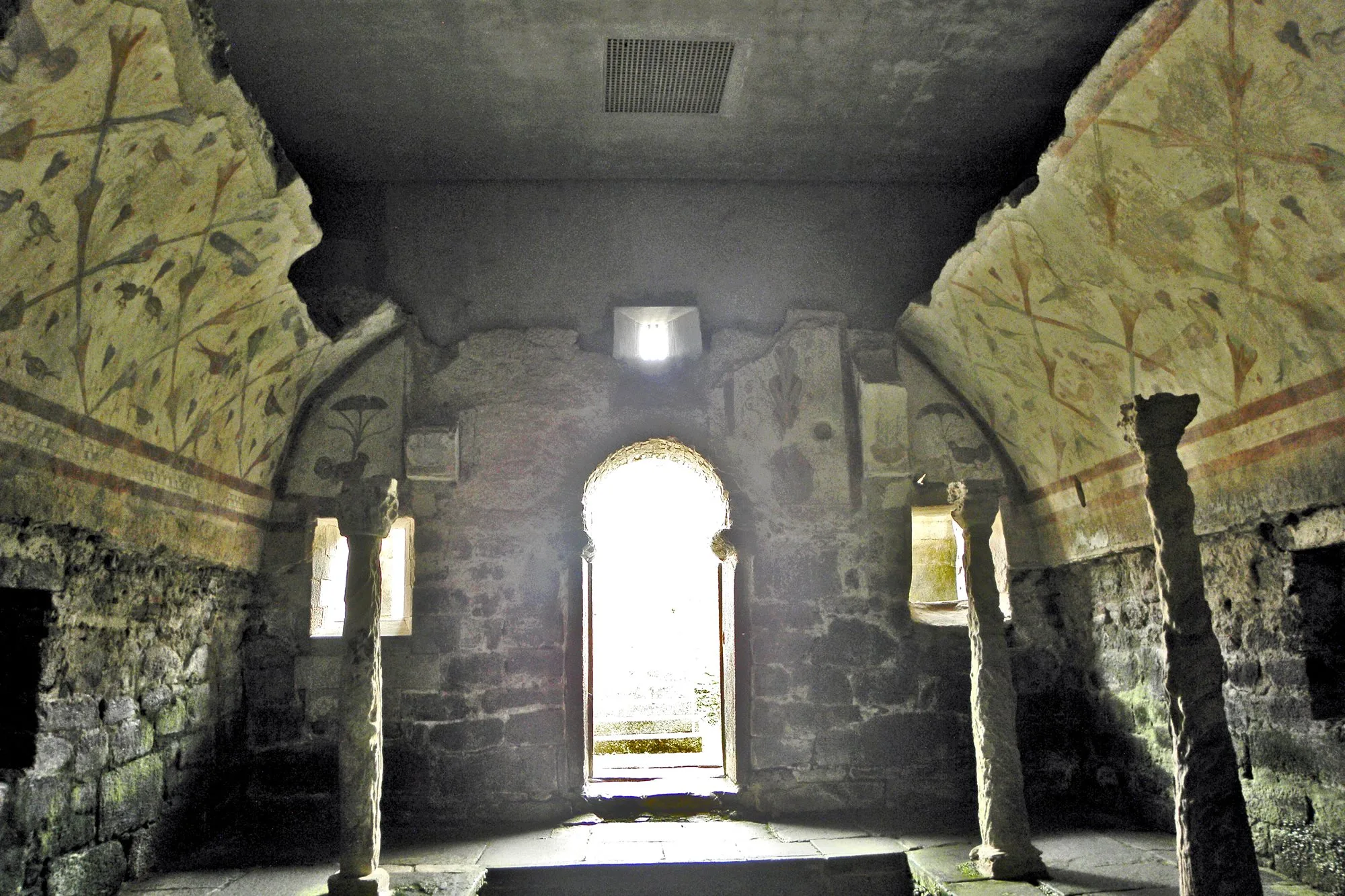
It is one of the magical places in Galicia and unique in all of Europe. It is a late Roman building, with no specific typology and a rectangular floor plan.
In the centre it has a small pool, with corner columns, and covered with a barrel vault decorated with paintings. The facade with a horseshoe arch door opens onto an atrium with two columns.
In the Germanic era and later, it underwent some reform in its function as a Christian temple. After being buried for centuries, it was discovered in 1926 and in 1931 it was declared a National Artistic Monument. Today, it is classified as a Cultural Heritage Site, under the ownership of the Xunta de Galicia.
This small building was possibly constructed in the 4th century although its purpose is not exactly known. It may be related to the worship of water and in later centuries was used as a Christian church. Some extraordinary Roman murals are preserved, with impressive realism and colour, representing various birds such as peacocks, pigeons, or pheasants. It is located in a village with traditional architecture where houses, sheds, ovens, horreos, and well-crafted walls are preserved.
Built: 4th century
Author: Anónimo
Style: Late roman
Category: Religious
Type: Temple
Address and telephone
Opening times
Prices
Free admission.
If you see any mistakes or want to add anything to this information, please contact us.

Book your hotel