Cookie settings
We use our own and third-party cookies in order to offer our services, display videos, obtain statistics and offer personalized advertising.
For more information, please read our cookies policy.
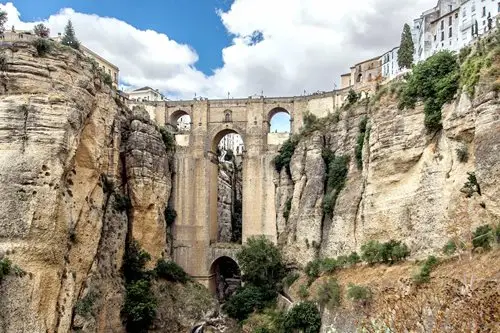
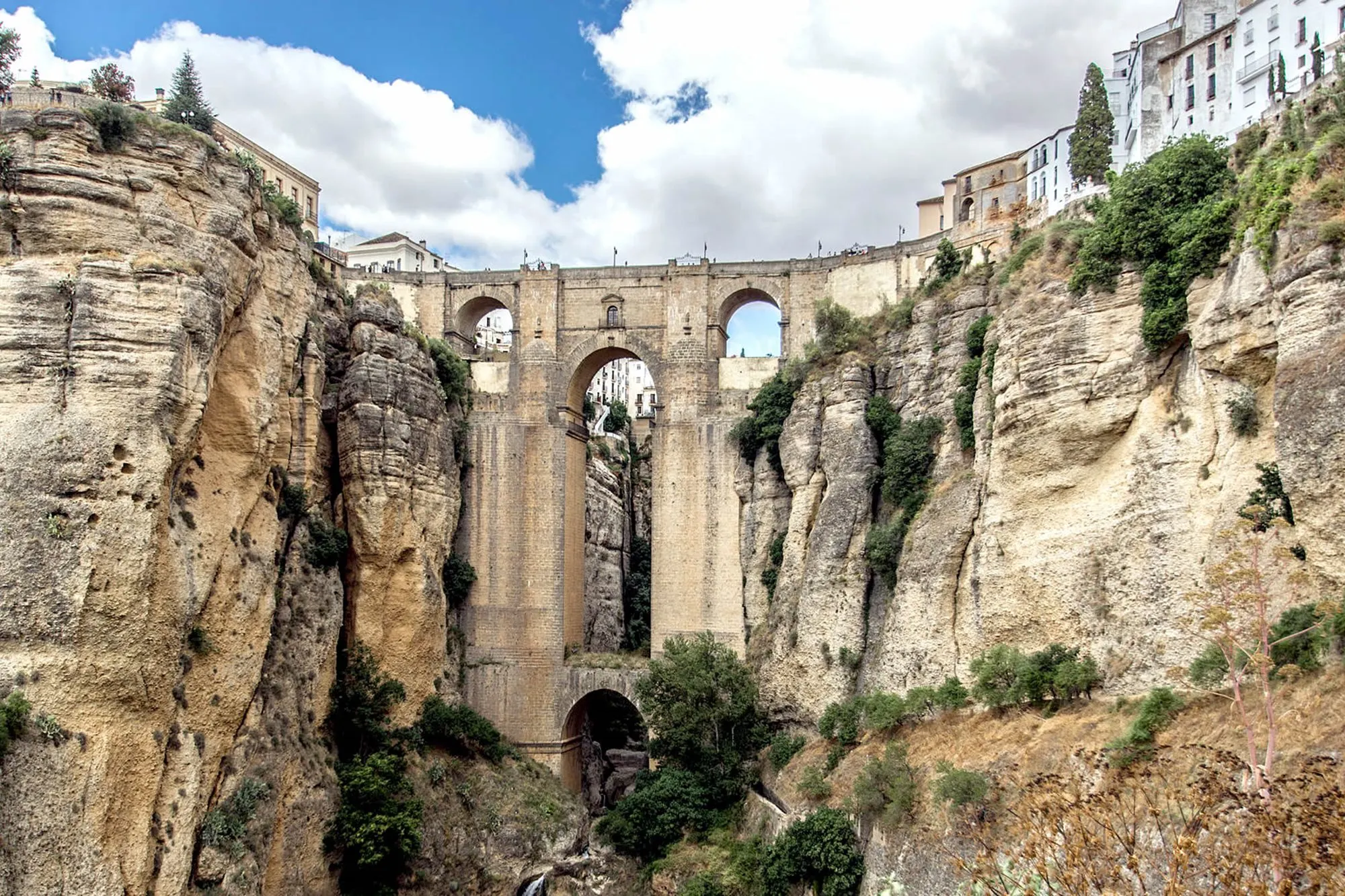
The greatest charm of this Malaga town is that its urban core is divided by the Gorge of Ronda and the New Bridge which connects both sides. This gorge is a ravine with a depth of over 100 metres. Furthermore, Ronda is one of the most notable towns on the White Villages route, located in the heart of the Ronda Mountains and just a few kilometres from the Costa del Sol. Here, ancient civilizations lived from the Celts, through the Phoenicians, Romans, and later Arabs, until the Christian reconquest.
The historic centre of the city (Cultural Heritage Site) lies to the south of the Guadalevín, preserving Arab reminiscences and a medieval layout. To the north of this riverbed is the Ronda that emerged in the Modern Age, from the 16th century. Several bridges connect both sides.
Ronda is also known as the “city of castles”, standing as a natural lookout with a defensive citadel at its most accessible part. To this day, its most significant walls and gateways giving access to the city are preserved. Access to the urban core in the southern part is through the Puerta de Almocábar (13th century), while the Puerta de la Exijara led to the Jewish quarter and the Puerta de Carlos I dates from the 16th century.
Within the walled enclosure of the old Ronda Citadel stands the Gothic-Renaissance church of the Holy Spirit. It was built by order of Ferdinand the Catholic in commemoration of the capture of Ronda. Another outstanding church is Santa María la Mayor, where both Arab and Christian elements meet.
The Great Mosque was built in the 13th century on a Roman temple. Its mihrab arch and minaret (now a bell tower) are preserved. Its interior was later decorated in Renaissance and Baroque style. The San Sebastián Minaret displays Mudejar decoration with horseshoe arches and stuccos. From the Arab period, the 13th-century Arab baths, which are in very good condition, also survive.
The civil architecture of Ronda is characterised by its palaces and stately homes. Some of the most charming buildings are the Palace of the Marquis of Salvatierra, the Mondragón Palace (now Ronda Archaeological Museum) and the House of the Moor. This last one preserves beautiful Gothic-Mudejar decoration, and its hanging gardens are declared an Artistic Garden. Other museums of great interest are the Bandit Museum, the Lara Museum, and the Hunting Museum.
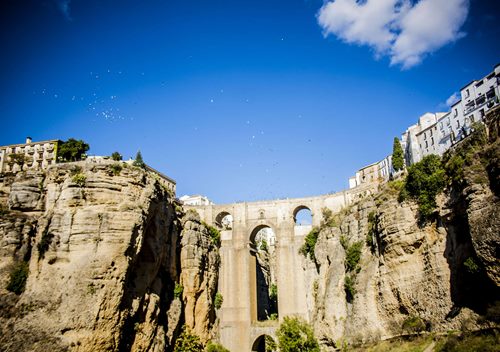
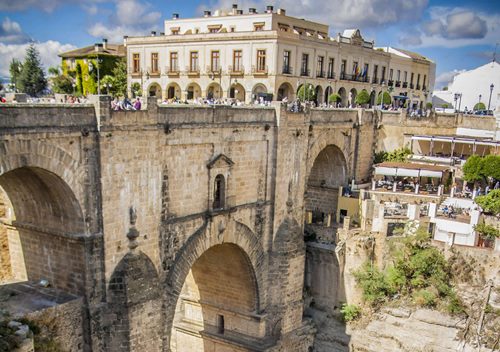
As mentioned previously, both sides of the city of Ronda are connected by bridges: The Arab Bridge (14th century), which led to the Old Suburb; the Old Bridge, with an arch of ten meters in diameter; and the New Bridge (18th century), the most prominent as a great engineering work connecting the neighbourhoods of Mercadillo and La Ciudad. The foundations of this bridge rest at the base of the ravine, reaching up to ninety-eight meters high and seventy meters long in some points.
The cliff is dominated by the old Town Hall (now a very special Parador de Turismo with spectacular views). Other perfect places to contemplate the landscape of the Guadalevín River are the Viewpoint of the Catholic Monarchs (near the Bullring, one of the oldest in Spain) and the Blas Infante Walk. In the urban layout of this area, the Virgin of the Sorrows Chapel and the church of Nuestro Padre Jesús stand out, the latter being Gothic in style with a Renaissance bell tower.
The Intangible Heritage of Ronda is formed by festivities of great interest, which make the city shine in all its splendour. The Pedro Romero Fairs with the Goyesque bullfight and the flamenco festival are its most notable events, along with Holy Week, the Pilgrimage of Our Lady of the Head, and the Reconquest Festivities.
Get to know by first hand the historical centre of Ronda, one of the most visited cities in Malaga's province.
Yo'll enjoy a pleasant walk along with an official tour guide, in which you'll stroll the Ronda streets and discover its culture and history. You'll be surprised with the amazing "Tajo de Ronda", an authentic icon of this city, as well as its ancient Celtic and Greek origin. Without forgetting the emblematic bullfighting ring and much more!
Delve into the history of Ronda, one of the most charming towns in Malaga province. Do it on this guided tour exclusively for you.
While you walk through the historic center of Ronda with an official guide, you will learn about its Celtic origin, the name that it had with the Ancient Greeks, and the legacy left of both Muslims and Christians.
You will walk through emblematic enclaves such as the gorge, the New Bridge, the bullring (one of the oldest ones in Spain), among others interesting sights.