Cookie settings
We use our own and third-party cookies in order to offer our services, display videos, obtain statistics and offer personalized advertising.
For more information, please read our cookies policy.
The original settlement where Estella is located was originally called Lizarra, which in Basque means ‘place of ash trees’. This municipality in the western mid-region of Navarre boasts an important patrimonial treasure due to its long historical past and its importance as a junction of the Camino de Santiago.
The Church of San Pedro de la Rúa, predominantly Romanesque in style, is one of the oldest temples in Estella. It stands on a large rock facing the Palace of the Kings of Navarre. The cloister of this church is notable, although only part of it remains. The columns supporting the arches of the gallery feature capitals with great sculptural richness.
The Church of San Miguel, on the other hand, combines a late Romanesque style for its apse and Gothic for its naves. It is a temple that has undergone various expansions and remodels over history, so it is easy to distinguish different volumes and additions that almost hide the original Romanesque plan.
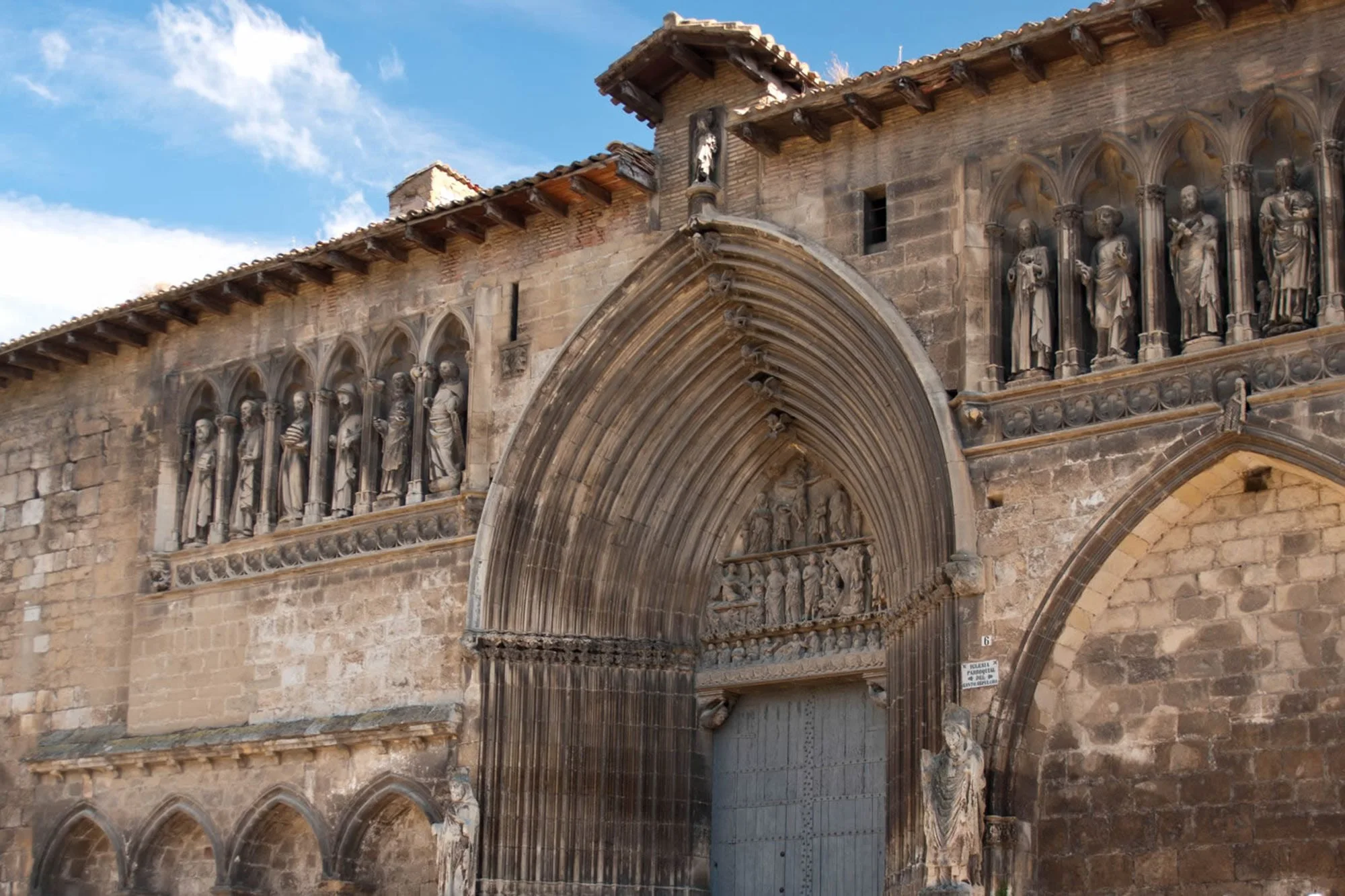
The Church of the Holy Sepulchre in Estella is also one of the oldest in the municipality. The most remarkable aspect of this temple is its façade, where there are several sculptural figures depicting the twelve apostles and Jesus Christ. Additionally, the representation of the apostle James in stone welcomes pilgrims arriving in Estella.
Among the civil monuments, the Palace of the Dukes of Granada de Ega or Palace of the Kings of Navarre stands out. It is Romanesque in style and extremely important as it is the only building of this style for civil use in Navarre.
Another notable place in Estella is the Park of the Awakened. It is a space where the sculptures of artist Luis García Vidal can be found. These works represent human skulls and are made from wood, cloth, and paint; as well as the stone and undergrowth of the area.