Cookie settings
We use our own and third-party cookies in order to offer our services, display videos, obtain statistics and offer personalized advertising.
For more information, please read our cookies policy.
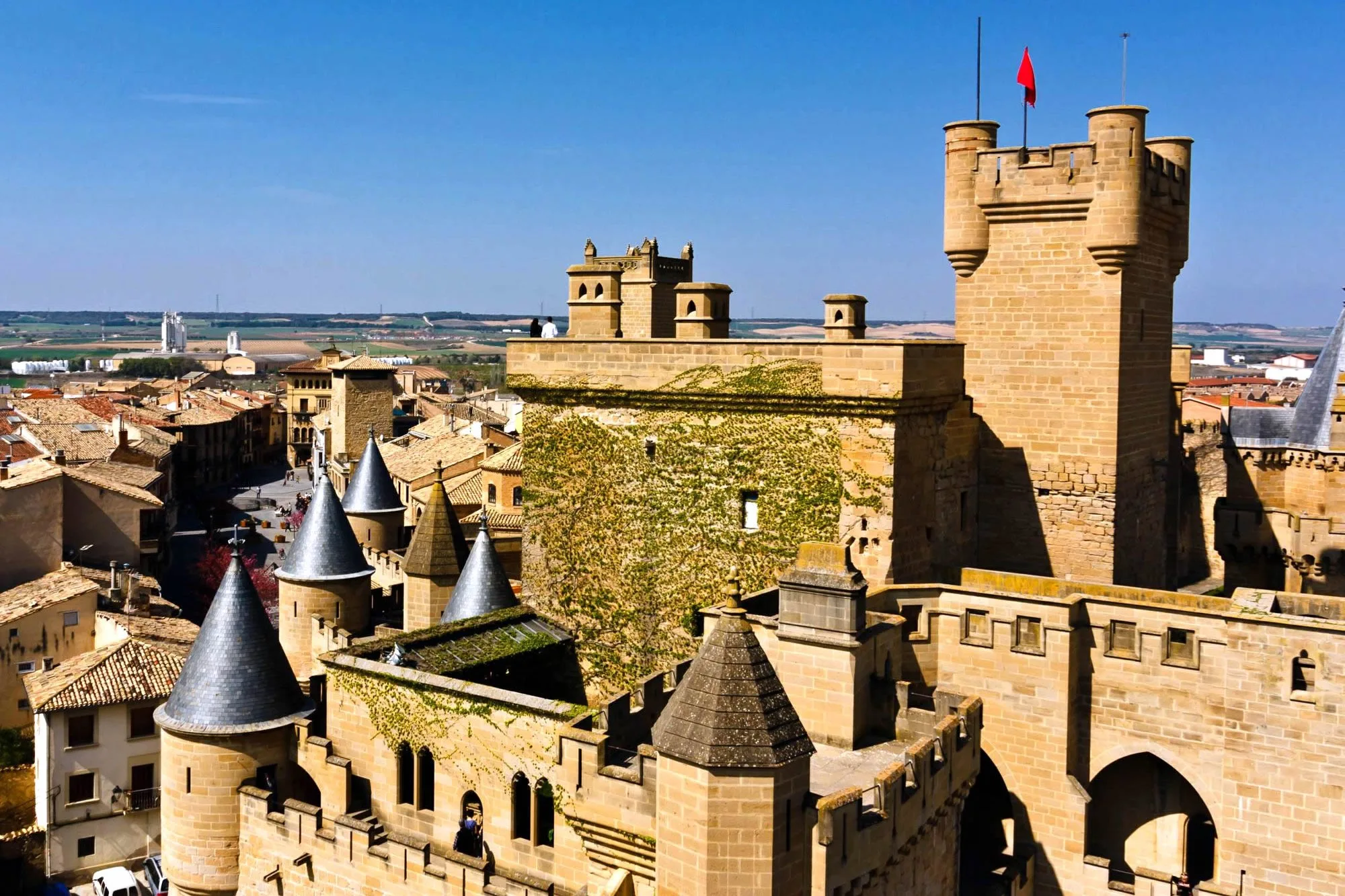
Olite is a town in Navarra that boasts an important historical past. From the Roman archaeological remains found, we know that Olite was a walled settlement until the medieval founding of the town.
During the 15th century, the Navarrese kings began constructing the Royal Palace of Olite, as the town was one of the favourite places of the monarchs of Navarre. This palace is commonly known as the “castle of Olite” and its construction led to the expansion of the palace of the Theobalds, an original Roman defensive structure, which is now the site of the national tourism parador. The Royal Palace of Olite is particularly attractive due to the disorder of its composition, as it never had a fixed design for its construction, but was expanded and refurbished several times over the years.
From the medieval period, many other remains are also preserved in Olite. The medieval underground galleries served various purposes during the time, and can still be visited today.
The Chapitel tower originally formed part of the Roman wall of the town, of which some remnants are still attached to the houses. This tower underwent several modifications which enabled it for different uses such as town hall or clock tower.
Among the religious buildings in Olite are found the churches of San Pedro and Santa María la Real. The first is the oldest of all those found in Olite and represents a mix of various styles. The most outstanding feature of this temple is its gothic tower over fifty metres high. Santa María la Real, on the other hand, is a beautifully gothic church that was built in conjunction with the Royal Palace of Olite.