Cookie settings
We use our own and third-party cookies in order to offer our services, display videos, obtain statistics and offer personalized advertising.
For more information, please read our cookies policy.
The palace was built according to the design of Virgilio Rabablio, a disciple of Santiago Bonavía (with whom he worked on the church of San Justo and Pastor in Madrid, in 1752). The exterior decoration was commissioned to Pedro Sermini. This made the palace one of the buildings with the greatest neoclassical influence.
The Marquis and Queen's secretary Annibale Scotti advised her on the construction of this palace. Scotti was an architecture enthusiast and was dissatisfied with the project designed by Sachetti for the Royal Palace of Madrid. Therefore, his criteria influenced the creation of a corrected and slightly reduced version of that building in the Royal Palace of Riofrío. The architect Vigilio Rabaglio was undoubtedly influenced by the more prominent Bovania and Scotti. Construction began in 1751 and was completed in 1762. However, when Charles III ascended the Spanish throne and his mother returned to her representative role at court, attention to this site waned.
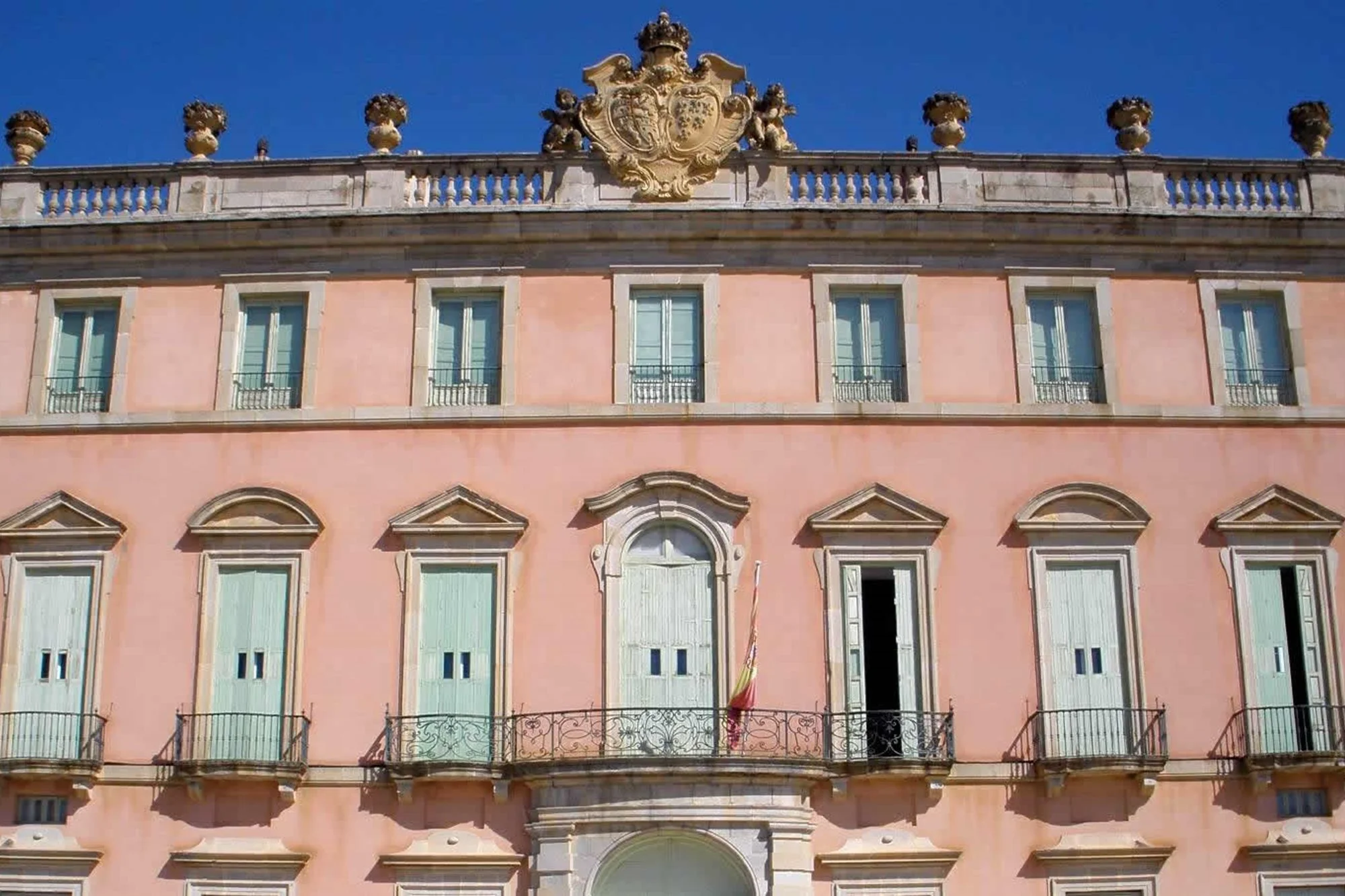
Its exterior elevation is austere and distanced from the Spanish Baroque style, adhering to a three-storey building, square in plan and centred by a large courtyard. Its four façades are practically identical. From the original design (large gardens, theatre, Franciscan convent with its church, Corps and Valonas guard barracks, tradesmen's houses and stables) conceived by Scotti, only the palace was completed. Of the two wings the honour courtyard for stables was supposed to have, only one was finished.
The result is a sober yet elegant building in its proportional layout, as observed in its elevation. We can see a subtle contrast created by the alternation of curved and rectangular pediments in the windows on its intermediate floor, as well as in the play of colours on the façade. The centrality of its façade is reinforced by the side bodies and its corners highlighted by ashlars, as well as the more decorative central door and its axis topped with the upper coat of arms.
The decorative elements of the palace and its basecourse ashlars are made of granite, while the surfaces are plastered.
The two wings with arcades on the exterior next to the palace were designed to house numerous service departments and other complementary ones (church and theatre).
Its Italian architecture is noted for its two main staircases, which are twin and symmetrical.
After the death of Isabel de Farnesio, the building remained a hunting lodge in the 18th and 19th centuries and as a temporary residence of Francisco de Asís and Alfonso XII. Hence, its furnishings and interior decoration belong to these eras.
Address and telephone
Opening times
* Ticket office opening and palace access until one hour before closing.
Prices
If you see any mistakes or want to add anything to this information, please contact us.