Cookie settings
We use our own and third-party cookies in order to offer our services, display videos, obtain statistics and offer personalized advertising.
For more information, please read our cookies policy.
The archaeological site Plaza de Armas (or Alcázar of Écija) is located on one of the highest parts of the city. Its area covers 5,480 square metres. It represents the history of Écija, as different levels can be observed according to its successive occupations from its origins to the present day.
The oldest remains documented date from the Late Bronze Age, whose foundations would have had oval and circular huts, as well as some rectangular structure.
Subsequently, came the occupation by the Turdetani, whose urban planning at that time consisted of paved streets. It wasn't until the Roman era that Écija was reoccupied. During this period, the Iberian structures were demolished and the materials reused for the new city. Several domestic structures with Roman mosaics of great value were documented in the plaza de armas.
In the 11th century, the Almoravids demolished what had been built to erect the alcázar of Istiya. Two centuries later, the alcázar passed into Christian hands following the conquest of the city in 1240, and the plaza was restructured. In the 16th and 17th centuries, it was abandoned. It became a horse riding school in the 18th century, colloquially known among the people of Écija as the Picadero neighbourhood.
The local Town Hall undertook recovery works in 1999 with various excavations, which continue today.
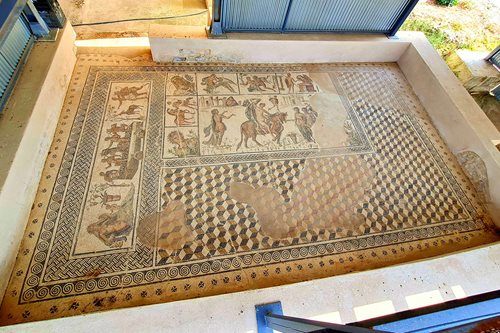
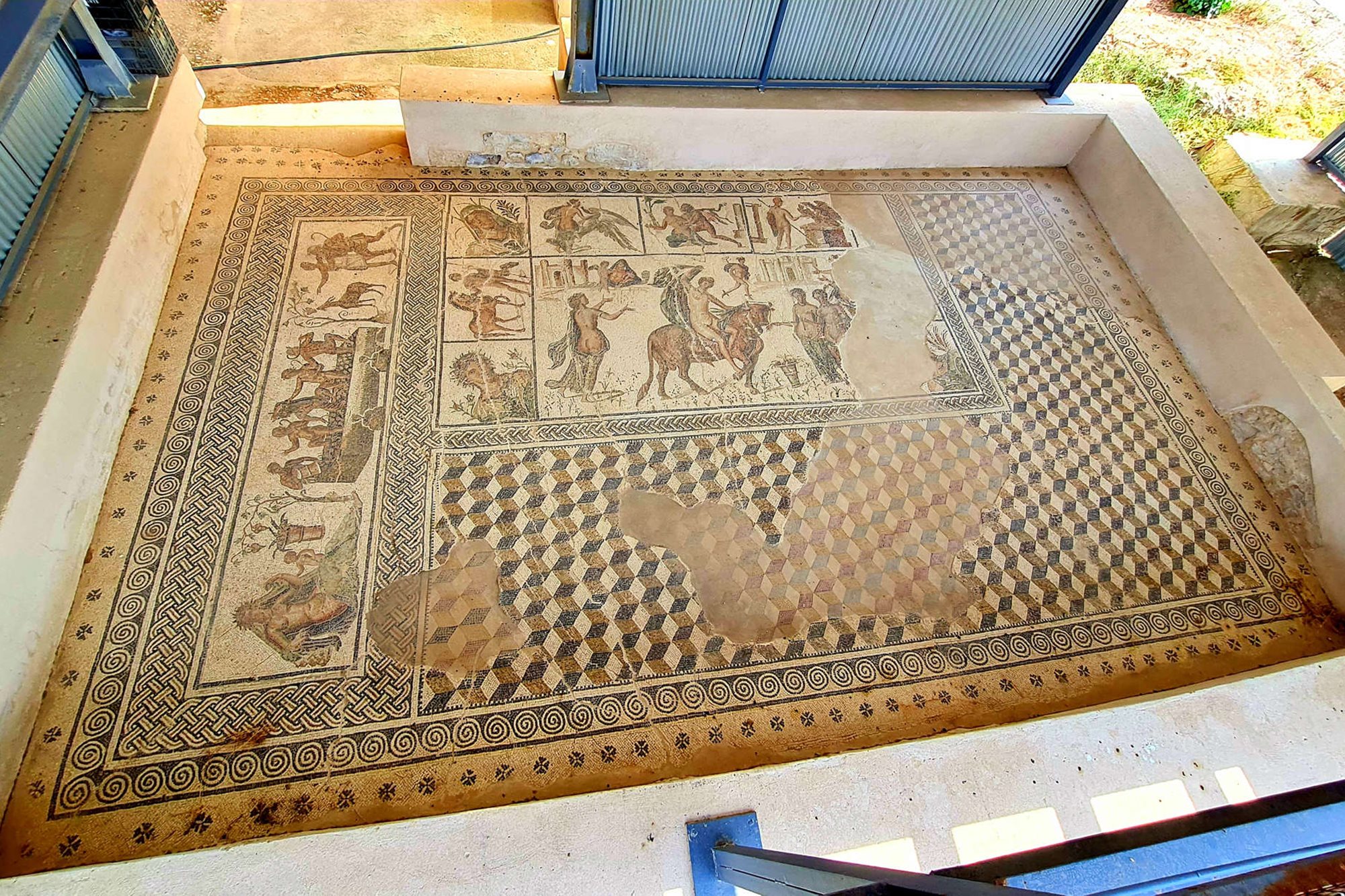
Notable within its interior is a Turdetani building that was used for worship. It houses several Roman rooms with rich mosaic decoration, mural painting, and marble flooring. Standing out is the mosaic of The Loves of Zeus, which measures 40 square metres and is in excellent condition. Its discovery was listed as one of the top ten discoveries of 2015 by National Geographic The remains of the Muslim alcázar's wall are also preserved, from which the entire city of Écija can be viewed.
Built: 9th century BC, 4th - 5th centuries BC, 11th century AD
Style: Bronze Age, Iron Age - Turdetani, Medieval, Roman Classic
Category: Military
Type: Fortress
Address and telephone
Services
Guided Tours.If you see any mistakes or want to add anything to this information, please contact us.
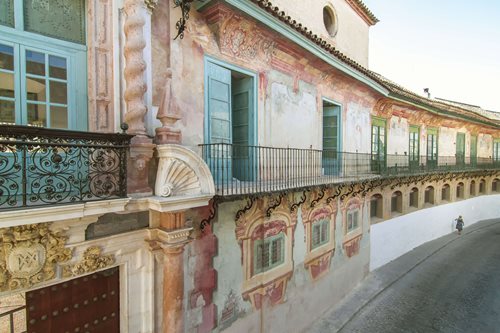
The Palace of the Marquises of Peñaflor and Cortes de Graena, also known as the Palace of the Long Balconies, is one of the finest examples of Écija's Baroque architecture.
It is a Baroque mansion remodelled from a previous Renaissance building. For this refurbishment, several adjoining houses were added to the original building, resulting in the current palace in 1775.
The most stunning aspect when encountering its curved façade, over sixty metres long, are its mural paintings. These were the work of Antonio Fernández, who painted them in fresco between 1764 and 1765, depicting trompe-l'oeils of architectural elements, figures, false windows that enhance the monumentality and colour of the palace. Of course, a continuous balcony along the entire façade, created by Pedro Calderón in 1762, is also notable.
A beautiful Baroque doorway provides access to the building (1726 – 1727). It was crafted in stone with Doric columns framing the entrance opening and Solomonic ones on the upper balcony, topped by the heraldry of the families that built this building: Barradas, Henestrosa, Bazán, and Fernández de Córdoba. At an angle and above the doorway lies an imposing viewpoint offering incredible views of the city of Écija.
Beyond the entrance doorway lies the hangar and the stables courtyard. Notably, the entrance to these stables, created by Juan Antonio Blanco in 1762, stands out. The interior of the stables is divided into three sections covered by cross vaults supported by robust columns. A grand staircase starting from the hangar is also noteworthy due to the proportions of its structure and decoration. On its walls is the altarpiece of the Virgin of the Rosary, richly embellished with plasterwork and paintings, by Fray Antonio de Molino (1767). Equally important is the domed ceiling that covers the staircase.
The ground floor of the palace features several courtyards, with the main one standing out. This courtyard is highlighted by two superimposed floors with arcades of semicircular arches. These white galleries contrast beautifully with the stone fountain located in the courtyard’s centre. Surrounding the courtyard are lounges covered with interesting wooden ceilings.
After several years of being in ruins and closed, the Palace of Peñaflor is now open to visitors thanks to restoration efforts; though currently only partially accessible until it can be fully opened.
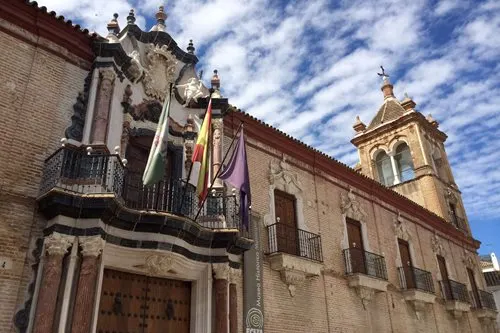
The Palace of the Marquises of Benamejí is a magnificent example of the 18th-century Baroque style characteristic of Écija and the lower Andalusia.
It was owned by the Marquises of Benamejí and later by the Counts of Valverde. Its construction dates from the first third of the 18th century and its layout is irregular. Its exterior is notable for the spectacular Baroque entrance and the towers on both sides of the façade. Inside, its main front stands out, with a lowered arch giving access to a monumental imperial staircase, not to mention its central patio and highly decorative semicircular arches.
During the French occupation in the early 19th century, the palace became a military barracks. In 1906, the municipality of Écija acquired it to hand it over to the Military Remount for most of the 20th century. It was declared a Site of Cultural Interest and a National Monument in 1994 and three years later became the headquarters of the Municipal Historical Museum of Écija.
The permanent exhibition of this museum shows the chronology of the local heritage of Écija. It is supplemented with a study of the social organisations of the different cultures that settled in the municipality.
Its initial section is archaeology: Prehistory, Iberian, Roman Empire, and Medieval. It also houses a room of Roman mosaics, and another section dedicated to the horse and equestrian art.
One of the museum's outstanding pieces is the sculpture of the Wounded Amazon. It was found in 2002 inside a Roman pond during excavations in Plaza de España. It is a Roman copy from the first third of the 2nd century AD. It is made from Greek marble in a single block. Its exceptional nature lies in being preserved almost intact and with visible traces of the colour it was finished in. Artistically, it corresponds to the Greek Classicist prototype of the Sciarra Amazon of the 5th century BC.
Although other three examples are preserved (in the Metropolitan Museum of New York, Berlin Museums, and Ny Carlsberg Glyptotek in Copenhagen), the one from Écija is the only one found outside Rome and with the characteristics previously noted.