Cookie settings
We use our own and third-party cookies in order to offer our services, display videos, obtain statistics and offer personalized advertising.
For more information, please read our cookies policy.
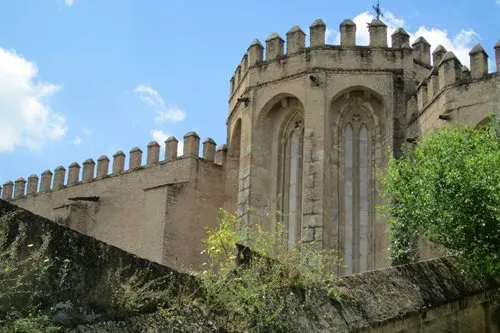
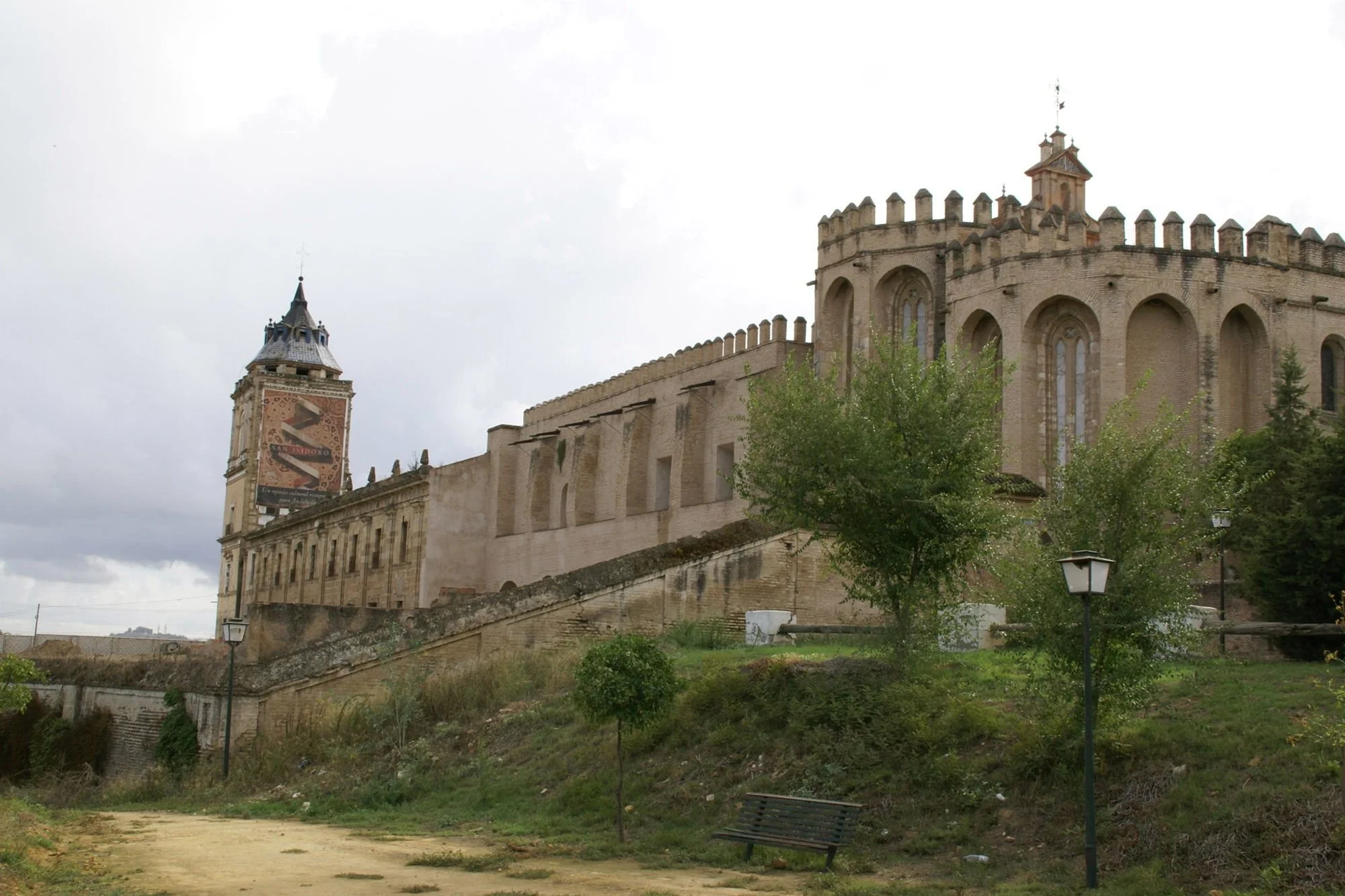
The Monastery of San Isidoro del Campo is located very close to the ruins of the Roman city of Itálica, next to the ancient Vía de la Plata. It was the first monument to obtain the title of National Historical-Artistic Monument in Seville (1872). It stands out for its fortified "twin churches".
It was founded in 1301 by the lords of the House of Medina Sidonia, Alonso Pérez de Guzmán (Guzmán el Bueno) and his wife María Alonso Coronel. This establishment was created to serve as a family pantheon and a witness to their piety under the reign of Ferdinand IV of Castile. It was built on a Mozarabic hermitage, where it is said that Saint Isidore of Seville was buried until his remains were transferred to the Basilica of San Isidoro in León.
A complex that consists of characteristic monastery elements along with other facilities, such as orchards, norias, ponds, a mill, granaries, stables, a dairy, an oven, etc. Its layout develops around two parallel Gothic churches, known as the twin churches.
The reason for having two churches is that Juan Pérez de Guzmán (son of Guzmán el Bueno and Doña María de Alonso) built a funeral chapel parallel to that of his parents, for himself and his wife Doña Urraca Osorio de Lara. This was done because in the will of his parents, it was forbidden to bury more family members in their chapel.
Subsequently, the monastery was handed over to the Cistercian monks, becoming the southernmost Cistercian Monastery in Europe. The hermits of the Jerónimos replaced the Cistercians, and the Order of Saint Jerome occupied the monastery in 1568.
From a historical perspective, it is noteworthy that in the 16th century, books prohibited by the Inquisition during the Reformation in Spain were translated here. Autos-da-fé were also conducted during this time against several propagandist monks. Casiodoro de Reina, translator of the famous Bear Bible (the first complete Castilian Bible), managed to escape. This monastery hosted the remains of Hernán Cortés until their transfer to Mexico. It also housed a large library.
With the Confiscation of Mendizábal in 1835, the monastery took on other functions until it returned to religious use between 1956 and 1978 with the occupation by the Jerónimos.
In 2002, the first phase of restoration was carried out to recover most of its medieval construction and offer public visits. The restoration would be complemented by the approval in 2020 of new investment by the Department of Culture and Heritage of Andalusia for three years. This phase would serve to halt the deterioration of elements and recover other still pending parts.
Built: 14th century.
Style: Gothic, Mudéjar
Category: Religious
Type: Monastery
Address and telephone
Opening times
If you see any mistakes or want to add anything to this information, please contact us.

Book your hotel