Cookie settings
We use our own and third-party cookies in order to offer our services, display videos, obtain statistics and offer personalized advertising.
For more information, please read our cookies policy.
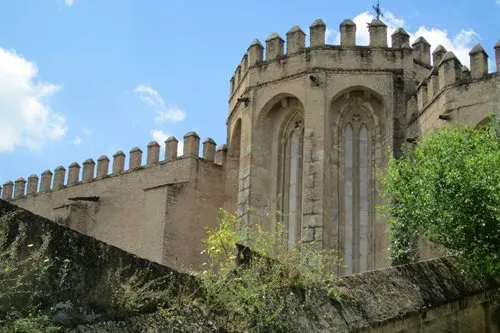
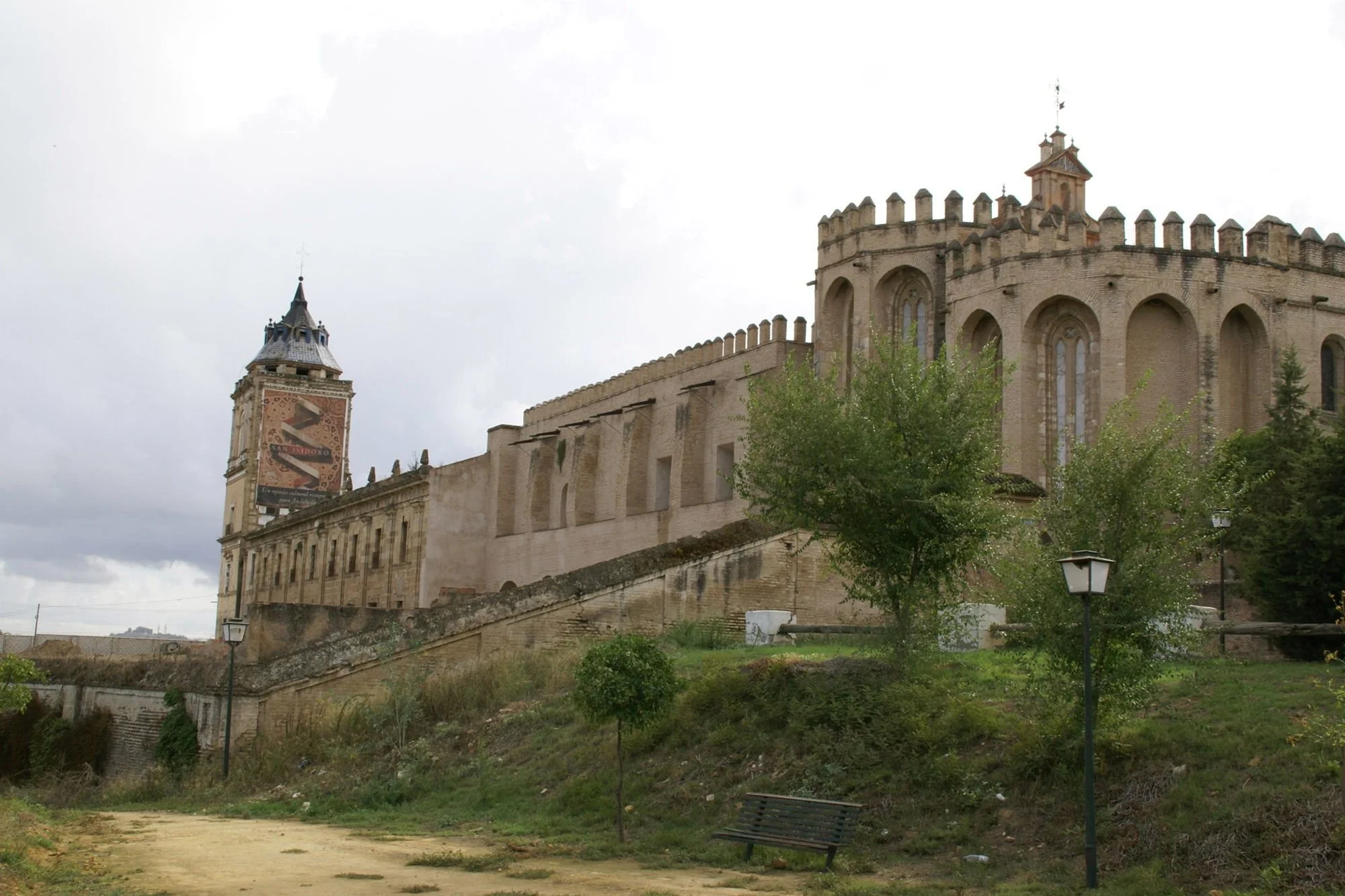
Both parallel temples of the monastery adhere to the architectural typology of fortified churches built after the reconquest. They consist of a single nave divided into three sections with a rectangular plan covered by ribbed vaults. The apse is pentagonal with a fortified appearance on the outside, as it is crenellated and has machicolations.
The construction of these churches represents a magnificent example of Mudejar architecture in Seville (15th century). They were built with brick, although some structural elements are made of stone (portals, arches, ribs, capitals, etc.). The roofs are laid out in terraces and the outer perimeter is topped with pyramidal merlons. The nave is covered with a rib vault and transverse arches supported on capitals and columns attached to pillars.
Access to both is via a Gothic-Mudejar portal of grooved brick (imitating layers), elevated on a base of white marble. This portal is located on the Gospel wall of Don Juan's Church. The opening is pointed and splayed with several overlapping archivolts. These are framed by an alfiz decorated with glazed Mudejar lacework in the spandrels. Above the portal, a flat arch is opened to support the cornice, which in turn supports a canopy (roof eave) through corbels.
Another smaller portal, which is now sealed, is located on the left. Its spandrels are decorated with eight-pointed stars and heraldic motifs of the Guzmán family.
The cloisters represent the precursors of those built in America. At the foot of Guzmán el Bueno's Chapel is the small Patio of the Evangelists. It has two floors. The lower one features semicircular arches slightly raised and framed by an alfiz, resting on octagonal brick pillars. The upper floor has slightly raised semicircular arches resting on the same type of pillar as the lower one. In its galleries are preserved outstanding 15th-century wall paintings, distributed between the base of geometric elements and figures such as St. Lawrence or St. Jerome.
The sacristy is rectangular and was refurbished in 1615 and 1668 with baroque elements. Behind it is the chapter house, whose original ribbed vault is concealed beneath the barrel vault lowered by the 17th-century renovations.
Both rooms are east of the Patio de los Muertos, located on the Gospel wall of Guzmán el Bueno's Church. This patio is rectangular with two floors with galleries of octagonal brick pillars, which rise above parapets decorated with lobed stars. The lower floor has semicircular arch galleries, while the upper ones are slightly raised semicircular arches. All are framed by an alfiz. Such a cloister preserves remarkable mural paintings, although some are covered by rehabilitations done between 1530 and 1540.
On the front of the upper gallery next to the spiral staircase, stands the belfry of Guzmán el Bueno's Church, dated 1609. However, the finishes correspond to the rehabilitation after the 1755 earthquake. This belfry has two sections. The lower one with four semicircular openings, with the central ones flanked by Tuscan pilasters on which rests an entablature with triglyphs in the frieze. The second section rises above the cornice of the central openings of the lower section, flanked by scrolls and pedestals. It has only one slightly raised semicircular opening, flanked by pilasters and crowned by a triangular pediment. Said pediment is topped with pedestals holding glazed ceramic finials (spindles).
The refectory is located in the west wing of the Patio de los Muertos, directly opposite the chapter room and sacristy. Its plan is rectangular, covered with four sections of Gothic rib vaults. It preserves remnants of wall paintings on the walls and vault.
The large cloister is located in the southernmost part of the complex and is called Hospedería. Its plan was square, like a cross-shaped courtyard in the centre. Its pillars are of cut brick, hexagonal in plan, with typical elements of late Gothic and early 16th century.
The tower is Baroque in style and was renovated after the 1755 earthquake. It is located at the southeast corner of this Hospedería cloister. Its plan is square and has two sections. The first section has balcony openings on each side, repeating the building's outer openings, thus masking this part of the tower. The second section is the bell chamber. It rises above the entablature separating it from the first section. Its four sides have semicircular openings with the key decorated, flanked by pairs of Tuscan pilasters on which rests another entablature with corbels in its frieze.
Above the tower cornice, there is a parapet surrounding it, leaving the central space for an octagonal spire with dormers. This spire is topped with a weathervane and a wrought iron cross. The bell tower was made of brick and glazed ceramic tiles in blue and white. These were used to decorate the pedestals, parapet, pilasters, spire, etc.
A notable artistic piece inside is the Main Altarpiece of Guzmán el Bueno's Church and his wife, made by Juan Martínez Montañés between 1609 and 1613. Also, a Virgin with the child in arms for the Reserved Chapel and a crucified Christ.
Address and telephone
Opening times
If you see any mistakes or want to add anything to this information, please contact us.

Book your hotel