Cookie settings
We use our own and third-party cookies in order to offer our services, display videos, obtain statistics and offer personalized advertising.
For more information, please read our cookies policy.
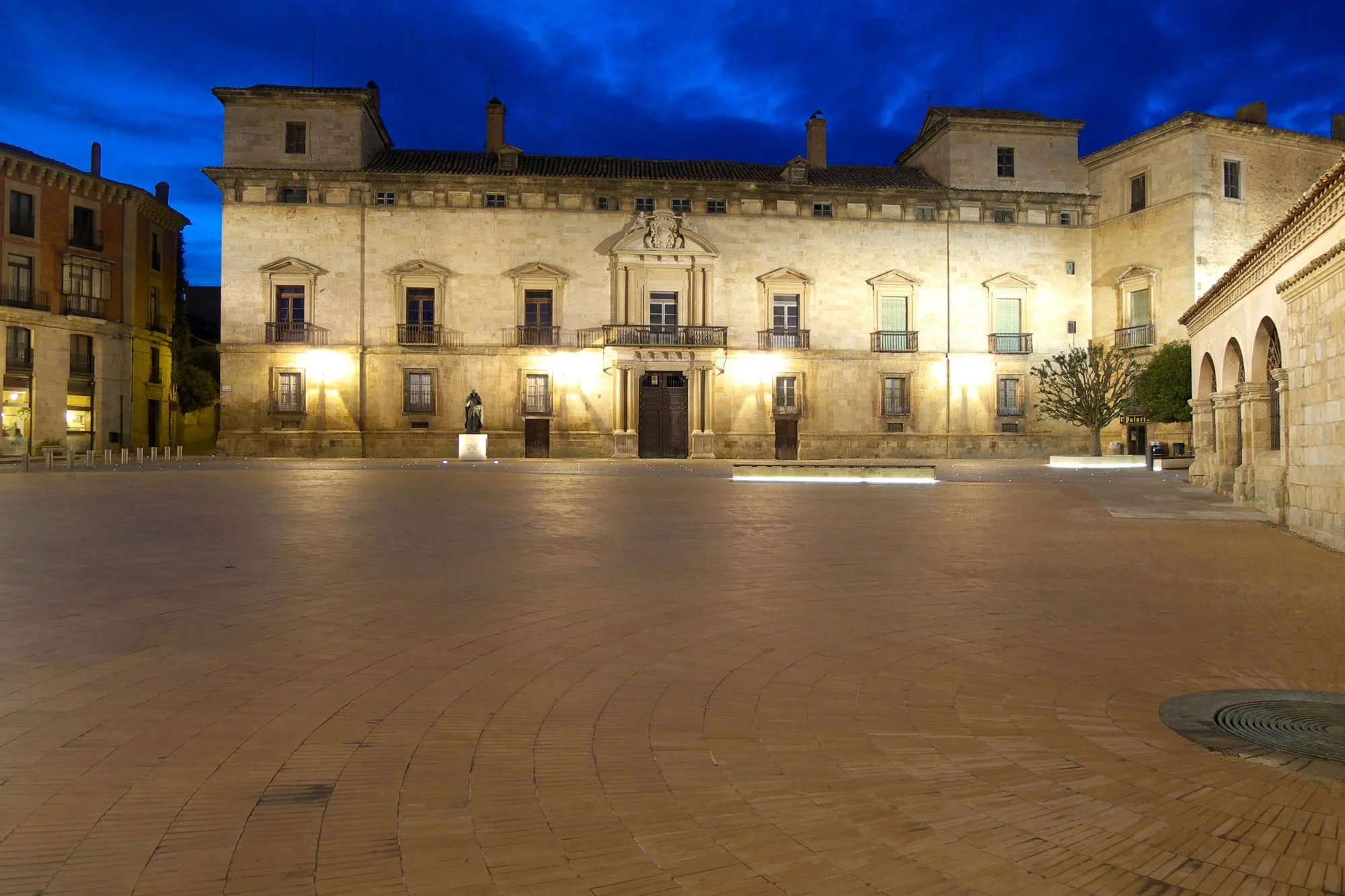
One of the places of great interest that can be found in the province of Soria is the Palace of the Hurtado de Mendoza, also known as the Palace of the Altamira.
In the Plaza Mayor of the charming medieval town of Almazán, we are dazzled by the majestic façade of this palace. It is the most important of all the palaces in this locality. It has been declared a Site of Cultural Interest with the category of Monument since 1991.
It was the place where the Catholic Monarchs stayed between the months of April and June of the year 1496. Prince Don Juan also resided there until March 1497. In 1575, Philip II granted the Marquess of Almazán to D. Francisco Hurtado de Mendoza and Chacón.
It was built at the end of the 15th century on a previous building and was renovated during the 16th century. There are parts from the late Renaissance period.
Its oldest part is the Gothic façade that faces the Duero. It preserves in the lower part three wide pointed arches (there were eight in total); featuring a Gothic-Isabelline gallery, with eleven lowered arches and mouldings with ball illustrations. In the spandrels of these arches, the coats of arms of the surnames Hurtado de Mendoza, Enríquez, Luna, Zúñiga, and Avellaneda can be found.
The gallery's roof is made of wood, in Mudejar style, with eight-pointed stars, and with paintings of vegetal motifs.
Another remnant of its medieval construction is a window that is preserved in the current courtyard, which was once the access door to the upper corridor, through a carpanel arch.
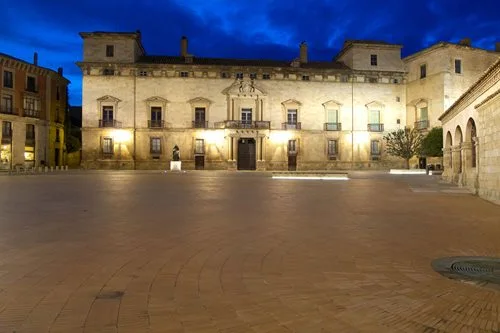
As we previously mentioned, upon arriving at the main square, we see its main façade. Elegantly and harmoniously built, back in 1575; the year when Philip II granted the Marquess of Almazán to D. Francisco Hurtado de Mendoza and Chacón. It is divided into two floors, with towers at its ends, and a projecting body on its left side.
Its beautiful Renaissance portal in the centre, with a balcony above it, is the hallmark of this Palace: both elements framed by double Ionic columns, topped by a split curved pediment, housing the noble coat of arms in the centre. A clear example of the Mannerist style, as seen in the two allegorical figures reclining on the arch, holding the coat of arms.
Built: 15th and 16th Century
Author: Anónimo
Style: Gothic, Renaissance
Category: Civil
Type: Palace
Address and telephone
If you see any mistakes or want to add anything to this information, please contact us.