Cookie settings
We use our own and third-party cookies in order to offer our services, display videos, obtain statistics and offer personalized advertising.
For more information, please read our cookies policy.
Zaragoza has an important historical heritage from the civilisations that have inhabited the province.
In its capital, Zaragoza, the most famous monument is the Cathedral of Nuestra Señora del Pilar, located next to the Ebro River and of Baroque and Neoclassical style. It is one of the most important Marian temples in the world and houses a large number of artworks of various types, such as paintings by Francisco de Goya. The other cathedral, El Salvador, was the first Christian cathedral in Zaragoza. Other Christian temples of tourist interest in Zaragoza are: the Cartuja de Aula-Dei or the Church of Santa Engracia.
The Palace of the Aljafería, has had various uses since it was built in the 11th century as a recreational residence for the Taifa kings. Later, it was the seat of the Inquisition Tribunal and underwent various renovations that gave it Gothic and Mudejar elements.
The Lonja of Zaragoza is a civil building constructed to serve as a meeting place for all merchants arriving in Zaragoza. Other interesting places to visit in the capital are the Provincial Museum of Fine Arts, the Puerta del Carmen or the Caesaraugusta Route, designed for visitors to explore the remains from the Roman era of the city. The Casa y Arco del Deán and the Piedra Bridge are also among the most iconic sites of the city alongside the Pilar Basilica.
At the Goya Museum, visitors can see more than fifty works by the artist, including paintings and engravings.
Belchite is one of the main tourist attractions of the province, as it was the scene of one of the battles of the Spanish Civil War and remains as it stood after the conflict. Daroca and Calatayud are two other municipalities famous for their significant Mudejar historical and artistic heritage.
In the region of the Cinco Villas are municipalities such as Ejea de los Caballeros or Sos del Rey Católico, places with important Sephardic, Romanesque, and Cistercian heritage.
In the Moncayo Natural Park is the Veruela Monastery, Cistercian and notable for its beauty and excellent state of preservation. The Monasterio de Piedra, also Cistercian, is located in an unparalleled natural setting with impressive waterfalls and lagoons. The Laguna de Gallocanta and the Saladas de Chiprana are also interesting for being saline water, despite being in the mountains, and for the beauty of their surroundings.
One of the typical products of Aragonese cuisine is borage, a delicious vegetable cooked in numerous ways.
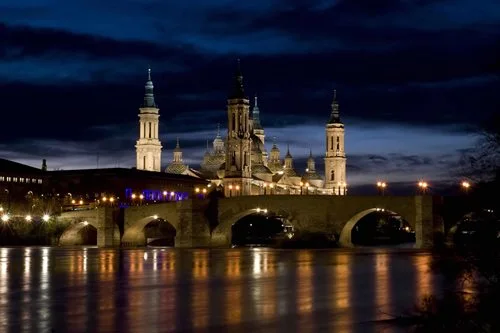
Capital of the eponymous province and region of Aragón, Zaragoza is one of the most spectacular cities in Spain. Situated in the heart of the Ebro valley, the city is traversed by this river as well as the Huerva and Gállego. This has meant that throughout history it has been a place inhabited by various peoples.

Book your hotel