Cookie settings
We use our own and third-party cookies in order to offer our services, display videos, obtain statistics and offer personalized advertising.
For more information, please read our cookies policy.
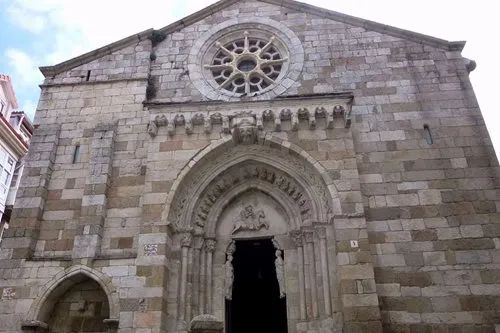
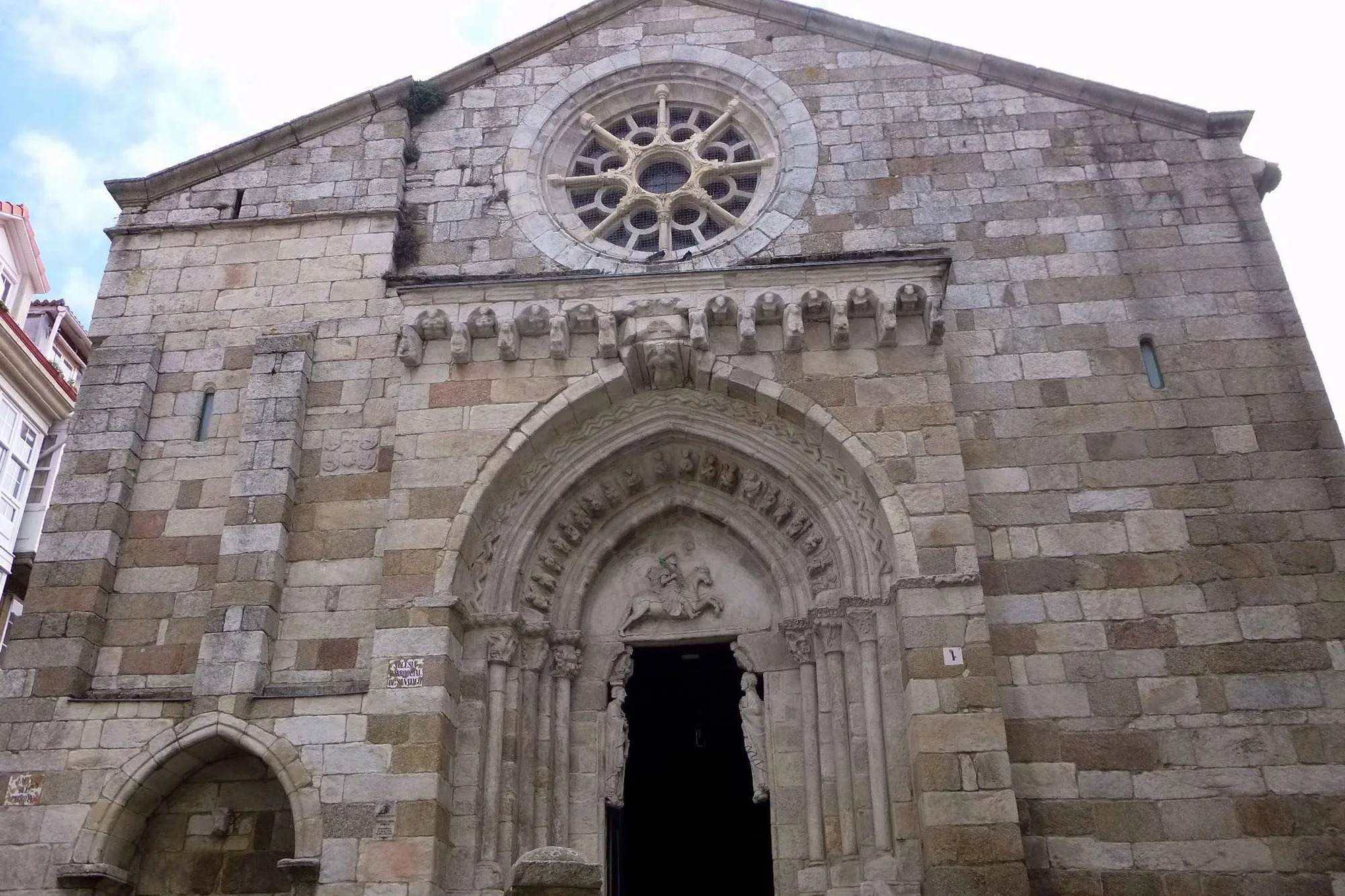
The Parish Church of Santa María y Santiago is located in the old town of La Coruña. It is the oldest in the city and retains Roman remains inside.
It dates from the Romanesque period of the Compostelan School (12th century), with later modifications. Originally, its design had three naves with apses at the end of each. Currently, the church has a hall plan, preserving the three apses of the former naves. After the fires and subsequent renovations, what is best preserved from the original construction is the chancel with these apses.
On the north wall, there is a small old doorway with the Agnus Dei in the centre of the tympanum surrounded by flowers. The Romanesque archivolt is decorated with rosettes.
On the south wall, the main doorway, added later and pointed, features an equestrian relief of Santiago in its tympanum. Both the archivolts and the capitals supporting them display beautiful religious sculptural figures, now weathered. The doorway is flanked by the apostles St. John and St. James on the jambs. Above this doorway is a large rose window.
With the change from three naves to a single hall inside, the roof is supported by robust pointed diaphragm arches from the Gothic period. These arches rest on pilasters that retain the capitals of the original side naves. The three apses of the Romanesque structure are heavily modified inside, whose capitals are also original and are decorated with vegetal and zoomorphic motifs.
Among the pieces preserved inside this church is a baptismal font and interesting Roman arae (small stone altars). Also notable are old sepulchres and a stone pulpit dating from the 17th century.
On August 18, 1972, the Church of Santiago in La Coruña was declared a Historic-Artistic Monument.
Built: 12th century.
Style: Gothic, Romanesque
Type: Church
Address and telephone
If you see any mistakes or want to add anything to this information, please contact us.
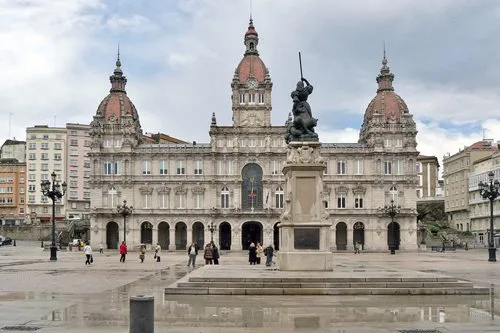
The Plaza de María Pita is the nerve centre of the city of A Coruña, where the monumental Palacio de María Pita is located, now the municipal town hall.
Its name comes from the Galician heroine María Pita. Previously it was called the square of Alesón, Liberty and Demolition.
It was built in the last third of the 19th century by the municipal architect Juan de Ciórraga. The paving dates from 1937, while the asphalting is from the 1950s. It was not pedestrianised until 1987, when an underground car park and a tunnel were constructed.
Architecturally, this square is rectangular with more than 10,000 square metres. On its north side stands the monumental Palacio de María Pita, built in an eclectic style by Pedro Mariño (1908-1912) and today functions as the city hall.
The other three sides are occupied by elegant buildings with balconies and arcades with arches on the lower floor. These arcades host various hospitality establishments, such as Galician cuisine restaurants, pizzerias or tapas bars.
The centre of the square is dominated by the Statue of María Pita, a bronze sculptural group by Xosé Castiñeiras.
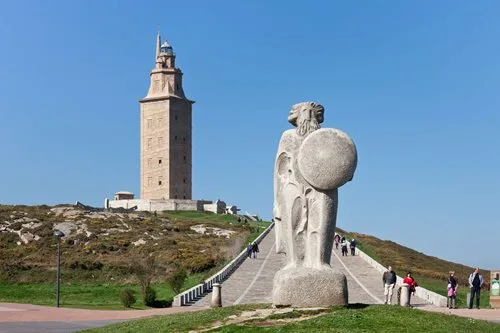
The Tower of Hercules is the only Roman lighthouse and the oldest still in operation.
Its height is 55 metres (36 metres of its Roman construction and 19 from its 1789 restoration for the modernisation of the maritime signalling system). Its focal height is 106 metres above sea level. Its plan is quadrangular, with each side measuring around 11.75 metres. Above this quadrangular part rises another polygonal section on which the lighthouse rests.
Until the 20th century, it was called the Bigantia Lighthouse (Farum Brigantium, now La Coruña). The name Tower of Hercules comes from several legends about its construction. One of them tells that Hercules arrived at the Galician coasts surrounding this tower, where he buried the head of the giant Geryon after defeating him. This legend would fall within the continuity of the Roman legacy over the Tartessian-Phoenician of Geryon.
Some historians believe that the site of this tower was where the Tower of Breogán was located, which appears in the mythological cycle of Ireland, from which Ith (son of Breogán) is said to have seen the Irish coasts.
Although it was rebuilt by the Romans, this tower has an unknown origin. At the base of this tower, a votive stone was found, whose inscription identified the architect Caius Sevius Lupus, hailing from Aeminium (Coimbra).
In the Middle Ages, it ceased to function as a lighthouse and became a fortification. But in 1682, architect Amaro Antune was commissioned by the Duke of Uceda for its restoration. This restoration was completed during the reign of Charles III. The neoclassical part was finished in 1791 by Eustaquio Giannini, which corresponds to the current façade.
The Tower of Hercules was a candidate in 2007 to be declared a World Heritage Site, with such declaration taking place two years later. On 9 September 2008, it was twinned with the Statue of Liberty in New York and, sixteen days later, with the Lighthouse of Morro in Havana.
Around it, we can also see a Sculpture Park, acting as an open-air museum. In this park, there are more than fifteen works by prominent 20th-century artists, such as Manolo Paz and Francisco Leiro.
Book your hotel