Cookie settings
We use our own and third-party cookies in order to offer our services, display videos, obtain statistics and offer personalized advertising.
For more information, please read our cookies policy.
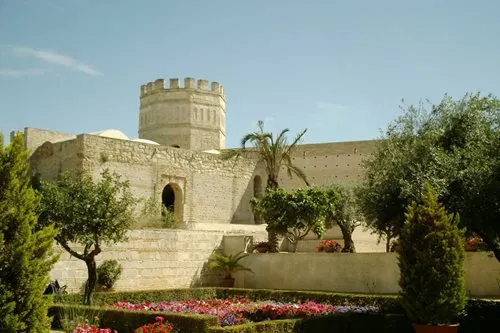
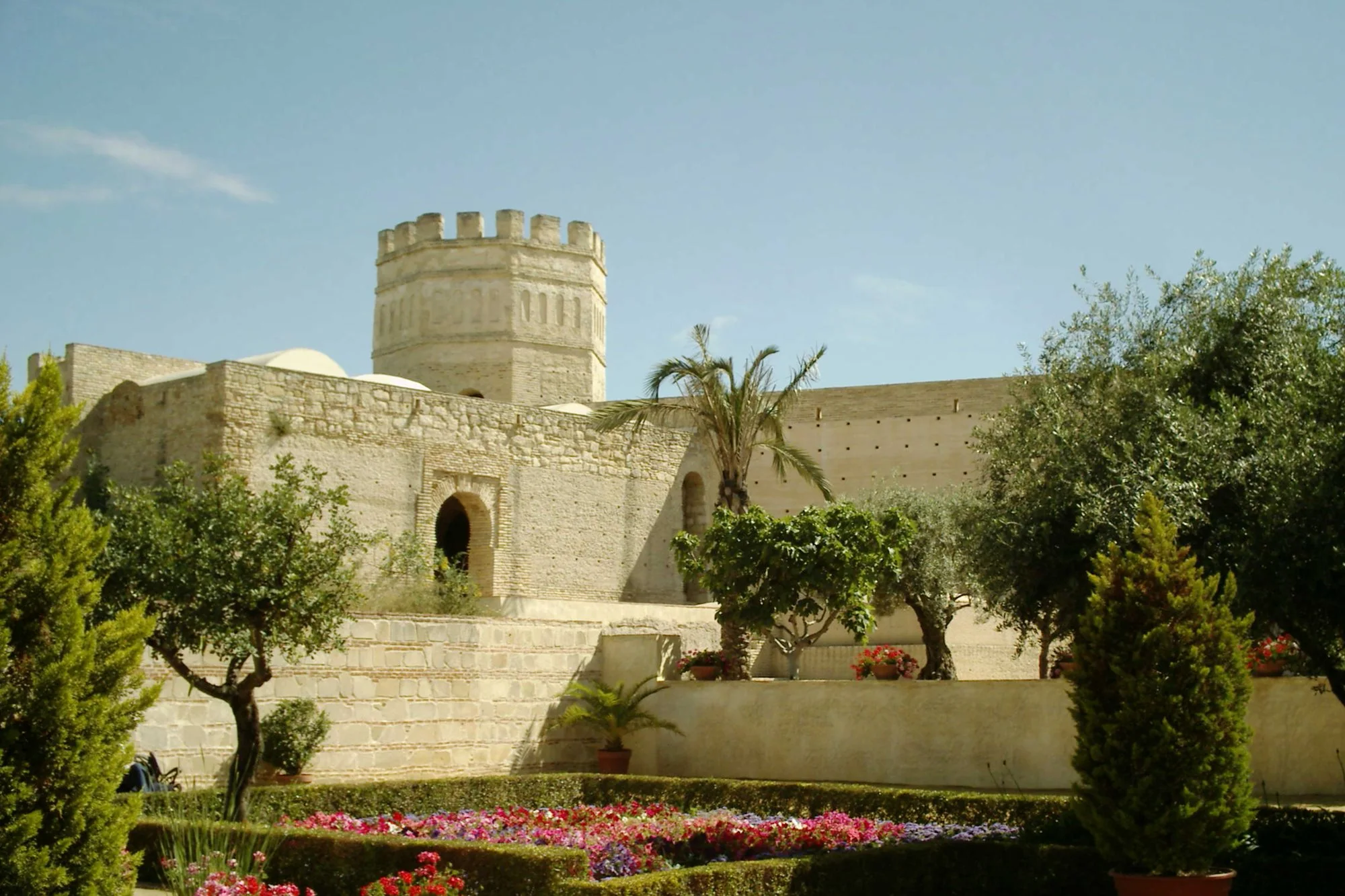
The Alcázar of Jerez de la Frontera is one of the few surviving examples of Almohad architecture in Spain.
In addition, it is the oldest monument in Jerez. It occupies the southeastern corner of the city, being the most strategic and elevated point. Its exterior octagonal tower is also the tallest in the city.
Due to its roofing, it is dated back to the Almohad period, but some isolated preserved vestiges suggest its age may be greater. It stands as a Romanesque fortress (11th century), which witnessed the exploits of its governor Garci-Gómez Carrillo and the ensign Fortún de Torres.
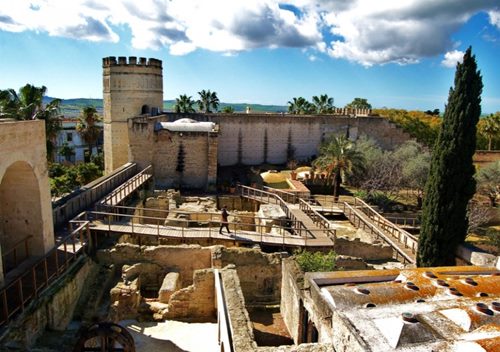
The Alcázar itself is a square-shaped enclosure and is attached to the walls. It may have had at least eleven defensive towers, including the keep and the Octagonal Tower (formerly called "the gold").
Its construction is simple. But it has other defenses besides the walls, such as a barbican and two battlemented towers: the Octagonal Tower (worthy of mention in Jerez's annals, for having raised the Castilian royal standard for the first time) and the Keep which is adorned with royal towers and the coat of arms of the Ponce de León.
There are three known doors that provide access to the site: the North, South, and East.
Inside this Monumental Ensemble stands out the City Gate, which is the only 12th-century access from Jerez to the fortified site. The Mosque also stands out, which is the only one preserved in the city. Also worthy of mention are the ablution courtyard, the baths, the gardens, and the Villavicencio palace (17th – 18th centuries).
Its registration as a Site of Cultural Interest took place on 4 June 1931, in the Monument category.
In the tower of the aforementioned Villavicencio palace, the Camera Obscura is installed, while in the palace itself there is a 19th-century pharmacy.
A 18th-century Oil Mill is also preserved.
Built: 11th - 19th centuries.
Style: Almohad, Baroque
Category: Civil
Type: Monumental Complex
Discover the historic quarter and the Alcázar of Jerez de la Frontera on a two-hour tour.
Accompanied by a tour guide and heritage interpreter, you will marvel at the palace houses and squares you will encounter along the way.
You will end up at the Alcázar of Jerez, a marvel of Almohad defensive architecture, unique in Spain.
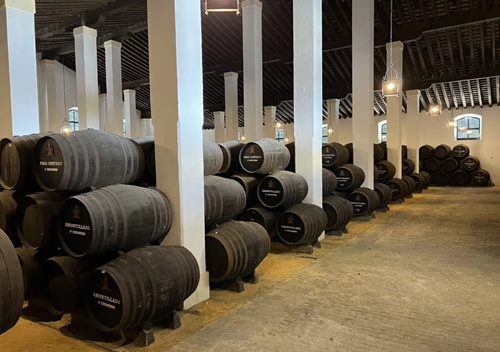
A must-see in Jerez is its wines, which hold a Designation of Origin and are renowned worldwide.
Discover them by visiting a traditional winery in this Cádiz city, such as Cayetano del Pino. With a guide from the establishment, you will explore all the winemaking processes of Jerez wines.
At the end of the tour, you will taste two types of wine, 100% produced in the winery.
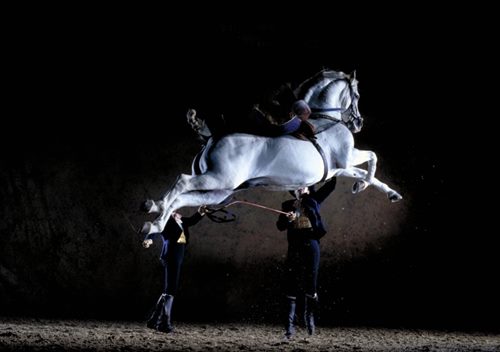
Visiting Jerez and want to experience its culture in one go?
Enjoy a guided tour through the historic center and discover its rich architectural heritage. The experience includes a spectacular equestrian show at the Royal Andalusian School of Equestrian Art Foundation (REAE).
An unmissable plan for your getaway to Jerez.
Discover the historic quarter and the Alcázar of Jerez de la Frontera on a two-hour tour.
Accompanied by a tour guide and heritage interpreter, you will marvel at the palace houses and squares you will encounter along the way.
You will end up at the Alcázar of Jerez, a marvel of Almohad defensive architecture, unique in Spain.
Address and telephone
Opening times
Prices
If you see any mistakes or want to add anything to this information, please contact us.
Discover the historic quarter and the Alcázar of Jerez de la Frontera on a two-hour tour.
Accompanied by a tour guide and heritage interpreter, you will marvel at the palace houses and squares you will encounter along the way.
You will end up at the Alcázar of Jerez, a marvel of Almohad defensive architecture, unique in Spain.
A must-see in Jerez is its wines, which hold a Designation of Origin and are renowned worldwide.
Discover them by visiting a traditional winery in this Cádiz city, such as Cayetano del Pino. With a guide from the establishment, you will explore all the winemaking processes of Jerez wines.
At the end of the tour, you will taste two types of wine, 100% produced in the winery.
Visiting Jerez and want to experience its culture in one go?
Enjoy a guided tour through the historic center and discover its rich architectural heritage. The experience includes a spectacular equestrian show at the Royal Andalusian School of Equestrian Art Foundation (REAE).
An unmissable plan for your getaway to Jerez.
Discover the historic quarter and the Alcázar of Jerez de la Frontera on a two-hour tour.
Accompanied by a tour guide and heritage interpreter, you will marvel at the palace houses and squares you will encounter along the way.
You will end up at the Alcázar of Jerez, a marvel of Almohad defensive architecture, unique in Spain.
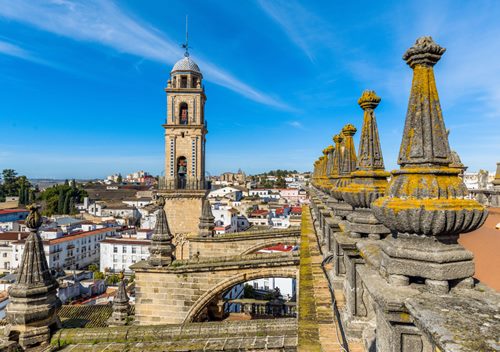
Would you like to visit two essential monumental gems of Jerez de la Frontera? This guided tour is for you. Discover two icons of Jerez’s Gothic and Baroque heritage: the Church of San Miguel and the Cathedral of Jerez, ideal for getting to know the soul of the city.
You will also walk alongside an expert art guide in a pleasant tour filled with architecture, history, and legends that bring Jerez’s heritage to life.
A must-see in Jerez is its wines, which hold a Designation of Origin and are renowned worldwide.
Discover them by visiting a traditional winery in this Cádiz city, such as Cayetano del Pino. With a guide from the establishment, you will explore all the winemaking processes of Jerez wines.
At the end of the tour, you will taste two types of wine, 100% produced in the winery.
Visiting Jerez and want to experience its culture in one go?
Enjoy a guided tour through the historic center and discover its rich architectural heritage. The experience includes a spectacular equestrian show at the Royal Andalusian School of Equestrian Art Foundation (REAE).
An unmissable plan for your getaway to Jerez.
Discover the historic quarter and the Alcázar of Jerez de la Frontera on a two-hour tour.
Accompanied by a tour guide and heritage interpreter, you will marvel at the palace houses and squares you will encounter along the way.
You will end up at the Alcázar of Jerez, a marvel of Almohad defensive architecture, unique in Spain.
Would you like to visit two essential monumental gems of Jerez de la Frontera? This guided tour is for you. Discover two icons of Jerez’s Gothic and Baroque heritage: the Church of San Miguel and the Cathedral of Jerez, ideal for getting to know the soul of the city.
You will also walk alongside an expert art guide in a pleasant tour filled with architecture, history, and legends that bring Jerez’s heritage to life.
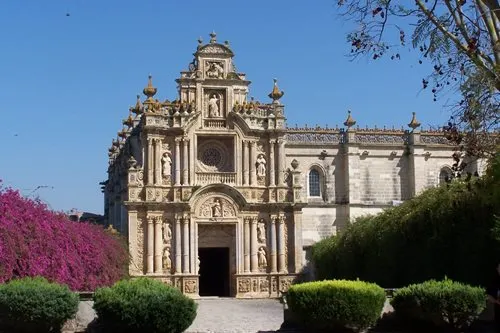
The Charterhouse of Jerez de la Frontera is the most artistically significant monumental complex in the province of Cádiz. In fact, it was declared a Historical-Artistic Monument in 1856.
It was established at the initiative of the knight Álvaro Obertos de Valeto in 1476, with construction beginning in late Gothic style two years later.
Most of its dependencies were built in the 16th century, and renovations and expansions took place during the 17th and 18th centuries. Flamboyant Gothic, plateresque, renaissance, and baroque styles harmoniously blend in this monumental complex.
Its Renaissance portal, created by Andrés de Ribera in 1571, stands out. This portal provides access to a large paved courtyard, at the far end of which rises the outstanding façade of the church, resembling a retablo. This façade consists of two side streets and an attic.
The church has a single nave plan and is covered by star-shaped ribbed vaults. It was completed in 1552 and underwent some reforms in the 17th and 18th centuries. Its grand façade, previously mentioned, was carried out in 1667.
The interior of the temple features the Chapel of Santa María, the Choir Stalls, and the Main Altarpiece, crafted by Juan de Oviedo de la Bandera. Originally, the altarpiece was made for the church of La Merced in Sanlúcar de Barrameda, but it was moved to the Charterhouse of Jerez in 1960. There are also other interesting pieces inside, such as the wrought iron screen at the foot of the church (16th century).
Besides the church, there are other constructions of special note within this monumental complex. The Gothic cloister or the claustrillo of the church attached to the temple stands out with its slender arches and pierced buttresses. It is crowned with a beautiful Gothic cresting and pinnacles over the buttresses. Here are the portals of other dependencies, which are also of great artistic quality: the refectory, the chapter house, and various chapels.
The large Cloister (also called the cemetery cloister) is of more austere construction but of elegant beauty. It is of a square plan and its galleries are covered by ribbed vaults.
From the southern wall, access is gained to an open courtyard, known as the Kitchen Courtyard, through which you reach the Lay Brothers’ Cloister. This cloister has a square plan, with galleries of semicircular arches on Tuscan marble columns. These galleries are covered with groin vaults.
The charterhouse was restored after destruction during the French invasion (1810) and regained its original function. Today it is in good condition.
With the arrival of the Mendizábal disentailment, Zurbarán’s works for the Main Altarpiece of the church were looted. Today, almost all are housed in the Provincial Museum of Cádiz (The Apotheosis of Saint Bruno and small canvases with four Evangelists, Saint Lawrence, and Saint John the Baptist).
It is currently occupied by the Sisters of Bethlehem, who organise exhibitions and other activities.
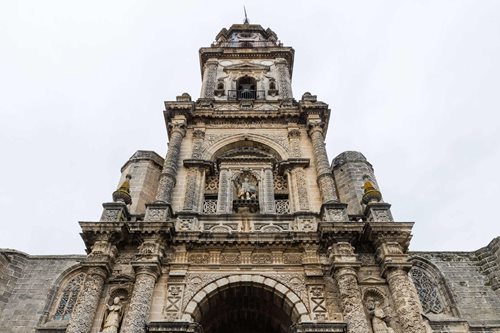
The Church of San Miguel is a majestic temple that combines Jerez's Gothic with Renaissance and Baroque art. For some, it is "the Nôtre Dame of Jerez". Its main altarpiece was created by Juan Martínez Montañés and José de Arce.
The Church of San Miguel is located in the gypsy quarter of Jerez de la Frontera, which bears its name. Its dimensions lead it to be mistaken for a cathedral, as it is the largest and most complete temple in its surroundings.
It dates back to the 15th century, with a plaque dated 1484 preserved on the door of the Gospel Gothic façade. It is deduced that it was built after a plea was made to the Catholic Monarchs following their visit to Jerez de la Frontera in that same year. Until then, the parishioners only had an old hermitage.
Its construction continued over subsequent centuries, resulting in one of the best ecclesiastical monuments in Jerez with a majestic main façade of three sections. This façade was the work of local architect Diego Moreno, who designed it in the style of a façade-tower. The third section corresponds to the bell tower, being the highest point in Jerez de la Frontera.
In this temple, Jerez's Gothic harmoniously merges with elements of the Renaissance and Baroque. In addition to the exquisite doorways of this church, its interior boasts an exceptional altarpiece carved by Martínez Montañés and José de Arce.
In 1931, it was declared a National Historical-Artistic Monument. Some call it “the Nôtre Dame of Jerez”.
As a curiosity, it houses the baptismal font where Lola Flores was baptised.
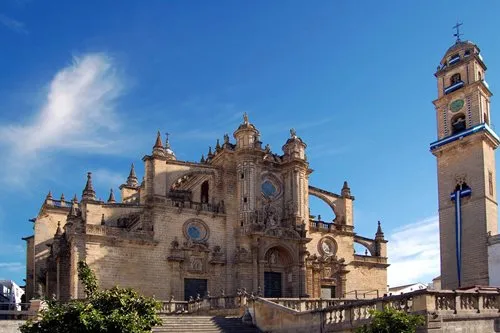
The Cathedral of San Salvador of Jerez de la Frontera was built on the site of a former Great Mosque, which later became the Church of the Saviour. A monumental 17th-century building where Gothic, Baroque, and Neoclassical styles blend.
It was initially an old Collegiate Church or Collegiate Church of Jerez de la Frontera, until it was elevated to the dignity of a cathedral in 1980.
Construction of the new cathedral began in 1695, with Diego Moreno Meléndez as the master builder in Jerez. The construction lasted for more than eighty years, until it was blessed on 6 December 1778. The works were directed by Ignacio Díaz de los Reyes, Juan de Pina and Miguel de Olivares, who worked under the supervision of Torcuato Cayón de la Vega.
As an additional fact to its importance, its construction was largely financed by Kings Charles II, Louis I, and Charles III. Popes Innocent XIII and Benedict XIII also contributed with the grace "of the masses obtained".
Its structure is of Gothic design with a quadrangular floor divided into five naves by thick pilasters. A sixth nave forms the transept. Its magnificent dome rises over the intersection of the main (central) nave and the transept. Its roofs feature simple ribbed vaults in the side naves and more ornate decoration in the central one. Among its interior rooms, the Sacristy, arranged in two sections and covered by sail vaults, stands out. This is accessed through a large neoclassical portal.
On the exterior, it features three façades. The most outstanding is undoubtedly the main façade. It has lintelled doors with circular oculi, rich columns and Baroque-style decorations. The large flying buttresses connecting the side naves with the central one enhance the magnificence of this cathedral.
Of the previous church demolished in 1695, only the bell tower, which is separated from the temple, remains. This tower has two distinct parts: the lower, from the 15th century, built in Gothic-Mudejar style, and the upper, from the 18th century, built by Juan Pina.
Due to its historical and artistic significance, the Jerez Cathedral is declared an Asset of Cultural Interest with the category of monument. This declaration was published in the Gaceta de Madrid on 4 June 1931.
In its Cathedral Museum, there are highly significant pictorial works, such as The Girl Virgin by Zurbarán and paintings by Juan Rodríguez “El Tahonero”.