Cookie settings
We use our own and third-party cookies in order to offer our services, display videos, obtain statistics and offer personalized advertising.
For more information, please read our cookies policy.
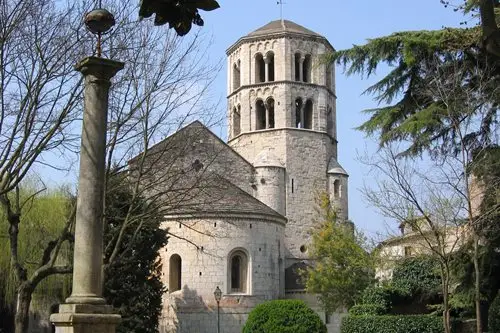
The cloister is a fine example of Catalan Romanesque. It is small in size and is attached to the right side of the church. Despite its small dimensions, it exhibits characteristics typical of the group of Catalan cloisters that still survive.
According to the studies by the modernist architect Puig i Cadafalch (1867 – 1956), the different galleries were built in the following order: north, east, south, and west. Due to topographical reasons, the monastic quarters were not located within the courtyard but in a building parallel to the river and attached to the west side of the cloister. A supercloister, situated above the cloister, constructed in the 19th century, is also preserved.
On the northwest pier, there is an inscription referring to Abbot Rotlandus (who died in 1154). Although it does not clearly reflect the possible relationship between the date of this abbot and the start of work on the cloister. There is a hypothesis that the inscription, due to its location, was used for the monks to make reverence to the abbot each time they passed by this place.
The north and south sides of the cloister are slightly longer, housing six arches in the lower gallery. Whereas the east and west sides have four arches. Their vaults are quarter barrel type. The arches of the galleries are semi-circular and rest on columns, whose capitals were very elaborate. The columns sit on a continuous plinth typical of Catalan cloisters.
In the centre of each side of the gallery, and where the central pillar should be, there are groups of five freestanding columns (an exceptional case in Catalan Romanesque cloisters). To the right and left of these groups of columns, three paired columns rise along the wall. In the corners of the cloister, the columns are attached to the pier angles. Above the arches and on the external wall, there is an ornamental gallery of blind arcades. These rest in turn on small corbels, crafted with vegetal and zoomorphic motifs. Of these arcades, only those on the south side are well preserved.
The capitals of the cloister were crafted between 1170 and 1185. They were meticulously worked with traditional formulas, without becoming archaic. A great example of Romanesque art in the area. Their decorative themes are narrative, zoomorphic, and vegetal. The most elaborately worked ones, with narrative stories, are found in the centre of the west side and on a piece of the north side. The remaining ones are classic Romanesque baskets of Provençal and Languedoc French descent.
The work of these capitals is considered related to the masonry of Sant Pere de Rodes, whose zoomorphic themes always have a symmetry axis.
On the west side, in the angles of one of the capitals, there are four dancers doing a somersault. Among them is a moustached man, a beardless youth, a musician playing a viol, and a bishop at an altar.
Another capital stands out where mermaids (or nereids) with double tails are represented. These were a symbol of the dangers of uncontrolled love and seduction. On another face, the Nativity is shown, and on another, the Flight into Egypt.
In total, there are thirteen capitals on this side. One of them, featuring human figures, is considered the most interesting. Others depict the Annunciation, the Adoration of the Magi, the Birth of Jesus, and the Virgin with the Child on her lap and St. Joseph beside her.
On the north side, almost all the capitals are decorated with vegetal themes. But there is one where eight standing figures can be seen, with a crozier and a book with a cross in front being recognisable. Other capitals feature human figures intermingling with vegetals.
The east and south sides have capitals with acanthus leaves, palms, pinecones, lions, mermaids, and birds.
Address and telephone
Opening times
Prices
If you see any mistakes or want to add anything to this information, please contact us.