Cookie settings
We use our own and third-party cookies in order to offer our services, display videos, obtain statistics and offer personalized advertising.
For more information, please read our cookies policy.
Huesca traces its origins to the Iberian city of 'Bolskan', which, after being conquered by the Romans, simplified its name and led to the current toponym.
The Aragonese province is mainly famous for its natural surroundings, which include a large number of national parks and the ski resorts of Formigal and Candanchú, major tourist attractions for winter sports enthusiasts. Near Candanchú is the Canfranc Railway Station, an old Pyrenees station now closed. The Canfranc building was made of metal and glass in the twentieth century.
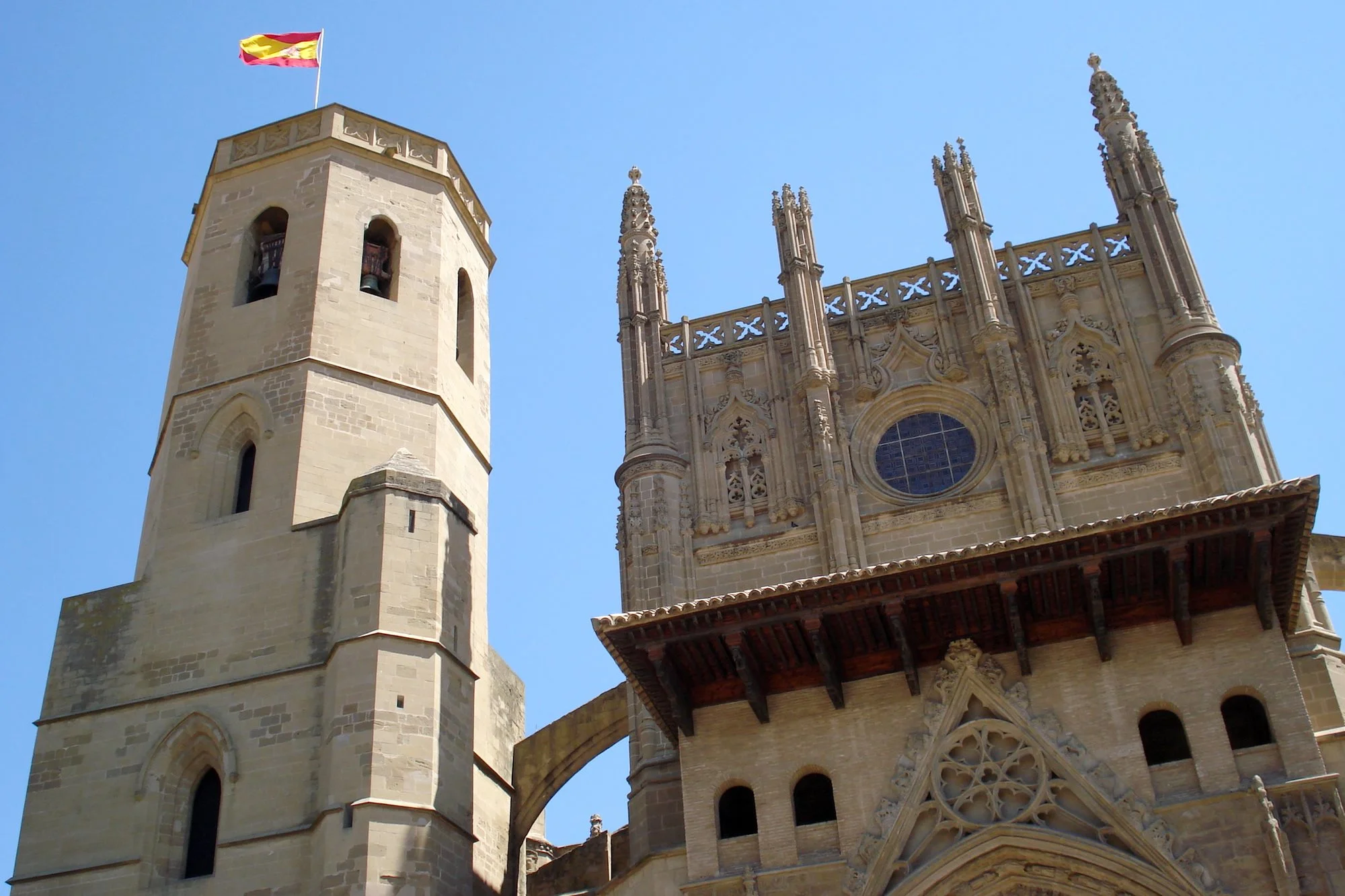
Meanwhile, in the capital of Huesca, notable sites include its cathedral, of Gothic style, whose main altarpiece is a sculptural marvel made of alabaster; the San Pedro el Viejo Church, one of the oldest in Spain, which according to some historians dates back to the Visigothic era; the Church of Santa María in Foris, a representative temple of Aragonese Romanesque; the Basilica of San Lorenzo, of Baroque style; and the Palace of the Kings of Aragón, a Romanesque and civil architectural complex currently housing the Museum of Huesca. The city was fortified by a wall built during the Muslim domination of the city, of which only a part remains today.
Jaca is one of the most important municipalities of Huesca in the province. The Jaca cathedral is famous for being the first Romanesque in Spain. The citadel is a fortress from 1592 built by Philip II as a defensive strategy and is also found in Jaca.
The Monastery of San Juan de la Peña, of Romanesque style and of great historical and artistic interest, is situated in one of the most beautiful landscapes of Jacetania.
In the natural park of the Sierra and Canyons of Guara are the municipalities of Aínsa and Alquézar, little towns where the medieval essence is still preserved. The historical centre of Aínsa has been declared a historical-artistic complex.
In the natural parks of Posets-Maladeta, Western Valleys, and Ordesa and Monte Perdido, there are many mountain refuges intended to accommodate all those trekkers or mountaineers visiting the wonderful natural setting of Alto Aragón.
Furthermore, in the Tena Valley you can find Lacuniacha, a wildlife park where it is possible to observe bears and wildcats in semi-freedom.
The city of Huesca, capital of the province of the same name, stands out as one of the most important hubs in Aragón. It is located in the comarca of Hoya de Huesca and within its municipal boundary lies the Sierra y los Cañones de Guara Natural Park, a unique natural setting.

Book your hotel