Cookie settings
We use our own and third-party cookies in order to offer our services, display videos, obtain statistics and offer personalized advertising.
For more information, please read our cookies policy.
The only nave of the temple features a high choir at its foot, accessible via a staircase. A transept and a presbytery raised on steps precede the camarin. The staircases and sacristy leading to the camarin are located in adjacent spaces at the west end of the chancel.
The main facade's portal dates back to 1682. It consists of a semicircular arch with imposts and a prominent keystone. This arch is flanked by Tuscan pilasters. Above it, there is a lintelled and shell-shaped niche, housing a cross and framed by hanging pilasters. The facade is topped with a triangular pediment with an oculus at its centre. Rising above this facade is an elegant bell tower divided into two sections. The lower section features two semicircular openings, reinforced with decorative pilasters and wings on the sides. The upper section holds a single opening topped with a pediment.
On the sides of the chapel, there are buttresses and attached sections. The secondary portal is located on the east side. It is a semicircular arch resting on Tuscan jambs and dates back to the 17th century.
The camarin's exterior resembles a tower, but its interior has a prismatic floor plan. Externally, the date 1744 is displayed on one of its walls, while another features a blind window with a coat of arms inscribed with “Ave María”. The walls are moulded with coffered pilasters, splayed oculi, and mouldings.
Inside, the nave is covered by a barrel vault, divided by strong transverse arches. This vault is decorated with frescoes simulating marble, mouldings, egg-and-dart, shells and vegetal motifs. In its centre stands out a depiction of a heavenly breaking with angel musicians. In subsequent sections, there are triangular canvases with scenes from the life of the Virgin (Annunciation, Visit to St. Elizabeth, Adoration of the Shepherds and Flight into Egypt). The choir vault also displays paintings, like a monogram of Jesus del Llano under a canopy surrounded by angels, cherubs, palmettes, scrolls and vases, set amid marble imitation. The semidome covering the presbytery is also polychrome with murals. In its eight ribs, scenes from the life and passion of Christ are distributed. The pendentives are occupied by paintings of the four evangelists.
At the back of the presbytery stands a reredos with three original canvases in its attic representing the Holy Trinity, St. Francis and St. Teresa. Behind this reredos lies the camarin of Christ of the Llano. The camarin is reached via a staircase behind the sacristy, with a landing featuring a richly decorated cupola.
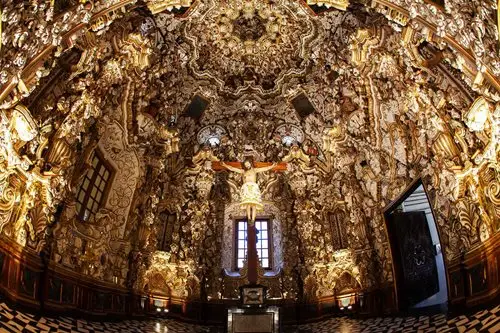
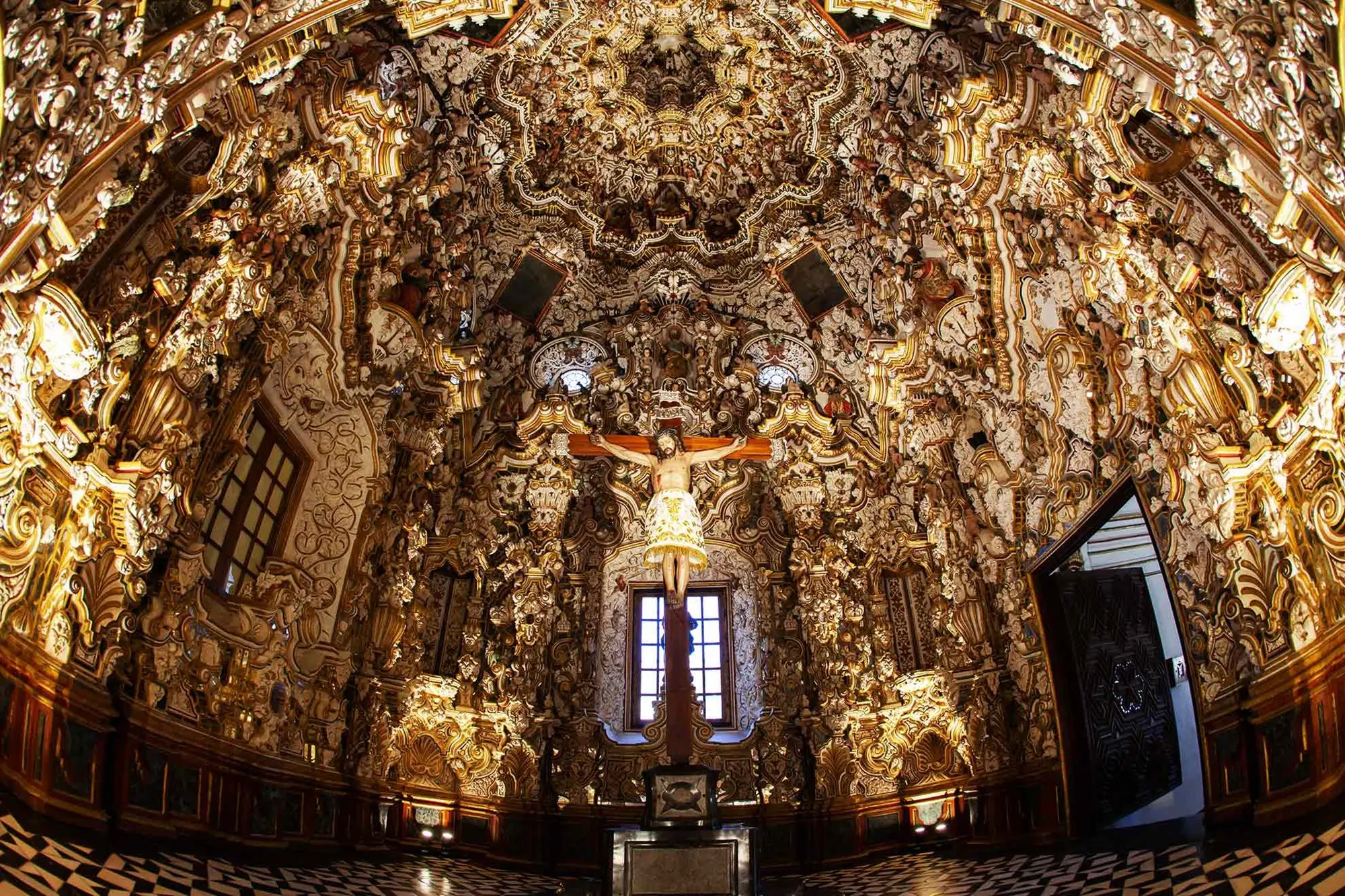
Inside the camarin, visitors are surrounded by its profuse decoration. Above the baseboard, complex Corinthian order stipites rise, structuring the axes of the first section. A new section of stipites housing niches rises above a broken cornice. The splayed oculi protect plaster works intertwining vegetal forms and grotesque masks. The camarin is covered by an incredible polylobulated vault resting on tromps in the stipites, niches and gilded and polychrome pedestals. This scenario is populated by hundreds of figures of saints, angels, putti, allegories, exotic birds, plants and fruits, not to mention its embedded mirrors, enhancing the fantastic optical effect of abundant lights and glows.
Address and telephone
Opening times
If you see any mistakes or want to add anything to this information, please contact us.