Cookie settings
We use our own and third-party cookies in order to offer our services, display videos, obtain statistics and offer personalized advertising.
For more information, please read our cookies policy.
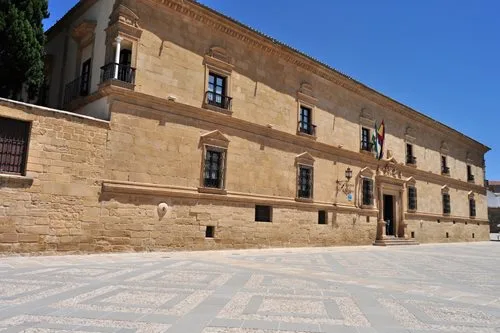
The Hospital de Santiago is considered a pinnacle building of the architect Andrés de Vandelvira.
It started in 1562, as stated on the staircase, and was finished in 1575.
Don Diego de los Cobos (bishop of Jaén) ordered the construction of this building as a hospital for the poor and sick, while also serving as a palace and church-pantheon.
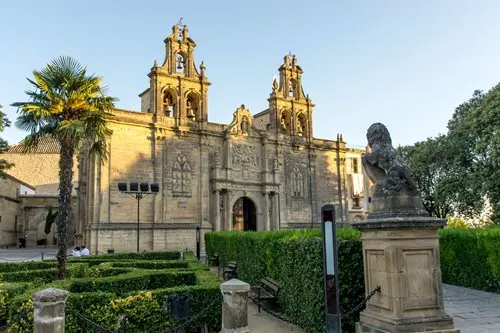
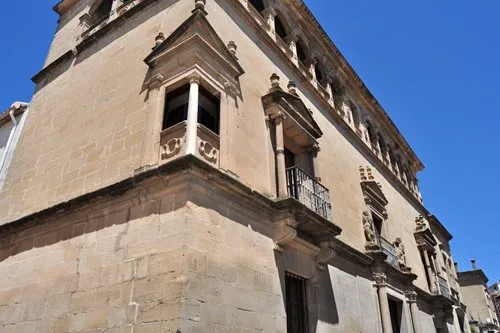
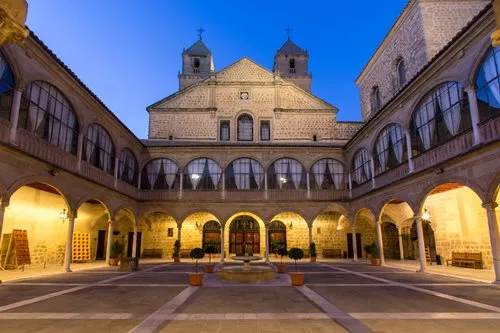
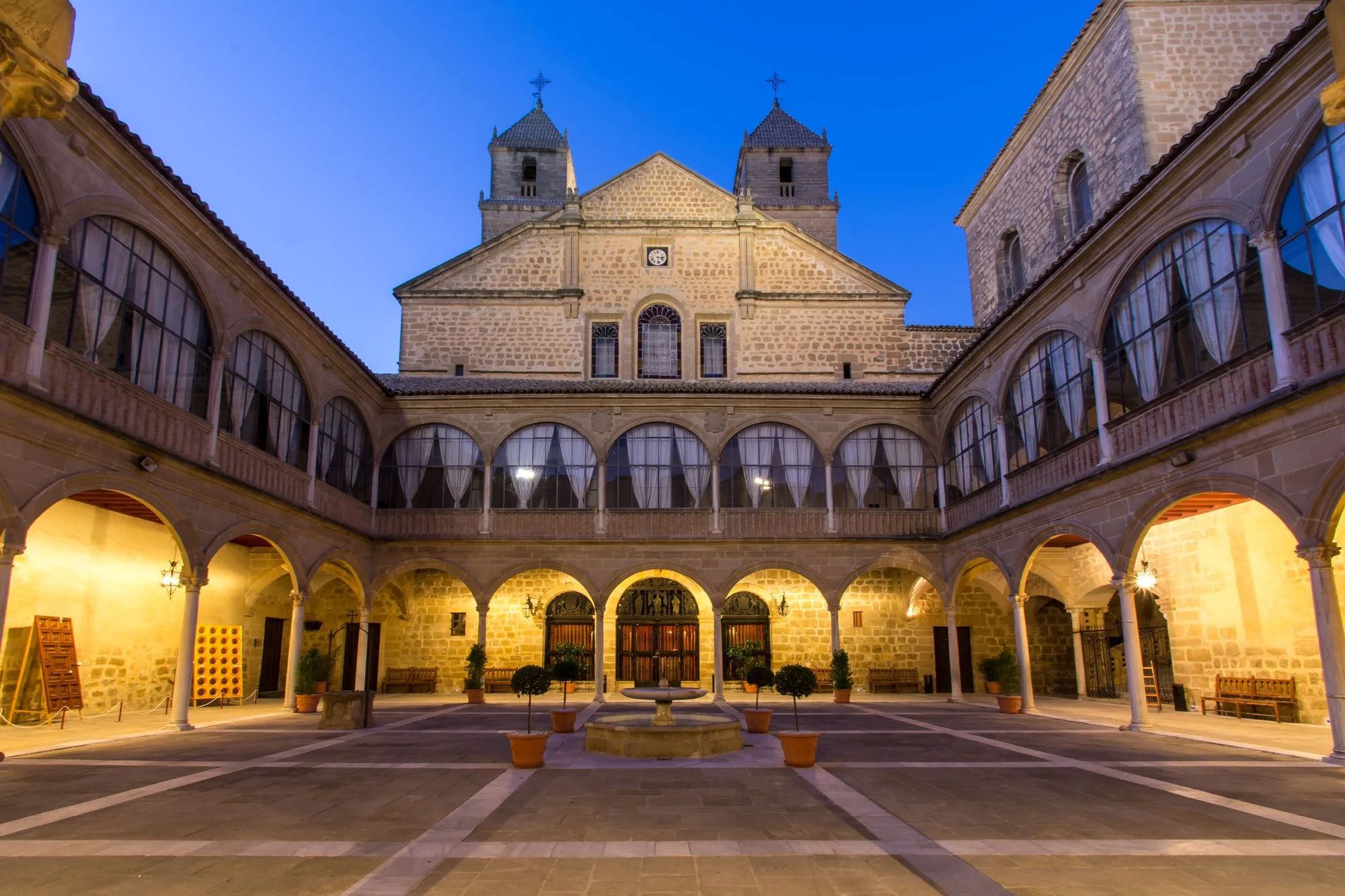
Due to its form, it has come to be called "The Escorial of Andalusia". It is a construction with an austere appearance, almost without ornamentation, yet with a great volume. It is structured over two floors around a large courtyard and a central chapel. Its two imposing towers at the ends of the main facade stand out on the exterior. One of them is notable for its colourful glazed ceramic roof. Another two towers frame the central chapel, these being quadrangular and topped with a hipped roof.
Its main entrance is a semicircular arch with a double voussoir. A tabernacle stands out inside, where the relief of Santiago Matamoros is found. In line with the entrance door, there is a chapel, with a three-door grille to access it. This grille was the work of Juan Álvarez de Molina, following Vandelvira's design.
Its courtyard features a double and open gallery of arches. These arches rest on columns of marble from Carrara. There are two more side courtyards that remain unfinished to this day.
The chapel stands out for its unique originality, presenting a plan in the shape of an inverted H, and two transverse towers that shift towards the centre of the chapel.
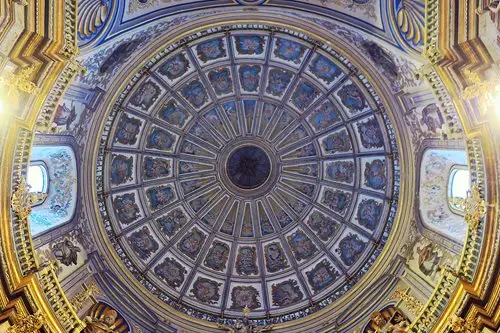
A surprising cloister staircase with a double flight rises from one side of the courtyard and is covered with a large "hanging" vault. This vault was decorated with frescoes shortly after being built. The frescoes are attributed to Pedro de Raxis and Gabriel Rosales. Both are documented for the painting of the main altarpiece (a work by Blas Briño and Luis de Zayas), which was destroyed in 1936.
In the vaults of the church, sacristy, and ante-sacristy, similar paintings in a Mannerist style with Italo-classical influence are preserved. These paintings constitute some of the few examples of mural painting from the Spanish Renaissance.
The Hospital de Santiago was declared a National Historic-Architectural Monument in 1917. Today it is used as a Cultural Centre, hosting Exhibitions, Conferences, Symphonic Concerts, Piano, Singing Cycles, and other activities.
Built: 16th Century (1562 – 1575).
Author: Andrés de Vandelvira. Pedro de Vandelvira
Style: Renaissance
Category: Civil
Type: Hospital
Address
Avenida Cristo Rey, s/n. 23400 Úbeda (Jaén)Opening times
Prices
If you see any mistakes or want to add anything to this information, please contact us.