Cookie settings
We use our own and third-party cookies in order to offer our services, display videos, obtain statistics and offer personalized advertising.
For more information, please read our cookies policy.
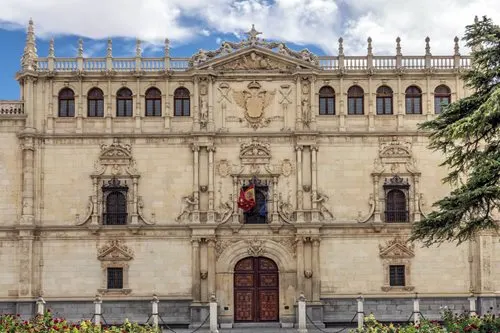
The College of San Ildefonso in Alcalá de Henares was built on the initiative of Cardinal Cisneros in 1499. It was the seed of the oldest University in Spain, and the first university city in the world.
Today it is the seat of the Rectorate of the University and has been declared a World Heritage Site along with the Historical Precinct of Alcalá de Henares (1998).
It is the most emblematic building in Alcalá, as it is one of the most outstanding constructions of the Spanish Renaissance. Its construction followed the design of Pedro Gumiel.
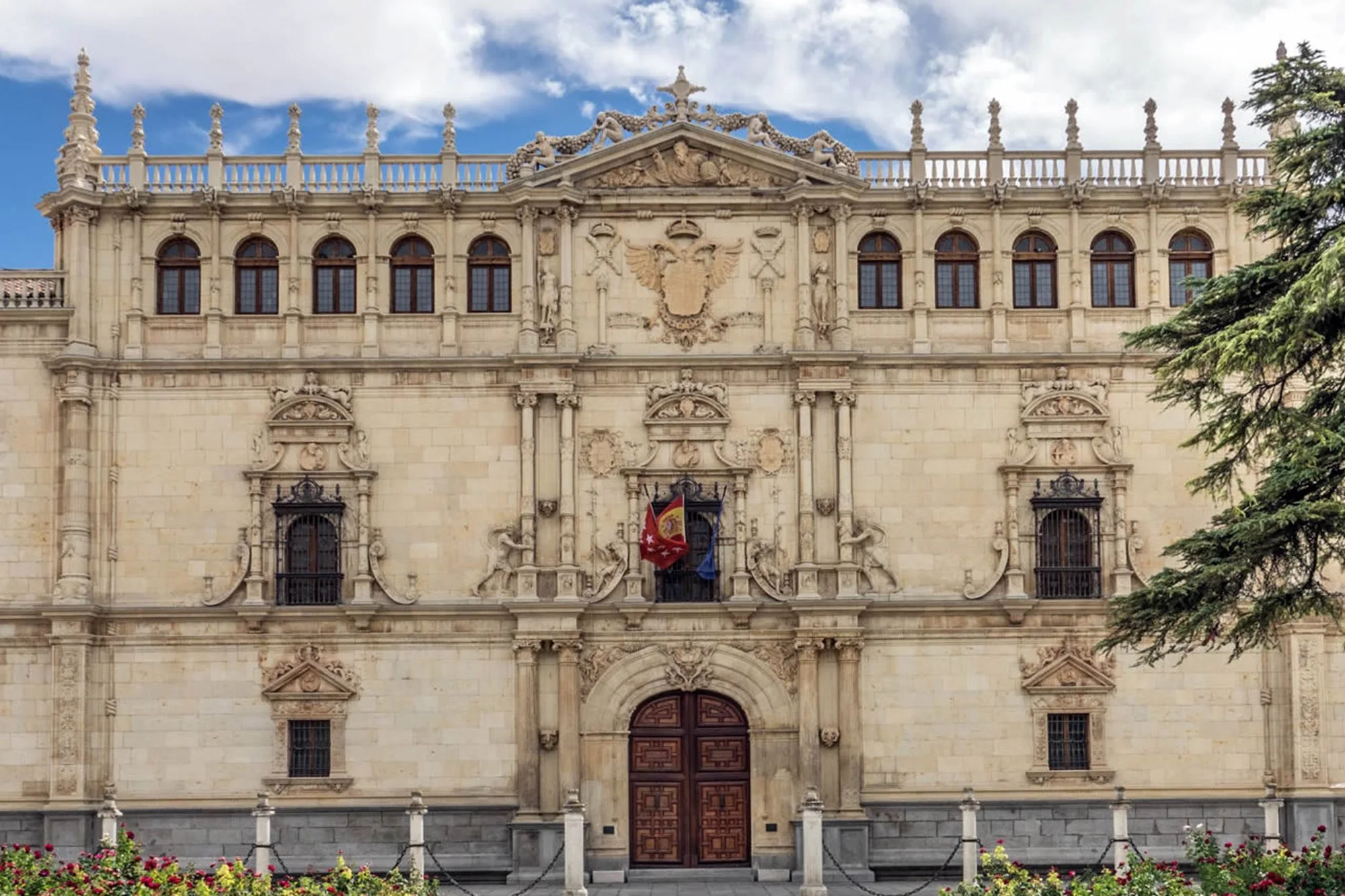
Its façade (1537 – 1553) is the most remarkable work of Rodrigo Gil de Hontañón. It is structured in three modules of uneven height, topped with a gallery of windows with semicircular arches and crowned with balustraded cresting and pinnacles. The monumental retable portal in the centre, with a semicircular arch framed by paired columns, stands out. The second body of the portal houses the coats of arms of Cardinal Cisneros on both sides. Meanwhile, in the third, there is the imperial coat of arms of the double-headed eagle with the figures of Minerva on each side. This is topped with a pediment housing the Eternal Father, festooned with human figures and fruit garlands.
Inside there is a large central courtyard, called Santo Tomás de Villanueva (17th century). The project was initiated by Juan Gómez de Mora and completed by José Sopeña. Its name is due to one of the most advanced buildings of the University and the first saint who came from it. It has three galleries with arches. The first and second arcades are semicircular, while the upper one has lowered arches. All are framed with ornamental classical columns.
Other notable spaces include the Auditorium with its beautiful Cisneros-style ceiling (where the Cervantes Prizes are awarded each year), the Philosophers' Courtyard, and the Trilingual Courtyard (built by Pedro de la Cotera in the second half of the 16th century and belonging to the College of San Jerónimo). The name of the latter is due to having hosted students of Greek, Latin, and Hebrew.
Special mention also deserves the Chapel of San Ildefonso, which was the college church. Its construction was completed in 1510 and is the burial place of Francisco Vallés de Covarrubias and Elio Antonio de Nebrija. The funerary monument of Cardinal Cisneros (who was eventually buried in the Magistral Cathedral) is the work of Domenico Fancelli and Bartolomé Ordóñez (authors of the cenotaphs of the Catholic Monarchs and Don Felipe and Doña Juana de Castilla in the Royal Chapel of Granada, successively).
With the Mendizábal Disentailment, the University of Alcalá was relocated to the Central University of Madrid (1836), leaving the building abandoned. Later, it passed successively to several owners. But in 1851, the Company of Co-owners of the University Buildings was constituted to preserve the artistic heritage. This ensured the recovery of its public and educational function, hosting institutions such as the Complutense Institute of Secondary Education, the Centre for Training and Improvement of Civil Servants, and the National Institute of Public Administration.
Built: 1499.
Author: Rodrigo Gil de Hontañón, Pedro Gumiel
Style: Cisneros Style, Plateresque
Category: Civil
Type: University
Address and telephone
Opening times
Prices
If you see any mistakes or want to add anything to this information, please contact us.

Book your hotel