Cookie settings
We use our own and third-party cookies in order to offer our services, display videos, obtain statistics and offer personalized advertising.
For more information, please read our cookies policy.
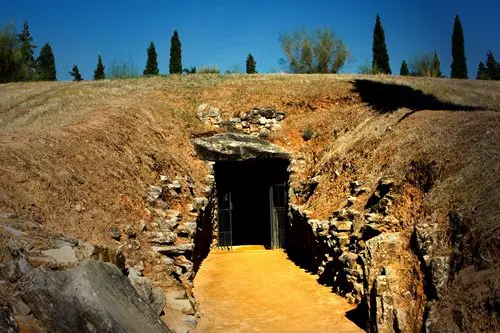
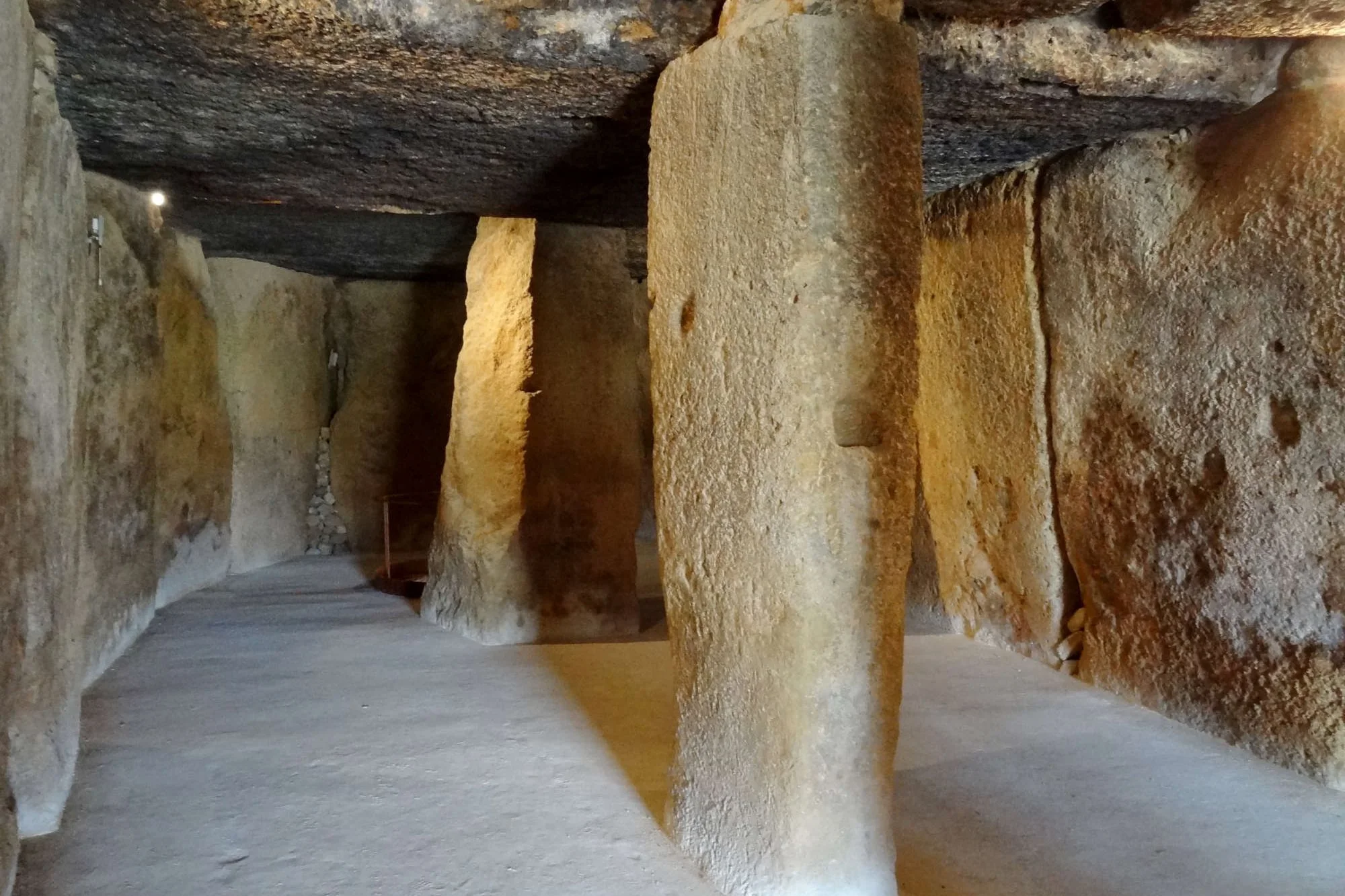
Dolmen de Menga.
It is a pinnacle example of prehistoric post-and-lintel architecture in Europe. It is characterised by its architectural aspect with an impressive and unprecedented interior space in the continent. Large stone slabs were used for its construction and a mound 50 m in diameter was employed to cover the 3,000 cubic metres of earth and rocks.
To build this dolmen, a slight rise in the terrain was taken advantage of to make a wide and elongated pit over virgin rock. This pit already had the dimensions of what would be the tomb, to place vertically large stone orthostats or slabs inside. Upon these orthostats, the gigantic covering slabs and three interior pillars were later placed.
It is structured into three areas: an atrium, a corridor, and a large funerary chamber. Although the difference between the corridor and the chamber is not very marked, it is considered a “corridor-type megalithic tomb.” It also seems a transition towards “gallery graves.” The total length is 17.5 metres. The total height increases from 2.7 metres at the entrance to 3.5 at the head. The width reaches 6 metres.
The atrium resembles a part of the corridor, but its trapezoidal shape and wider base towards the outside, suggest a porch or vestibule. Remnants of several truncated orthostats are preserved on each side of its entrance. The corridor is short and consists of three orthostats on the left and right with a covering slab.
A slight narrowing leads to the large funerary chamber, which occupies around three-quarters of the construction. Its plan is elongated with a tendency to be oval. It consists of seven orthostats on each side and a large slab on top, forming the back of the head. The orthostats can measure up to 4.7 metres in height, including the metre beneath the foundation. They measure around 1.5 m in thickness. What draws the most attention are three large pillars aligned along the longitudinal axis of the chamber.
This construction method is exceptional in all European megalithism, very different from other areas or regions where constructions of the same period are found. There is also no parallel to the fact that a narrow and deep well was found behind the third pillar in 2005. The relationship of this well with the rest of the construction has yet to be uncovered.
Dolmen de Viera.
It was also constructed partially on a natural elevation, where a trench was opened to place the orthostats vertically. Upon these rest the covering slabs. The entire construction is covered with a 50-metre diameter mound.
Its plan is of the “corridor-type megalithic tomb.” This corridor is nineteen metres long, divided into two sections by a door. The covering of this passage or corridor is formed by 10 or 11 slabs and leads to a small square chamber about 1.6 m wide by 2 m high. This chamber has four vertical slabs and one covering slab.
Tholos del Romeral.
The tholos of Romeral is a tomb covered with a false dome. One of the best examples of this technique from Prehistory in the Iberian Peninsula. This false dome that covers it is an artificial mound made with layers of clay and stone slabs.
Its construction was done with masonry in the walls and vaults, while stone slabs were used on the coverings and doors.
Its corridor is 26 metres long, made by two long end walls and an elaborate door, leading to a large funerary chamber.
The chamber has a circular plan, its diameter measuring 5.20 at its base. The upper span is closed by a stone slab and measures only 2.20 metres in diameter. As for the height of the chamber, it is about 4 metres. From this large chamber, a small corridor opens whose construction was done similarly to the previously mentioned 26-metre one. This small corridor gives access to another much smaller chamber, about 2.34 metres in diameter and 2.40 metres high.
The floor of this small chamber is mainly occupied by a large limestone slab with a thickness of 20 cm.
The mound with which the false dome was made to cover the tomb has a maximum height of 10 metres and a diameter of about 85 metres. The upper part is closed with four enormous slabs.
Inside the tombs, hardly any funerary contents have been found. Only several pottery bowls, some small flint tools, several axes made with polished stone and a copper awl have been recovered.
But on their walls, some interesting examples of schematic art have been preserved. Specifically, several orthostats (large stone slabs) of the Viera corridor are covered with typical holes or “cupules” of this art. One orthostat of the Menga corridor retains some highly schematized anthropomorphic motifs in the form of a cross, made with a thick stroke. This set of schematic art is also completed with another motif similar to a star.
Regarding the Menga motifs, some researchers think they are from prehistoric times, while others place them at a later occupation in different historical phases.
Another previously mentioned settlement is the Cerro de Antequera or del Marimacho, whose studies have identified it as a small Calcolithic village, already in the Bell Beaker phase.
As for the Carnicería de los Moros or Roman Villa of Antequera, it has not yet been excavated, but its nymphaeum can be directly observed.
Address and telephone
Opening times
Prices
If you see any mistakes or want to add anything to this information, please contact us.


Book your hotel