Cookie settings
We use our own and third-party cookies in order to offer our services, display videos, obtain statistics and offer personalized advertising.
For more information, please read our cookies policy.
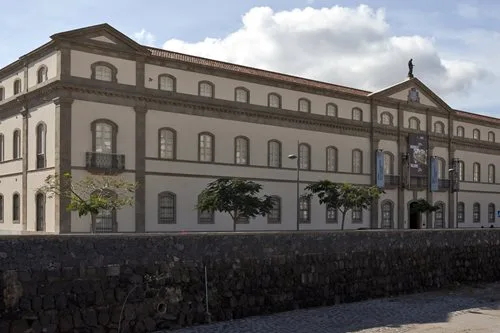
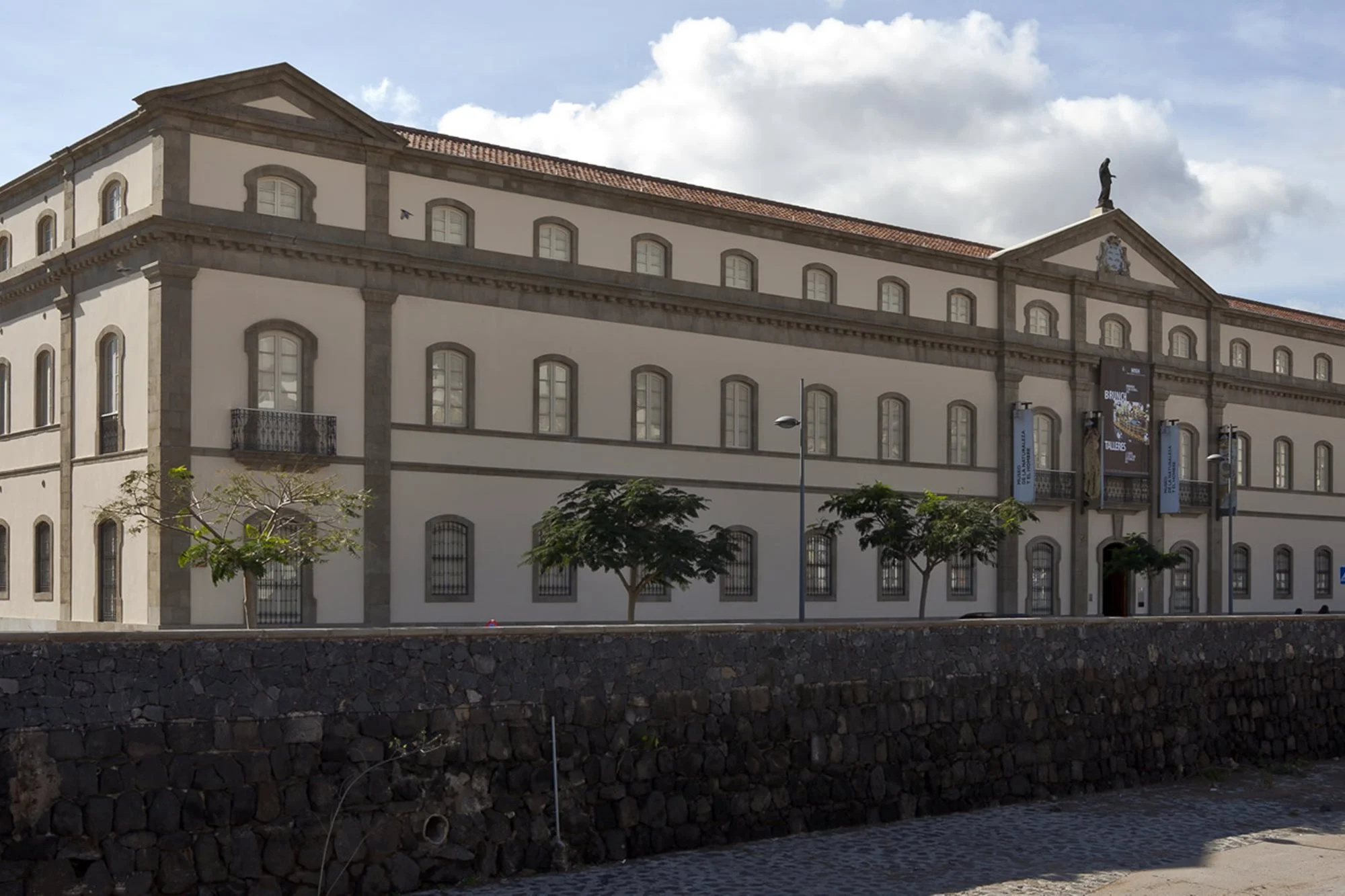
The Museum of Nature and Man has organised a moern museum exhibition Project to present the investigation and conservation work conducted over the decades by the Museum of Natural Science and the Arhaeological Museum of Tenerife.
The result of the Canary Islands on the one hand, and on the other, it is a chance to discober the largest existing collection on the Guanche culture. The Guanches are the aboriginal people that inhabited Tenerife before the arrival of the first European conquerors.
The most important objective of the Museo de la Ciencia y el Cosmos (Science and Cosmos Musuem) is to awaken and develop curiosity about the world of Science and the Universe, a cultural vehicle open to all kinds of demands and concerns.
Since its creation in 1993, with the backing of the Astrophysics Institute of the Canary Islands (IAC), the museum has exhibited a hundred modules and interactives experiments, bringing society closer to scientific ideas.
Temporary displays, sessions at the plantearim informative talks, educational workshops the showing and debate of films with scientific content, coamping and astronomical nights, among other activities, complement the exhibitions.
Built: XX Century
Author: Anónimo
Style: Neoclassical
Category: Museum
Type: Museum
Address and telephone
Opening times
Tuesday to Sunday: 9:00 a.m. – 7:00 p.m.
If you see any mistakes or want to add anything to this information, please contact us.
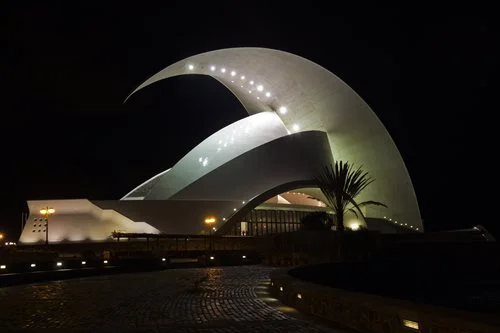
The Tenerife Auditorium is the creation of architect Santiago Calatrava. This impressive piece of architecture has a huge sculptural impact and it is well known as a unique landmark.
It offers its visitors the opportunity to admire the architecture as well as being able to enjoy the other natural attractions, such as the sea and mountain ranges that form part of the ancient Anaga Mountains.
The auditorium has tiered platforms that overspill onto the stunning curved area of the Symphonic Hall. This is surrounded by an impressive wing, suspended at 50 metres giving the sensation of movement and flexibility as though it were animated.
In addition to being an architectural masterpiece the Tenerife Auditorium also offers a wide variety of programmes that can be viewed on their official website.
The variety of contemporary programmes, such as Tenerife Dance Music, Atlantic Jazz and World Music complement the more classical style of the Tenerife Philharmonic Orchestra, Opera and the Festival of Canarian Music.
The success of these programmes relies on the a variety of open spaces and halls available- such as the Philharmonic Hall, which can accommodate up to 1,658 guests and the Camara Hall with 428 seats. There are also smaller areas available such as rehearsal and meeting rooms or dance and exhibition halls.
The Tenerife auditorium is finished in stunning white, which gives huge visual impact. The interior is equally impressive with its unusual open spaces and modern curved architecture that attract the eye in particular due to its wealth of silhouettes and complex structures.
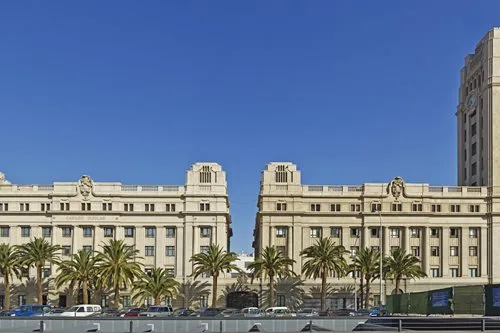
The headquarters of the island government is located in Santa Cruz de Tenerife next to the Plaza de España and the port.
This impressive building was designed by the well-known architect from Tenerife Jose Enrique Marrero Regalado (1897-1956). Work began in 1935 and the building was finished in 1940.
The interior of the building contains some very interesting murals in the "Salon Noble" by Jose Aguiar, an artist originally from the island of La Gomera.
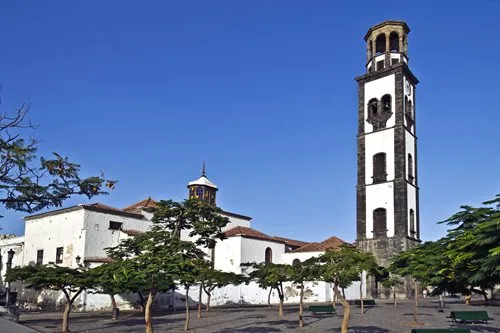
In the year 1500, Juan Guerra, the church founder, began building this church dedicated to the "Santa Cruz" (Holy Cross).
In 1638 the church was given the name of Nuestra Señora de la Concepción but it was destroyed by a fire in 1653. The tower that one can see now was built in 1786.
The current building dates from the 17th and 18th centuries and consists of five naves in the shape of a Latin cross. The church was built with a Tuscan architectural structure but in a Canarian colonial style.
This church contains an important artistic patrimony.
Its oldest works are the small, gothic statue of the Virgen de Consolación, (the conquistador Fernández de Lugo built a chapel to this Virgin in 1496) and the Cruz de la Conquista, which Fernandez de Lugo brought ashore on landing on the island in 1494.
The church also has a series of marble pillars produced in Genova. The pulpit is notable for its carving by Rodríguez de la Oliva, an artist from Tenerife. As for gold and silver works, the silver throne that carries the statue of the Santo Entierro (Holy Burial) in Easter stands out as one of the best in the Canary Islands. In the sacristy (vestry) the Corpus throne is well preserved: Damián de Castro from Cordoba, who has several other pieces in the church, carried out this work.
The brothers Logman, who were priests at the church, donated several valuable works such as the beautiful monstrance (the vessel used by the Roman Catholic Church to display the Eucharist, during Adoration) called "de los Logman". However, for many, the masterpiece of this church is the Chapel of the Carta, in the sacristy entrance. Capitan Matías Rodríguez Carta, commissioned the building of this chapel in the 18th century and dedicated it to San Matías.
Its altarpiece is richly decorated in a baroque style. The main altar is presided over by a statue of the Inmaculada Concepción, an excellent statue by the artist Fernando Estévez from La Orotava, and the altarpiece itself is one of the most elegant examples of baroque art in Tenerife. This church also contains one of the best pieces of religious art on the island, the Cristo del Buen Viaje from the 16th century, together with other valuable pieces from the Canarian statue-makers Miguel Arroyo, Luján Pérez, Rodríguez de la Oliva, González de Ocampo and Fernando Estévez. In terms of pictorial works, the church houses two interesting canvases by Juan de Miranda, as well as other anonymous works. The church also has an important musical archive and an organ built in London in 1862.
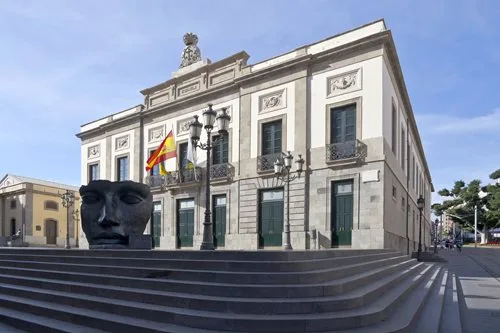
The project for the theatre was drawn up in 1849 by Manuel de Oraá in a classic-romance style and was built on the site of the old convent of Santa Domingo.
This convent had been in existence until 1835, date of the Mendizábal Confiscation, during the reign of Isabel II.
Although the theatre was inaugurated in 1851 it was only given its current name in 1925, in honour of the great dramatist from Tenerife, Angel Guimerá, who died in Barcelona in 1924.
It was recently restored and inside it is decorated with gold leaf. The ceiling is painted with frescos by Angel Romero, an artist from Tenerife.